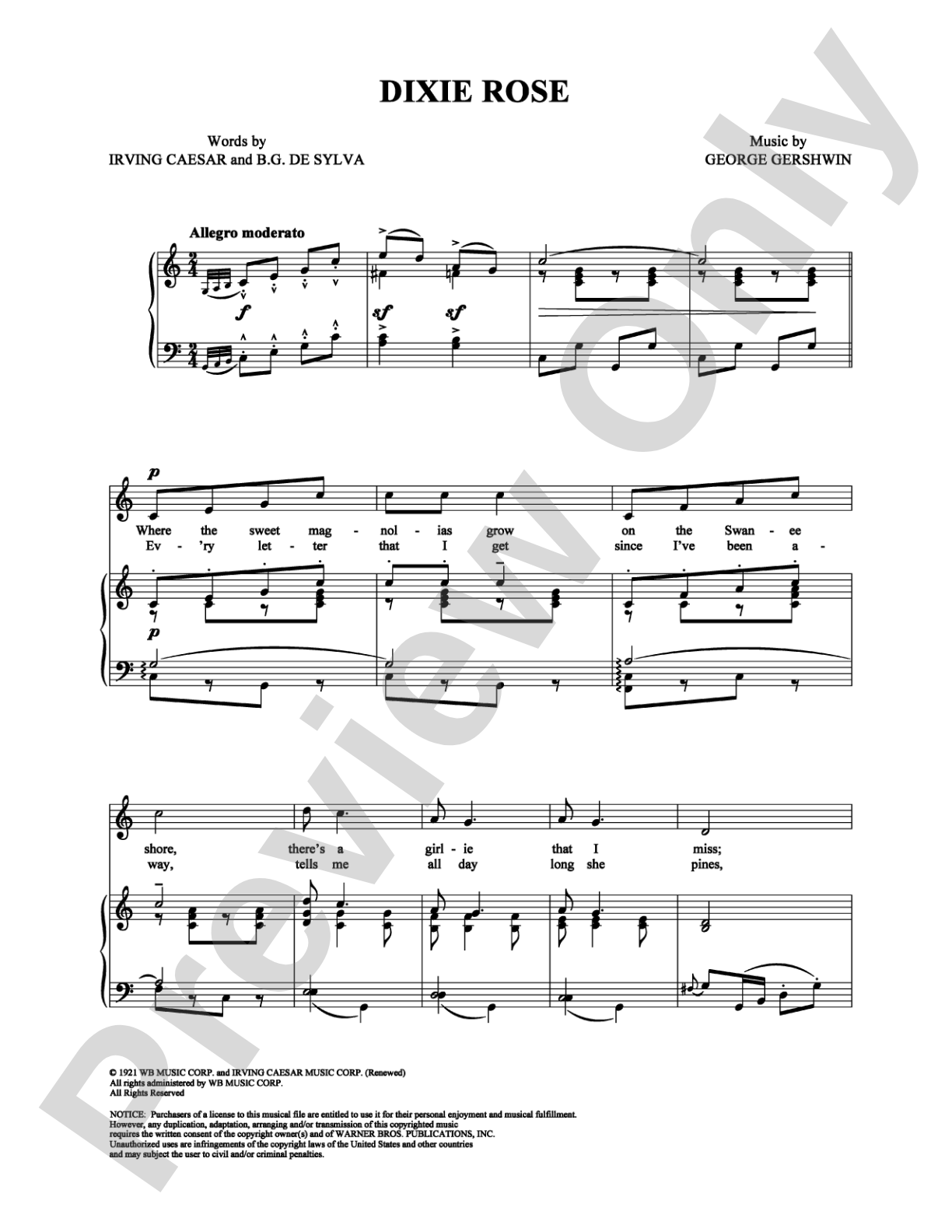
Dixie Rose: Piano/Vocal/Chords Digital Sheet Music

Dixie Rose: Piano/Vocal/Chords Digital Sheet Music

George Gershwin

Item: 00-PS-0002165

Digital Download
$3.99
Description

Dixie Rose: Piano/Vocal/Chords Digital Sheet Music isn't in MakeMusic Cloud just yet...but it could be. Let us know you'd like to see it, and you'll help shape what comes next. In the meantime, start a free trial and dive into thousands of interactive titles your students can play along with today.

Sample Audio
No sample audio found.
Sample Video
Additional Details
SKU: 00-PS-0002165

More about this title

Why we love this

Dixie Rose works beautifully in mixed-ability settings because the piano part accommodates both simple comping and more decorative voicings depending on the player's level. The chord symbols make it accessible for guitarists or keyboardists who prefer a lead-sheet approach, while the full notation serves singers who want instrumental support without getting lost.

What to expect

Dixie Rose captures the warmth and nostalgia of vintage popular song writing, with a melody that sits comfortably in the voice and harmonic progressions that feel natural and singable. The piece balances accessibility with genuine musical character, offering enough melodic substance to keep singers engaged without demanding unusual ranges or technical pyrotechnics.

Who it's for

Vocalists working with pianists in studio settings, community theater programs, or recital contexts will find this straightforward to learn and perform. It also suits pianists preparing material for vocal students or ensemble singers who want quality lead-sheet accompaniment.

How to get the most out of it

  • Balance the vocal line so the lyrics sit clearly above the piano texture; the chords can recede without losing harmonic definition.
  • If a pianist is less comfortable with the written part, simplify to rootless voicings on the chord changes and let the singer carry the melody.
  • Shape the phrases by letting the piano breathe with the voice rather than locking into metronomic accompaniment.

How to use it

Place this in a set of American songs or folk-influenced standards for an evening of vocal recitals. It also works well as a lighter interlude between heavier art song selections, or as a bridge piece in a program that mixes classical and popular repertoire.

Skills your students will build

  • Interpreting chord symbols and realizing accompaniment from lead-sheet notation
  • Balancing melody and harmony in the vocal-piano relationship
  • Shaping legit vocal phrasing in a popular song idiom

You May Also Like