
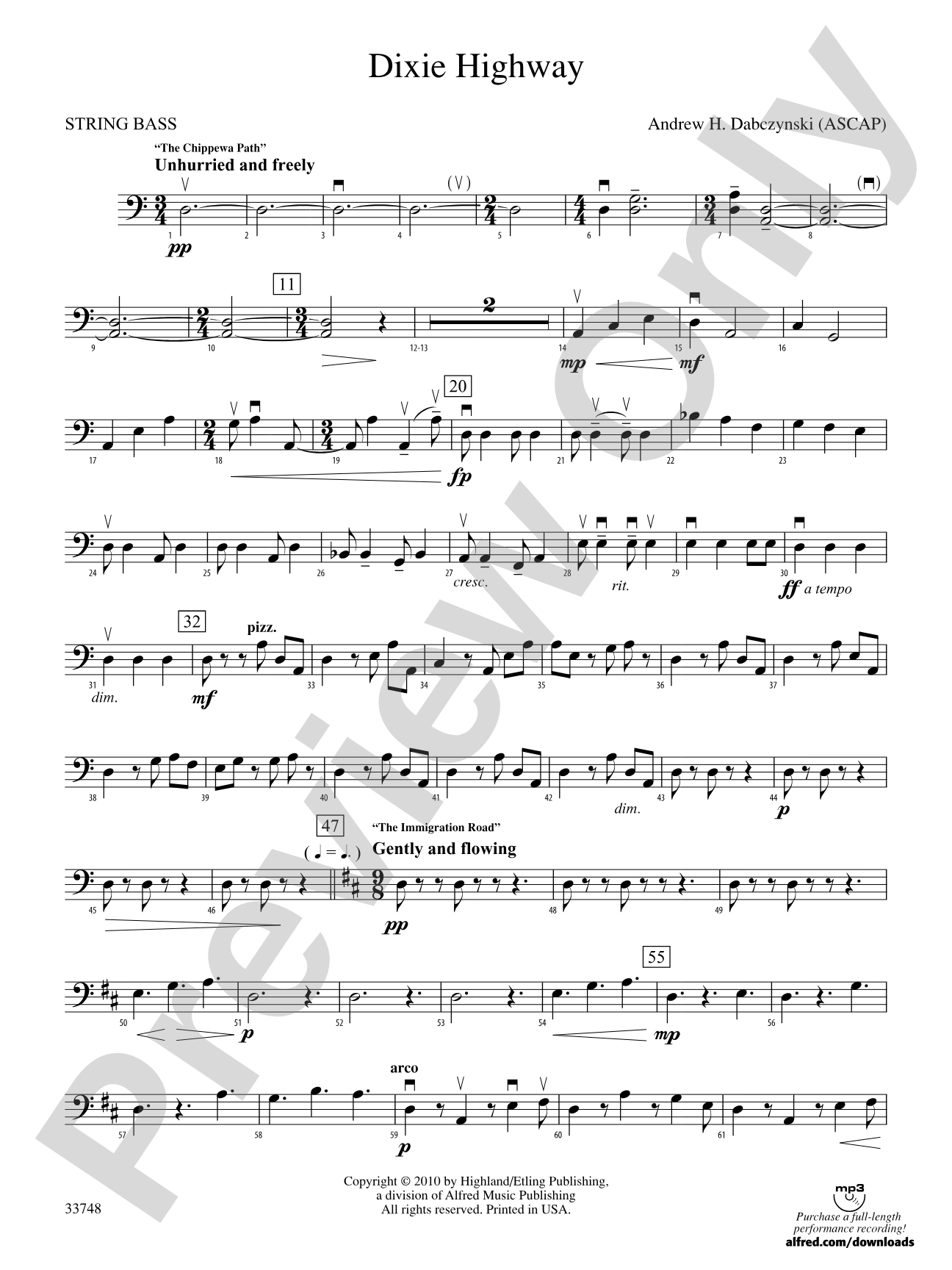

Dixie Highway: String Bass
By Andrew H. Dabczynski
Grade: 3.5
Item: 00-PC-0014532_SB
$5.99
Pickup currently not available
Description
A hint of New Age, a bit of traditional Irish fiddling, and some intense Bluegrass---those are the sounds of this creative work which musically depicts the history of the famous auto road that was built to connect Midwest America with the Deep South. Based on Chippewa, Irish, and Old-Time melodies, this exceptional composition contains individual and section solos, opportunities for improvisation, suggestions for traditional folk ornamentation, and "hip" bass lines. With its variety of musical moods, Dixie Highway offers a dynamic and motivating change of pace to any orchestra program, one that promises to shift both the audience and orchestra to overdrive!


Don't just read it, hear it, play along with it, and watch your students grow with it. In MakeMusic Cloud, Dixie Highway: String Bass comes alive with professional accompaniment, adjustable tempo, and built-in practice tools that turn solo practice into real progress.
Open in the Player
Jump straight in and assign it today.
Start Your Free Trial
Open this title and explore the full library in minutes.
Sample Audio
1
Audio File
--:--
0:00
0:00
Sample Video
No sample videos found.
Additional Details
Series:
Highland/Etling String Alternatives
Publisher:
Alfred Music
Page Count:
124
SKU:
00-PC-0014532_SB
More about this title
About the Composer: Andrew H. Dabczynski

Andrew H. Dabczynski has shaped string education through teaching, research, and composition. He founded the BYU "New Horizons Orchestra" while serving as Emeritus Professor of Music Education at Brigham Young University, creating both an ensemble for adult beginners and a training ground for string teachers. His contributions earned him BYU's Joseph E. White Fellowship for Teaching and Learning. Earlier in his career, he held positions at the Eastman School of Music and in public school districts across New York and Michigan, including supervisory roles in fine arts education.
As a performer, Dabczynski played viola with the Rochester Philharmonic, Hartford Symphony, Portland Symphony, and other regional orchestras, and spent six years as a member of the Colden String Quartet at Western Michigan University. He co-authored the String Explorer method series with Alfred and has held leadership roles in the American String Teachers Association, serving as past-president of the Utah chapter. His research and creative work center on folk music and ethnomusicology, particularly the study of fiddling traditions and how they are transmitted across generations.
Why we love this
Dabczynski's gift for weaving folk traditions into accessible orchestral writing shines here. This piece delivers real musical substance without overreaching technical demands, giving your orchestra the chance to tackle stylistic variety, improvisation, and soloistic moments that keep rehearsals fresh and performances memorable.
What to expect
A musical journey that begins with contemporary New Age textures, detours through the warmth of Irish fiddle traditions, and arrives full-throttle in bluegrass country. The energy builds through clever orchestration and rhythmic drive, creating moments of intimate solo work alongside passages where the whole ensemble locks into an infectious groove.
Who it's for
String orchestras at the 3.5 grade level looking for repertoire that speaks to audiences beyond traditional classical territory. Directors seeking pieces that offer soloists a chance to shine, challenge rhythm sections with contemporary bass writing, and give the full ensemble a reason to engage with folk styles and improvisation.
How to get the most out of it
- Encourage soloists to lean into traditional ornamentation; the score suggests these touches, so give players permission to add slides, scoops, and slight rhythmic flexibility as part of the folk character.
- Work the rhythm section early and often. Those "hip" bass lines anchor the bluegrass and New Age sections, and clean articulation from cellos and basses sets the groove for the whole ensemble.
- Map out improvisation sections in rehearsal before expecting performers to navigate them in performance. Sketch the harmonic framework and suggested melodic contours so soloists know their boundaries.
- Use the stylistic contrasts to your rehearsal advantage. Practice each section (New Age, Irish, bluegrass) separately to nail the character, then integrate transitions so they feel purposeful, not abrupt.
How to use it
Program this as a concert centerpiece that bridges classical and folk repertoire, giving audiences a refreshing change of pace mid-concert. Its narrative arc about an American auto road connecting regions works well thematically if you're building a program around American history, regional traditions, or transportation and culture.
Skills your students will build
- Reading and performing folk-style ornamentation (slides, scoops, rhythmic flexibility)
- Improvisation within harmonic frameworks
- Stylistic versatility across New Age, Irish, and bluegrass idioms
- Rhythmic precision in contemporary bass lines and groove-based accompaniment
- Solo performance and leadership within section contexts
- Ensemble balance and blend while maintaining rhythmic independence