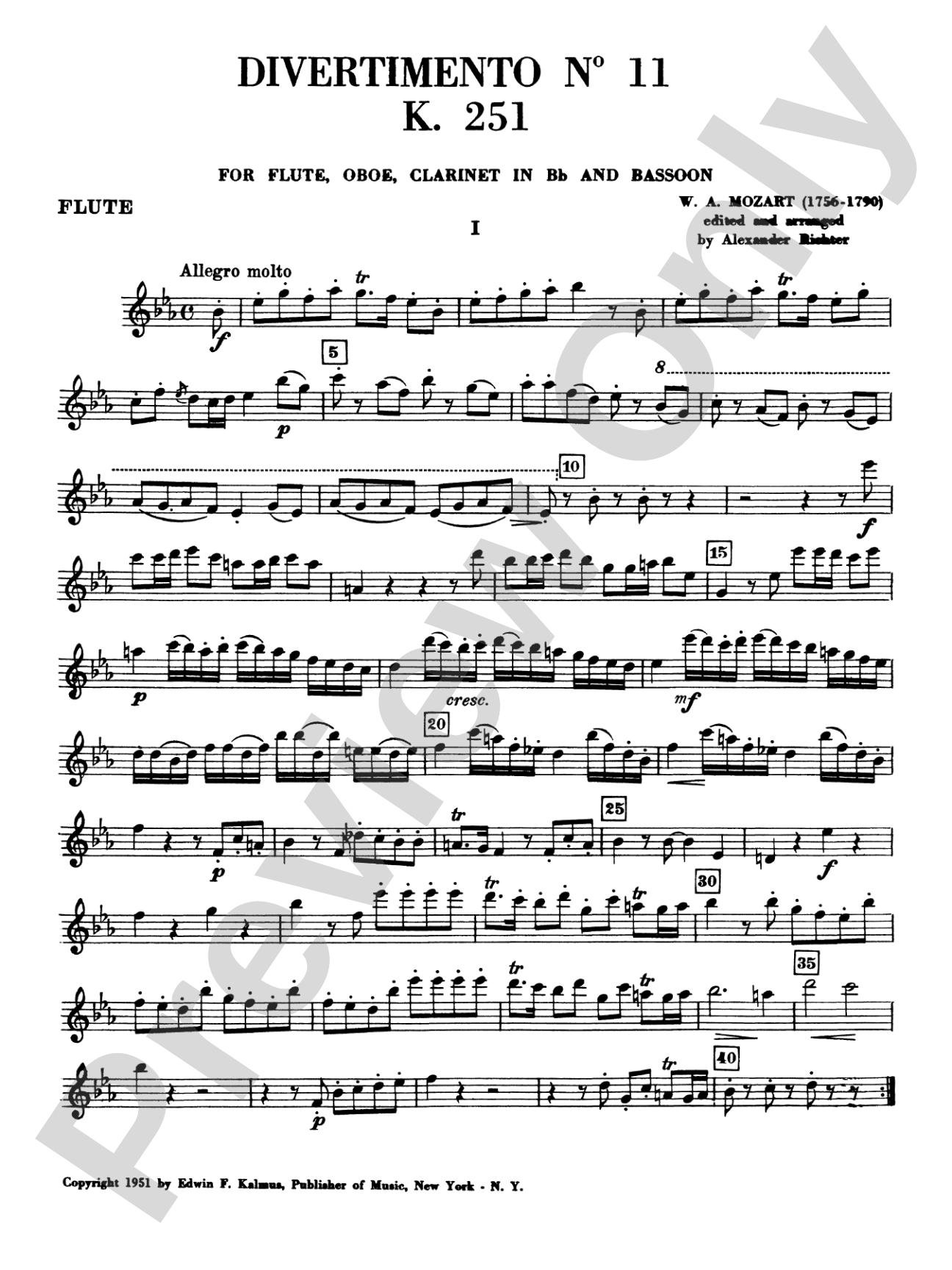
Divertimento No. 11, K. 251: Flute Sheet Music Preview

Divertimento No. 11, K. 251: Flute

Arranged for Woodwind Quartet

By Wolfgang Amadeus Mozart

Item: 00-PC-0002523_F1

Digital Download
$3.00
Description
A quartet for Flute, Oboe, Clarinet and Basson by Wolfgang Amadeus Mozart.

Don't just read it, hear it, play along with it, and watch your students grow with it. In MakeMusic Cloud, Divertimento No. 11, K. 251: Flute comes alive with professional accompaniment, adjustable tempo, and built-in practice tools that turn solo practice into real progress.

Sample Audio
No sample audio found.
Sample Video
Additional Details
Series: Kalmus Edition
Publisher: Alfred Music
Page Count: 36
SKU: 00-PC-0002523_F1

More about this title

About the Composer: Wolfgang Amadeus Mozart

Wolfgang Amadeus Mozart (1756-1791) composed across every major genre of his era with astonishing fluency and invention. His command of counterpoint, harmonic color, and melodic gift shaped the Classical style itself, and his chamber music remains a touchstone for understanding how to write idiomatically for small ensembles.

Why we love this

Mozart's K. 251 sits at that perfect intersection of accessibility and sophistication. The writing is transparent enough for ensemble members to hear themselves and support one another, yet the musical ideas unfold with such grace and harmonic subtlety that audiences hear genuine depth, not simplification. It's the kind of piece that rewards both careful preparation and spontaneous musicality from players who know how to listen.

What to expect

Elegant and conversational, with each instrument taking turns in the spotlight while the others provide gentle support. The music breathes naturally, moving between moments of crystalline clarity and warm harmonic color, with a sensibility that feels intimate despite the bright woodwind timbres.

Who it's for

This divertimento suits mixed woodwind ensembles at the intermediate to advanced level who can manage the technical demands and the rhythmic independence required of each voice. It works equally well for student quartets preparing for festival competition and for adult musicians seeking genuinely satisfying chamber repertoire.

How to get the most out of it

  • Balance the melody generously but never at the expense of the inner voices; Mozart's orchestration relies on each part contributing to the harmonic and textural fabric.
  • Approach the phrasing as you would in a string quartet: think in long musical lines rather than measure-by-measure units, and shape the dynamics within phrases rather than in dramatic contrasts.
  • Use vibrato sparingly and tastefully on sustained notes; the clarity of the four-part writing comes into focus when each voice remains distinct.
  • Lock in rhythmically during the faster movements without sacrificing the lightness of articulation that Mozart's style demands.

How to use it

Program this as a centerpiece in a chamber concert, or use it to showcase the woodwind section's versatility and musicianship in a larger pops or classical concert. It also makes an excellent festival or competition selection for quartets seeking repertoire that demonstrates technical control and musical maturity without relying on pyrotechnics.

Skills your students will build

  • Independent voice leading within a four-part ensemble
  • Balancing melody with supporting harmonic lines
  • Long-phrase phrasing and shaping at moderate tempos
  • Rhythmic precision across separate instrumental voices
  • Stylistically appropriate articulation and vibrato control in the Classical era
  • Listening and blend within a small ensemble setting

You May Also Like