
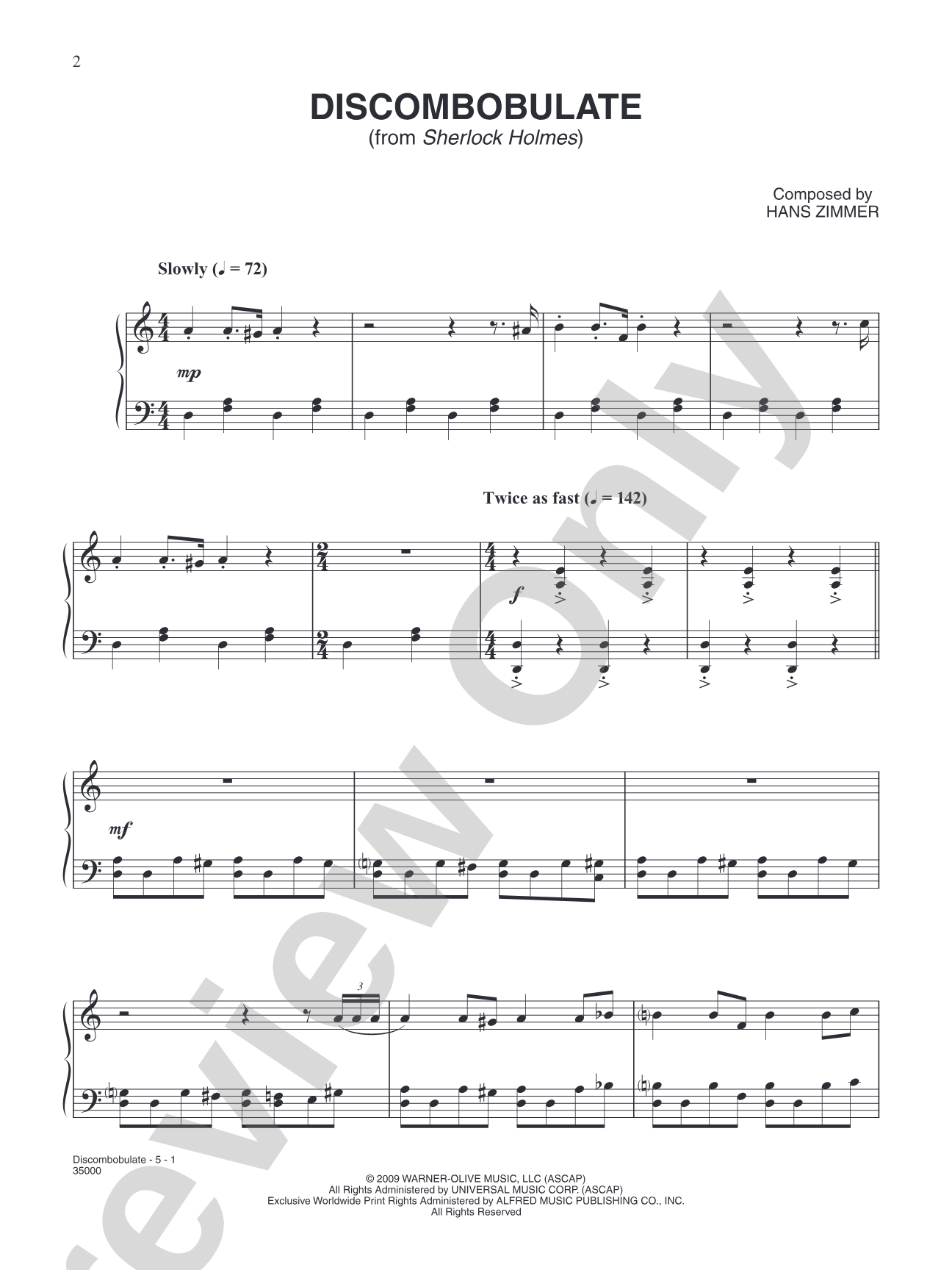

Discombobulate (from "Sherlock Holmes"): Piano
Composed by Hans Zimmer
Item: 00-PS-0012296

$3.99
Pickup currently not available
Related Items
Discombobulate (from the Motion Picture Sherlock Holmes): Piano Sheet |
$3.99
|
View |
Description
Composer Hans Zimmer delights once again with this intriguing piano solo from the score to the box office smash Sherlock Holmes.


Don't just read it, hear it, play along with it, and watch your students grow with it. In MakeMusic Cloud, Discombobulate (from "Sherlock Holmes"): Piano comes alive with professional accompaniment, adjustable tempo, and built-in practice tools that turn solo practice into real progress.
Open in the Player
Jump straight in and assign it today.
Start Your Free Trial
Open this title and explore the full library in minutes.
Sample Audio
No sample audio found.
Sample Video
No sample videos found.
Additional Details
Series:
Original Sheet Music Edition
Publisher:
Alfred Music
Page Count:
6
SKU:
00-PS-0012296
More about this title
About the Composer: Hans Zimmer
Hans Zimmer stands among the most prolific and influential film composers of the past four decades. His approach to scoring blends orchestral sophistication with electronic textures and accessible melodic writing, making his work instantly recognizable across genres from action thrillers to intimate dramas. For pianists and music students, Zimmer's compositions offer a bridge between classical technique and contemporary film music composition.
Zimmer's scores have earned him an Academy Award, a Golden Globe, and multiple Grammy nominations. His ability to craft memorable themes that serve narrative while remaining musically substantial has made his work a natural entry point for students exploring how concert music principles apply to visual storytelling. Many of his piano arrangements bring his signature orchestral ideas into an idiom that rewards both technical and interpretive development.
Why we love this
This solo captures Zimmer's gift for creating character through music, and the piano arrangement distills his orchestral concept into something genuinely playable yet dramatically effective. The piece sits at a sweet spot for intermediate pianists: it looks impressive and sounds sophisticated without requiring virtuosic passage work, making it ideal for recitals where you want students to perform film music with real artistic weight.
What to expect
Discombobulate lives up to its title, capturing the musical essence of a brilliant mind in motion: curious, slightly off-kilter, and subtly propulsive. The piece alternates between introspective moments of careful observation and bursts of restless energy, mirroring the investigative mindset that inspired it. Musically, it avoids predictability through unexpected harmonic turns and syncopated rhythmic figures that keep both player and listener slightly on edge.
Who it's for
Intermediate pianists seeking repertoire that feels contemporary and dramatically engaging without veering into transcription difficulty. This arrangement works equally well for students building confidence with film music and for performers looking to add accessible yet substantial popular music to their recital sets.
How to get the most out of it
- Treat the accompaniment figures as a rhythmic anchor rather than mere filler; they drive the piece's nervous energy forward, so keep them steady and clear without rushing.
- Listen closely to the melody line's contour and shape each phrase as if it were being played by a solo instrument against an orchestral backdrop—this creates space and prevents the piece from sounding like note-for-note transcription.
- Lean into dynamic contrast; the piece relies on shifts between introspection and intensity, so distinguish between the quieter, questioning moments and the more assertive sections with real conviction.
- Experiment with pedal carefully around the harmonic changes to avoid muddiness, especially in the lower register where the bass and accompaniment live.
How to use it
Program this as a contemporary centerpiece in a recital pairing classical and film music traditions, or use it as an accessible gateway to piano arrangements of orchestral scores for students exploring beyond traditional repertoire. It also works well as an encore that surprises audiences—something recognizable enough to engage listeners unfamiliar with concert piano, yet crafted with enough sophistication to satisfy musicians.
Skills your students will build
- Rhythmic precision with syncopated figures and off-beat accompaniment patterns
- Dynamic shaping and phrasing independent from harmonic structure
- Pedal technique in sustained harmonic contexts with active bass movement
- Interpretation of contemporary film music on concert instruments
- Balance between left-hand rhythm and right-hand melody in texturally layered writing