
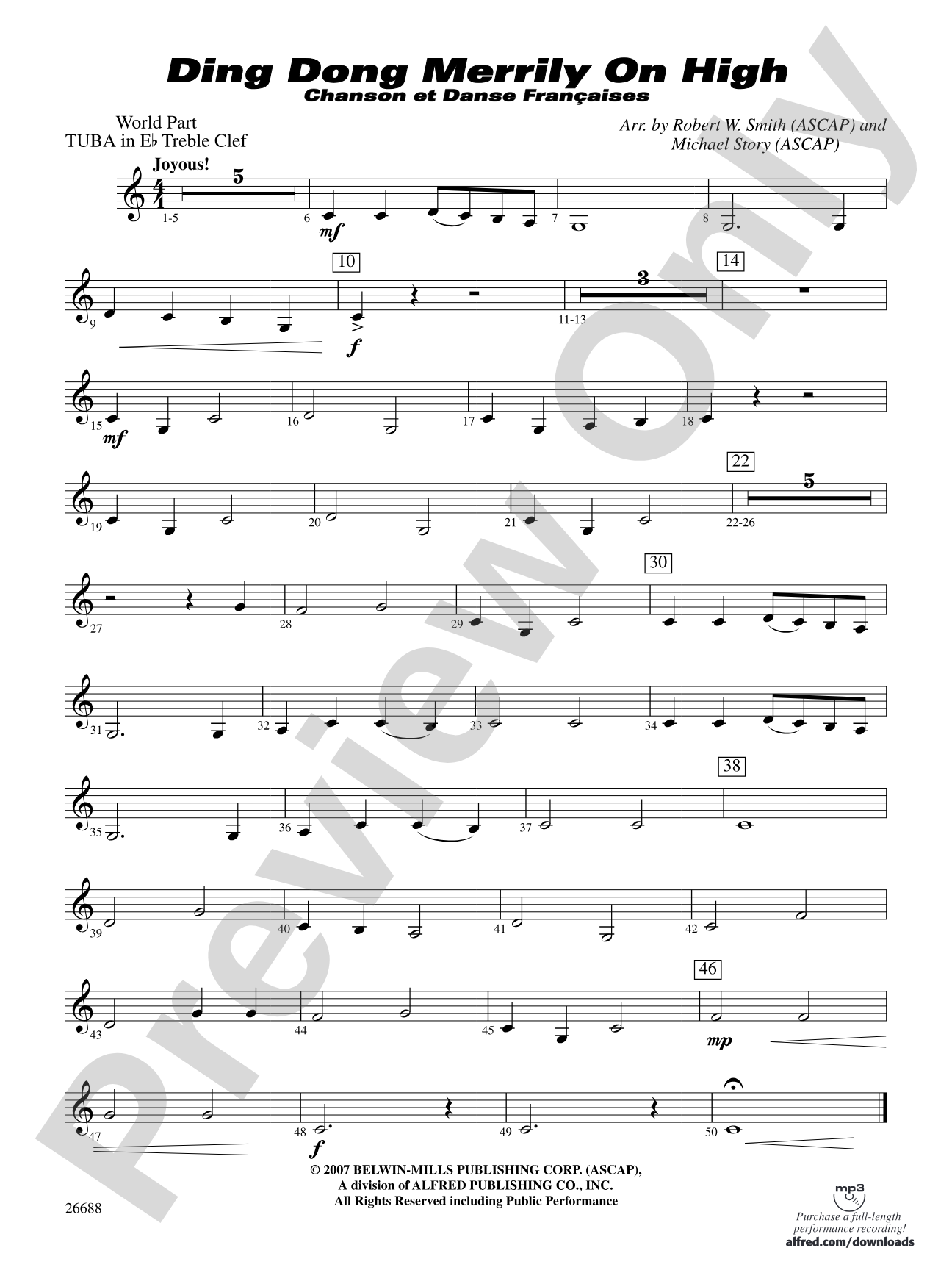

Ding Dong Merrily on High: (wp) E-flat Tuba T.C.
Arr. Robert W. Smith and Michael Story
Grade: 0.5 (Very Easy)
Item: 00-PC-0001170_wpTBETC
$3.00
Pickup currently not available
Description
Based on a traditional French dance melody, this popular holiday favorite has been scored for performance after only a few months of instruction. Arranged to accompany Band Expressions™ Book One, it is attainable for students in the middle of any first-year method. Perfect for your first holiday program again and again. This title is available in MakeMusic Cloud.


Don't just read it, hear it, play along with it, and watch your students grow with it. In MakeMusic Cloud, Ding Dong Merrily on High: (wp) E-flat Tuba T.C. comes alive with professional accompaniment, adjustable tempo, and built-in practice tools that turn solo practice into real progress.
Open in the Player
Jump straight in and assign it today.
Start Your Free Trial
Open this title and explore the full library in minutes.
Sample Audio
1
Audio File
--:--
0:00
0:00
Sample Video
No sample videos found.
Additional Details
Series:
Band Expressions
Publisher:
Alfred Music
Page Count:
70
SKU:
00-PC-0001170_wpTBETC
More about this title
About the Arranger: Robert W. Smith

Robert W. Smith stands among the most frequently performed band and orchestra composers in America, with over 400 published works to his name. His catalog spans original compositions, arrangements, and orchestrations distributed primarily through Alfred Music. He holds degrees from Troy State University (AL) and the University of Miami (FL), and his works have been performed across North America, Europe, Australia, and Asia.
Smith's output ranges from accessible literature for developing ensembles, like The Tempest and other foundational band pieces, to sophisticated symphonic works including The Divine Comedy and The Odyssey. His arrangements and compositions have appeared in high-profile broadcasts and events including the Macy's Thanksgiving Day Parade, the Olympic Games, and major television network programming. He maintains an active schedule as both conductor and clinician internationally.
Why we love this
Smith and Story understand exactly what beginning bands need in a holiday program: a recognizable tune, accessible writing, and nothing that will derail your rehearsal schedule. The arrangement respects the 0.5 difficulty level without condescension, giving first-year students genuine musical work without requiring technique they haven't yet developed. This is the rare holiday selection that sounds genuinely festive in performance, not merely competent.
What to expect
The familiar melody of this French dance floats through bright, simple harmonies that capture the joy and gentle energy of the season without overwrought arrangements or synthetic holiday sentiment. The writing lets young musicians actually play rather than struggle, creating the confidence that comes from successfully executing what they've learned. There's a real sense of celebration here, rooted in the elegant simplicity of the original dance melody.
Who it's for
This arrangement is designed for concert bands in the first half of their first year of instruction, making it ideal for groups that need a solid holiday program without extensive technical demands. It pairs directly with Band Expressions Book One, so if your students are working from that method, the reading level and instrumentation will align perfectly. Directors programming their initial winter concert will find this title removes the scramble of finding accessible yet musically worthwhile seasonal repertoire.
How to get the most out of it
- Balance the melody across your woodwind and brass sections so the French dance character remains prominent; avoid letting one color dominate.
- Maintain the forward momentum through the piece by keeping the harmonic foundation steady and avoid dragging into the holidays.
- Encourage clear articulation in the accompaniment figures to preserve the rhythmic snap typical of a traditional dance melody.
- Use the conductor score to identify where first-year players might need rhythmic reinforcement and mark those moments for section rehearsal.
How to use it
This works beautifully as a first-half concert opener when you need something uplifting and seasonally appropriate without risk, or as a closer if you want to send your audience out with a recognizable melody. Pair it with one more substantial or contrasting piece to round out your program and avoid an all-holiday feel. Plan for this approximately three weeks before your concert to ensure all sections have adequate time with their parts.
Skills your students will build
- Reading and performing in keys appropriate to first-year bands
- Maintaining steady rhythmic pulse within a moving melody
- Balancing melodic and accompanying voices
- Executing basic articulation and style choices that shape the character of a traditional melody