
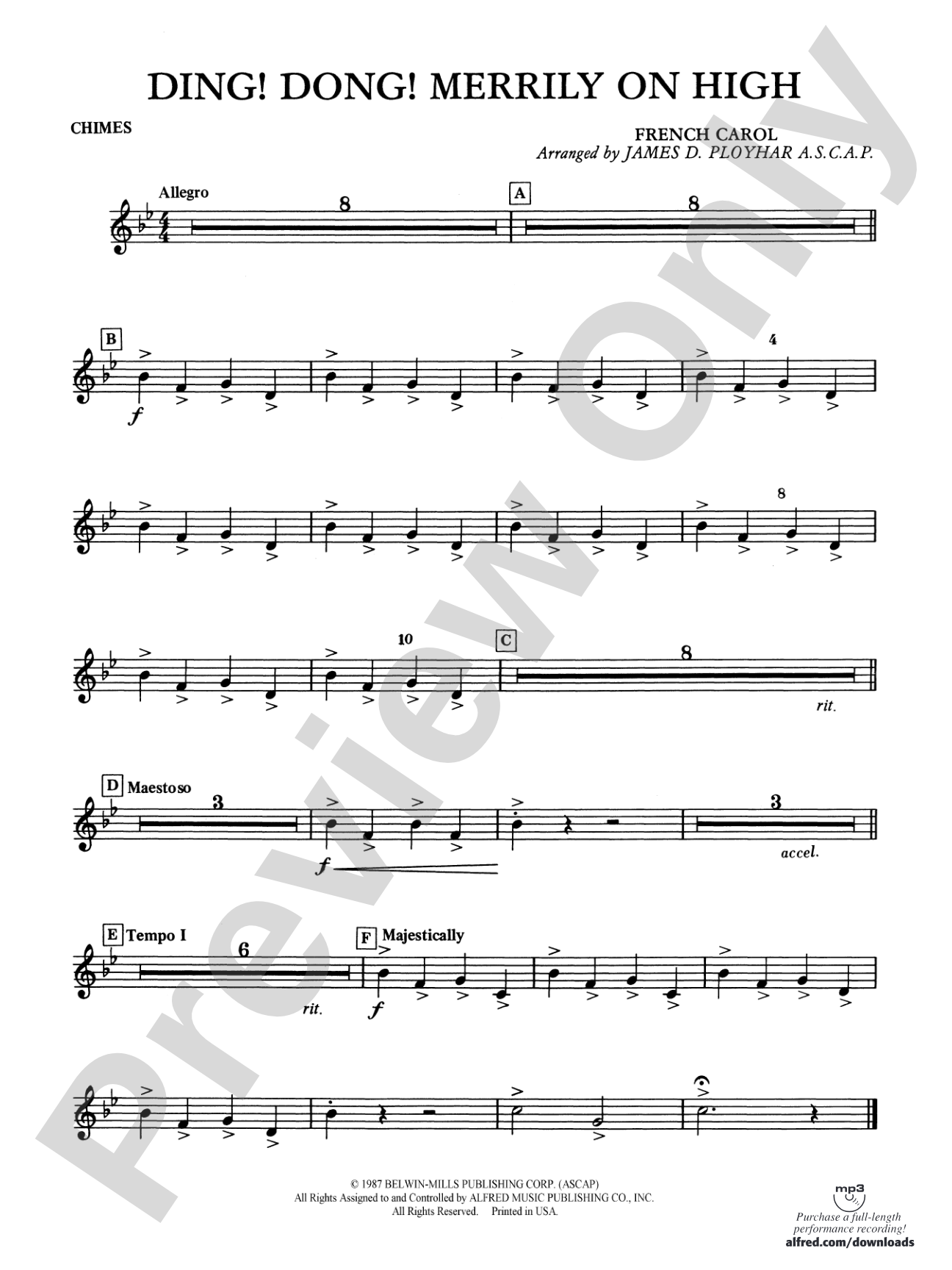

Ding! Dong! Merrily on High: Mallets
Traditional / arr. James D. Ployhar
Grade: 2.5 (Easy to Medium Easy)
Item: 00-PC-0015584_M1
$3.00
Pickup currently not available
Description
This tuneful French Christmas carol has retained popularity from year to year. This charming arrangement captures the melodic excitement that makes this theme so popular with carolers each holiday season. Chimes play a prominent part in this setting along with chime-like effects in the woodwinds and brass. We hope this delightful carol will help you capture the mood and spirit of the holiday season. (2:15)


Don't just read it, hear it, play along with it, and watch your students grow with it. In MakeMusic Cloud, Ding! Dong! Merrily on High: Mallets comes alive with professional accompaniment, adjustable tempo, and built-in practice tools that turn solo practice into real progress.
Open in the Player
Jump straight in and assign it today.
Start Your Free Trial
Open this title and explore the full library in minutes.
Sample Audio
1
Audio File
--:--
0:00
0:00
Sample Video
No sample videos found.
Additional Details
Series:
Belwin Concert Band
Publisher:
Alfred Music
Page Count:
118
SKU:
00-PC-0015584_M1
More about this title
About the Arranger: James D. Ployhar

James D. Ployhar has established himself as a prolific and influential voice in music education, with more than 800 published works across multiple genres and ensembles. His pedagogical contributions extend far beyond individual compositions; he developed the Contemporary Band Course, now published by Alfred Music and adopted in schools across Norway, France, and beyond. His training in orchestration came through direct study with Knud Havalde of the Danish Royal Philharmonic Orchestra, grounding his arranging work in professional ensemble practice.
Plyohar's career has bridged the classroom and the concert hall. After spending over 19 years as a public school music teacher, he became a sought-after clinician and guest conductor throughout North America and Europe, including frequent appearances in Norway, Germany, and England. His contributions to music education earned him the National Band Association Citation of Excellence and the Distinguished Alumnus Award from Valley City State University, where he completed his undergraduate degree. He holds a master's degree from the University of Northern Colorado and completed graduate composition study at California State University-Long Beach.
Why we love this
Ployhar's treatment of this beloved carol strikes an ideal balance between accessibility and musical substance. The featured role for chimes (with clever woodwind and brass effects mimicking bell tones) gives every rehearsal something distinctive to highlight, while the Grade 2.5 level ensures your entire band can participate meaningfully without requiring advanced technique.
What to expect
Warm and luminous, with the shimmer of bells creating an almost mystical backdrop for a melody that feels both ancient and instantly recognizable. The orchestration captures the gentle joy of caroling, inviting rather than demanding.
Who it's for
Directors seeking a straightforward, festive addition to the holiday concert that sits comfortably within the technical range of developing bands. This arrangement works well for groups new to holiday programming or those looking for sacred music that avoids overly complex textures.
How to get the most out of it
- Balance the chime part so it rings clearly through the texture without overwhelming the melody; these bell sounds anchor the carol's character and deserve to be heard.
- Shape the woodwind and brass lines that echo chime-like effects with a light articulation and subtle dynamic swells to enhance their shimmer without sounding mechanical.
- Allow the melody to breathe at natural phrase points rather than pushing through; this carol's strength lies in its singing quality, not its tempo.
- Consider the recorded accompaniment to establish a natural, unhurried tempo that gives your ensemble time to lock the harmonic foundation beneath the floating melodic line.
How to use it
Program this as the centerpiece of a holiday concert segment, perhaps pairing it with one or two other carols of contrasting character to build a varied and engaging program. Its moderate length (2:15) and accessible difficulty make it ideal for early-season concerts when rehearsal time is limited.
Skills your students will build
- Balancing featured instrumental colors against supporting harmonic layers
- Shaping sustained melodic lines with phrase awareness rather than relying on tempo
- Responding to bell-like articulation and resonance in woodwind and brass writing
- Coordinating ensemble texture when multiple sections carry thematic material simultaneously