
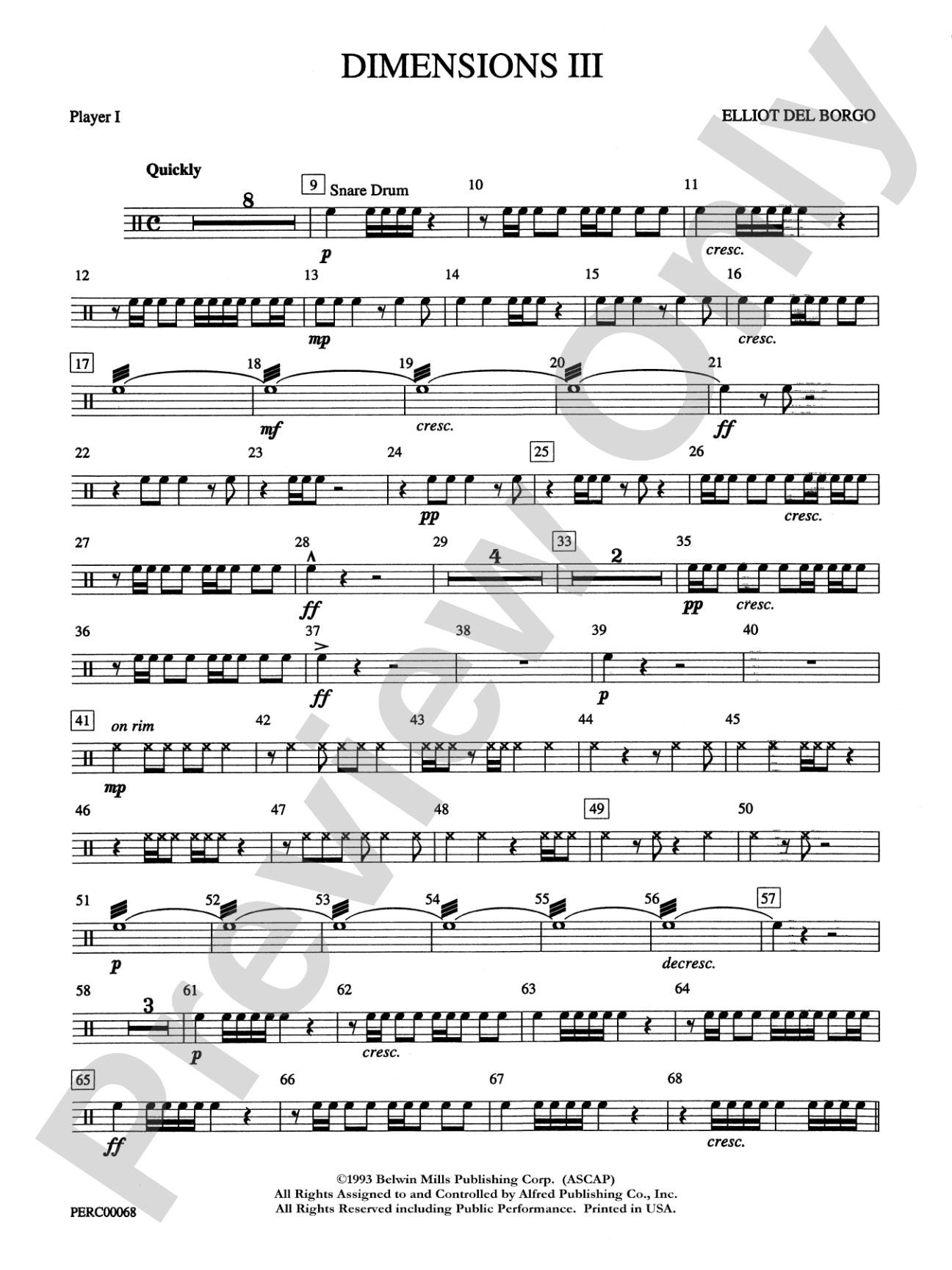

Dimensions III: 1st Percussion
For 4 Players
By Elliot Del Borgo
Level: Intermediate
Item: 00-PC-0002545_PC1
$3.00
Pickup currently not available
Description
For four players and conductor. Del Borgo introduces the grade I and II percussionist to ensemble playing through homophonic writing for four players and conductor. Standard instrumentation is used, with the fun of bongos, claves, the suspended cymbal or gong and woodblocks. Instrumentation: snare drum, triangles, bongos, woodblock, bells, tom-toms, suspended cymbal, timpani, claves, large suspended cymbal or gong.


Don't just read it, hear it, play along with it, and watch your students grow with it. In MakeMusic Cloud, Dimensions III: 1st Percussion comes alive with professional accompaniment, adjustable tempo, and built-in practice tools that turn solo practice into real progress.
Open in the Player
Jump straight in and assign it today.
Start Your Free Trial
Open this title and explore the full library in minutes.
Sample Audio
No sample audio found.
Sample Video
No sample videos found.
Additional Details
Series:
Percussion Ensemble Series
Publisher:
Alfred Music
Page Count:
8
SKU:
00-PC-0002545_PC1
More about this title
About the Composer: Elliot Del Borgo
Elliot Del Borgo is a prolific composer and arranger whose catalog spans concert band, orchestra, chamber ensembles, and percussion. His writing for young musicians is marked by clarity of purpose and genuine musical substance; he avoids condescension while respecting developmental limitations. Del Borgo's percussion works in particular have become standards in school programs because they balance accessibility with the kind of scoring that keeps players engaged and challenged.
A committed music educator, Del Borgo understands what happens in rehearsals and what resonates with students. His Percussion Ensemble Series builds methodically from fundamental concepts to more sophisticated textures, making it a trusted resource for directors introducing young percussionists to ensemble work.
Why we love this
Del Borgo's homophonic approach here means every player has something musical to do without getting tangled in complex rhythmic coordination. The instrumentation list reads like a percussion class learning tree: familiar instruments like snare drum and timpani sit alongside the brightening colors of bongos, claves, and suspended cymbal, giving you natural ensemble variety without requiring specialized equipment. This is how young percussionists discover that ensemble playing is about listening and blending, not just keeping the beat.
What to expect
Dimensions III has a buoyant, almost playful energy without sacrificing musicality. The homophonic texture lets melodic ideas breathe clearly while the percussion voices create a harmonic fabric that feels spacious rather than crowded. There's genuine warmth in the orchestration; claves and bongos add personality, and the suspended cymbal swell feels earned rather than incidental.
Who it's for
Percussion classes and small ensembles at the grade 3-4 level, including intermediate beginners who are ready to step beyond solo playing. Directors looking for a graduated introduction to ensemble percussion will find this a natural follow-up to foundational snare drum and mallet work. This score works equally well in a school percussion quartet context or as a section warm-up for a larger band or orchestra program.
How to get the most out of it
- Balance the metallic voices (triangles, bells, suspended cymbal) so they add shimmer without dominating the snare drum and timpani foundation.
- Use the bongos and woodblocks to bridge the pitched and unpitched worlds; their timbral character matters as much as their rhythmic placement.
- Have players mark their entrances lightly in pencil if parts arrive unmarked; younger percussionists benefit from visual cues on the page and from the conductor's preparatory gestures.
- Lock the snare drum and timpani players into a subtle communication about pulse; this gives the ensemble stability across the homophonic texture.
How to use it
Program this as a standalone percussion feature on a concert where you want to highlight the variety and maturity of your percussion section without overwhelming the audience or the ensemble. It also works beautifully as a concert opening, setting an upbeat tone and celebrating young players who are discovering ensemble musicianship. Include it in a spring pops concert or an all-percussion assembly program where it can anchor a set of works for four players.
Skills your students will build
- Balancing pitched and unpitched instruments within a homophonic texture
- Listening for ensemble blend across different timbral families
- Reading multiple percussion parts simultaneously and maintaining rhythmic independence
- Responding to conductor gestures in a multi-part percussion setting
- Coordinating attacks and releases across snare, mallets, and accessory percussion