
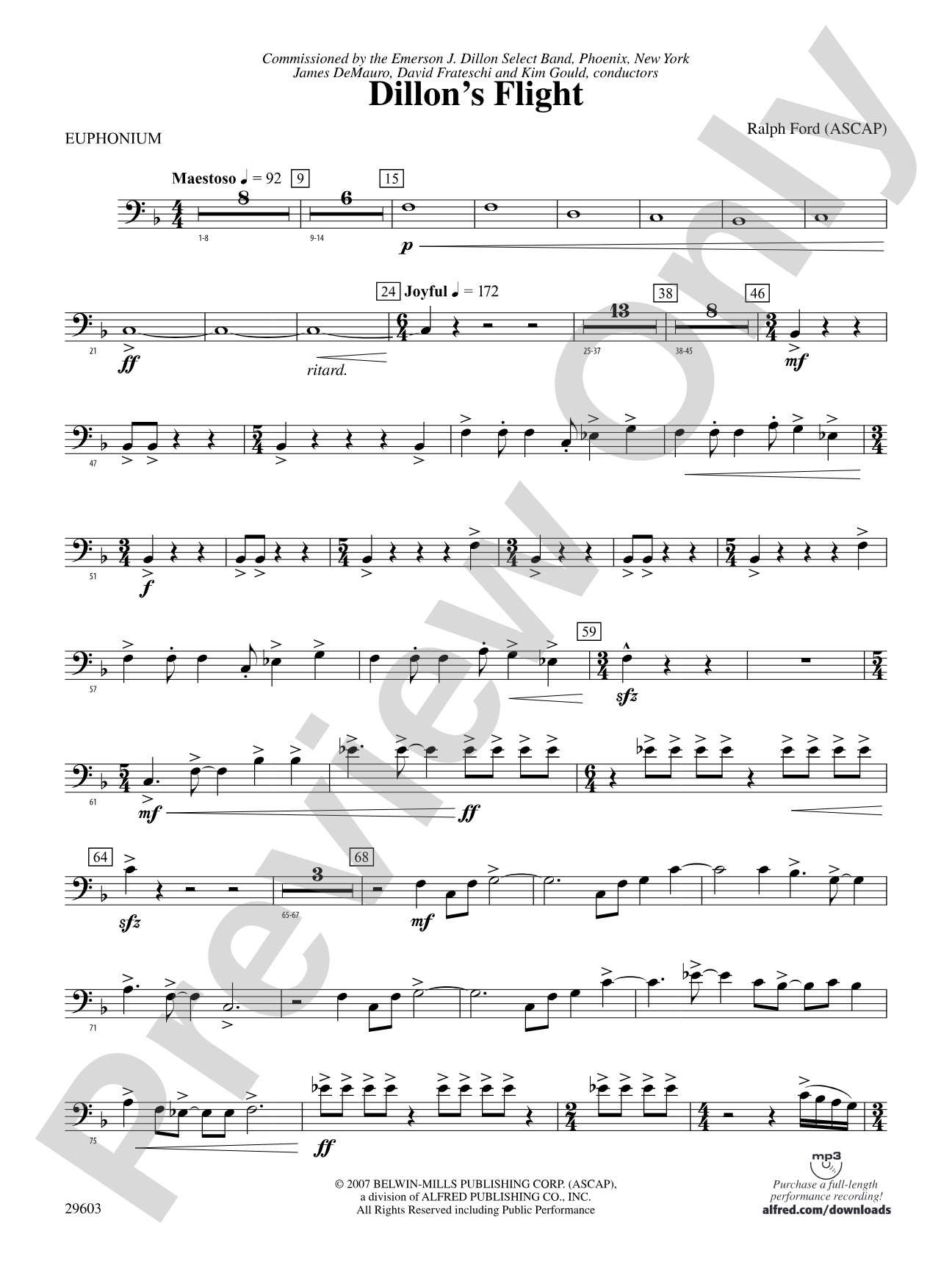

Dillon's Flight: Baritone B.C.
By Ralph Ford
Grade: 3 (Medium Easy)
Item: 00-PC-0001493_BBC1
$3.00
Pickup currently not available
Description
"Dillon's Flight" was inspired by the legend of the Phoenix, a bird of fire that does not lay eggs, has no younglings, was here at the beginning of time, and yet still lives today in a hidden desert land. Every 500 years, the sun burns down on the Phoenix until a flash of light appears and it becomes consumed by the flames of fire. From the pile of silvery-gray ash rises up a young Phoenix. The young Phoenix then takes flight and sings its glorious song to the sun for another five hundred years. Dedicated to the Dillon School in Phoenix, New York, this musical depiction is jam-packed with energy. (5:07) This title is available in MakeMusic Cloud.


Don't just read it, hear it, play along with it, and watch your students grow with it. In MakeMusic Cloud, Dillon's Flight: Baritone B.C. comes alive with professional accompaniment, adjustable tempo, and built-in practice tools that turn solo practice into real progress.
Open in the Player
Jump straight in and assign it today.
Start Your Free Trial
Open this title and explore the full library in minutes.
Sample Audio
1
Audio File
--:--
0:00
0:00
Sample Video
Additional Details
Series:
Belwin Concert Band
Publisher:
Alfred Music
Page Count:
280
SKU:
00-PC-0001493_BBC1
More about this title
About the Composer: Ralph Ford
Ralph Ford has spent nearly three decades on university music faculties while building one of the most prolific catalogs in modern band music. His background spans conducting, arranging, and composition across multiple genres; he began arranging professionally at fifteen and was directing ensembles by his sophomore year in college. Ford earned his Master of Science degree from Troy State University in 1988 and has since become an exclusive composer and arranger for Belwin/Alfred Music, with over 250 published titles for orchestra, concert band, jazz ensemble, and marching band performed worldwide by school, university, military, and professional ensembles.
Beyond the concert hall, Ford's work extends into media production, broadcast, and commercial scoring. He has received international awards for advertising work and has contributed to live radio broadcasts, television productions, and recording projects across traditional and digital platforms. His voice as a composer reflects his diverse experience: his concert band works balance accessibility with genuine musicality, making them reliable choices for school programs and contest stages alike.
Why we love this
Ford captures the Phoenix legend with genuine drama and forward momentum rather than relying on bombast. The Grade 3 level means your ensemble can sound impressive and energized without getting bogged down in technical complexity, freeing students to focus on phrasing, balance, and musical storytelling. At just over five minutes, it's a complete concert experience that works equally well as a festival piece or a centerpiece for a thematic program about mythology or transformation.
What to expect
The piece pulses with the intensity of transformation and rebirth. Expect sweeping gestures, moments of brightness and shadow, and an overall arc that mirrors the Phoenix's eternal cycle of destruction and renewal. The energy is relentless but not exhausting, building to moments of genuine soaring flight.
Who it's for
Concert bands at the Grade 3 level will find a piece that challenges musicianship without overwhelming technical demands. Directors seeking repertoire that engages student musicians with vivid imagery and rewarding ensemble writing will recognize Ford's gift for writing that serves both the music and the performers.
How to get the most out of it
- Build the crescendos gradually and deliberately rather than jumping straight to forte; the piece gains its power through accumulation, so let each wave of energy feel earned.
- Anchor the low brass and woodwinds to establish the rhythmic foundation, especially during the middle section where syncopation can drift if the ensemble loses focus on the pulse.
- Shape the melodic material with direction even in softer passages; this piece tells a narrative, so each phrase should have intention and lead toward the next musical event.
- Balance the percussion colors carefully so they enhance the imagery without overwhelming the ensemble; the transition moments hinge on clarity and texture.
How to use it
Program this alongside other pieces exploring mythology, nature, or transformation to create a thematic concert arc. The five-minute length makes it an ideal opener that establishes energy and engagement with your audience, or a strong closer if you need a final dramatic statement. It also stands confidently in a mixed concert setting or as a festival entry.
Skills your students will build
- Phrasing and musical direction across longer crescendo shapes
- Rhythmic precision under syncopated passages
- Dynamic control and balance within the ensemble
- Sustained tone quality during lyrical sections
- Ensemble cohesion across rapid textural changes