
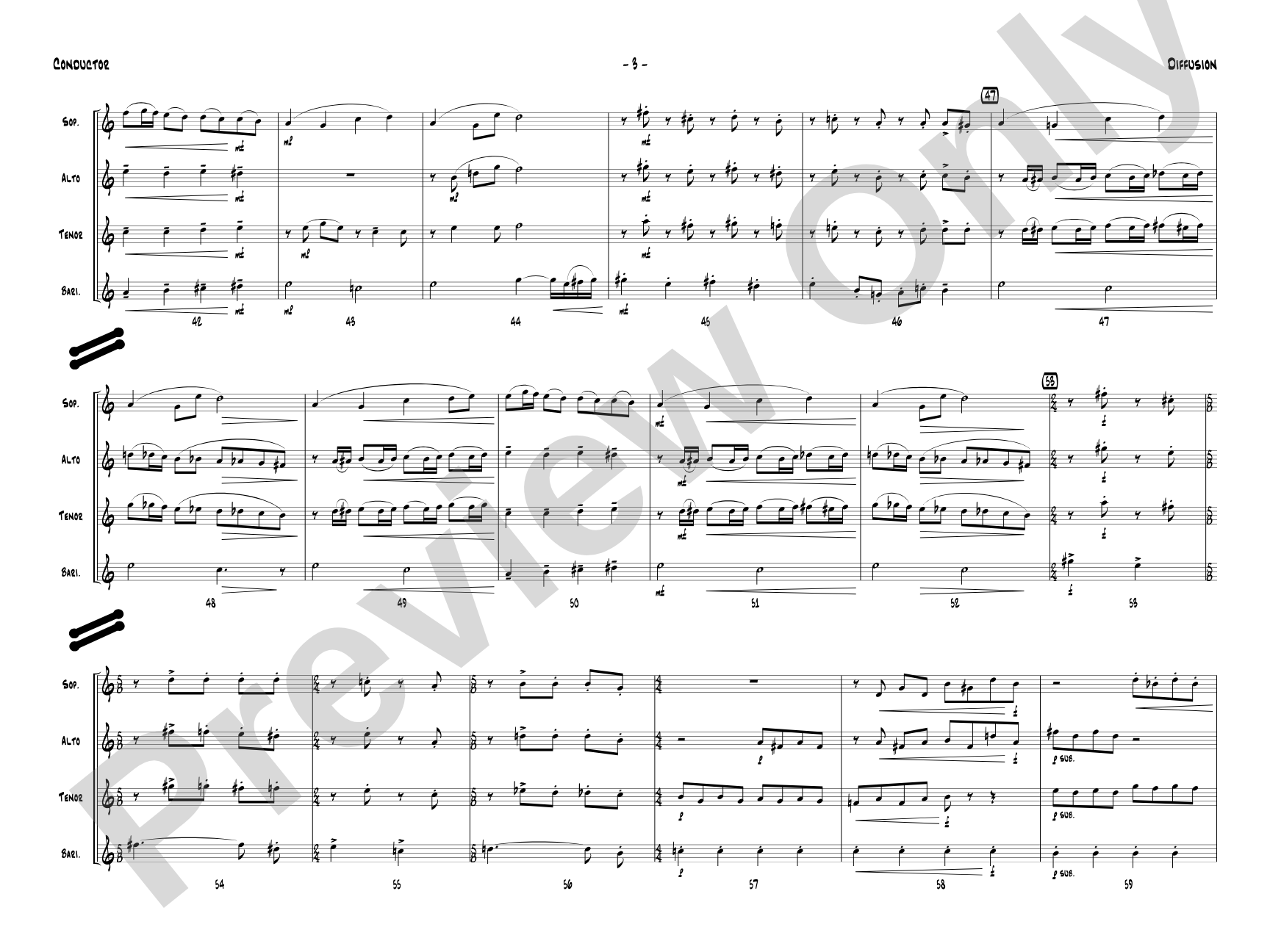
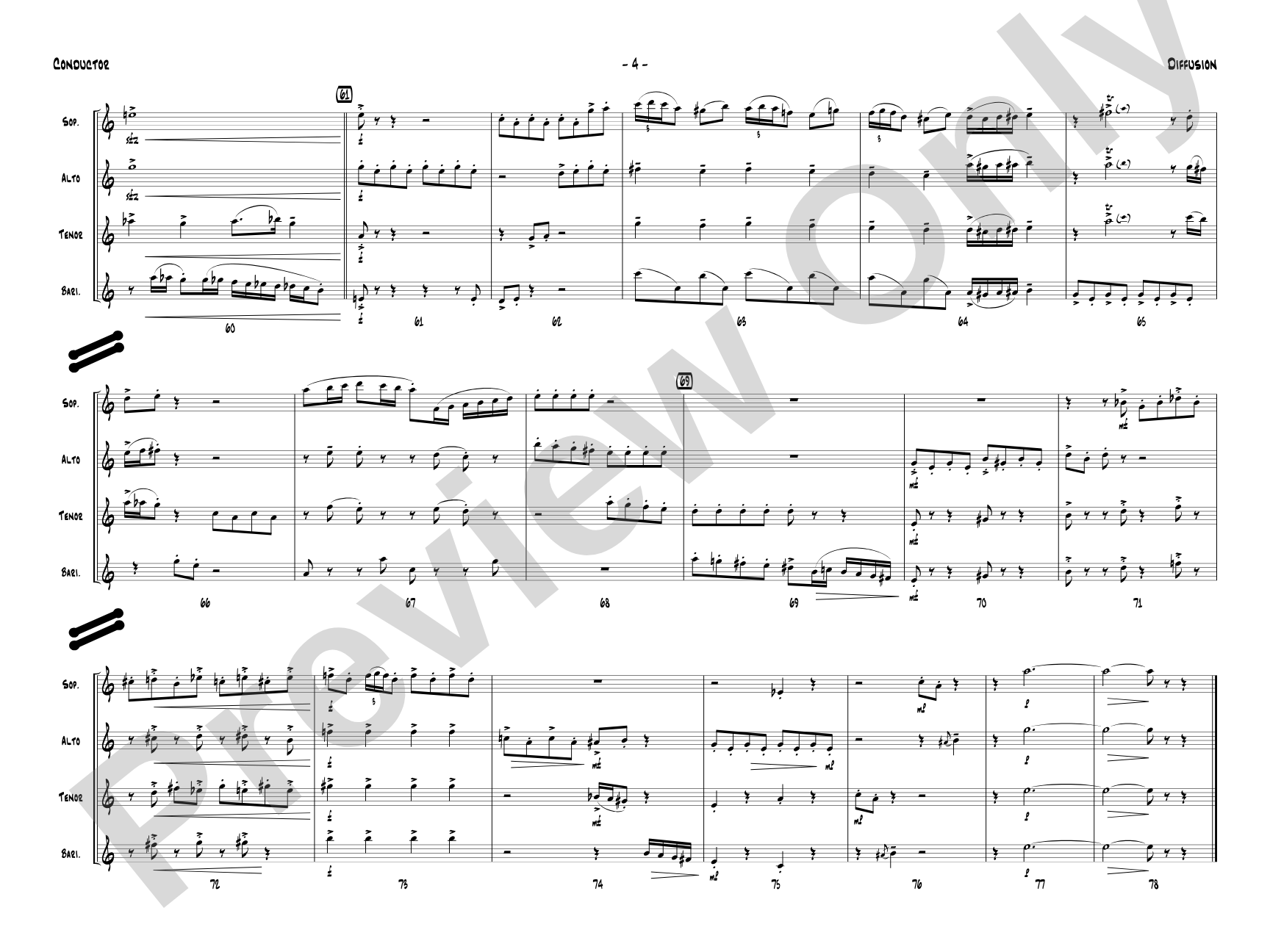
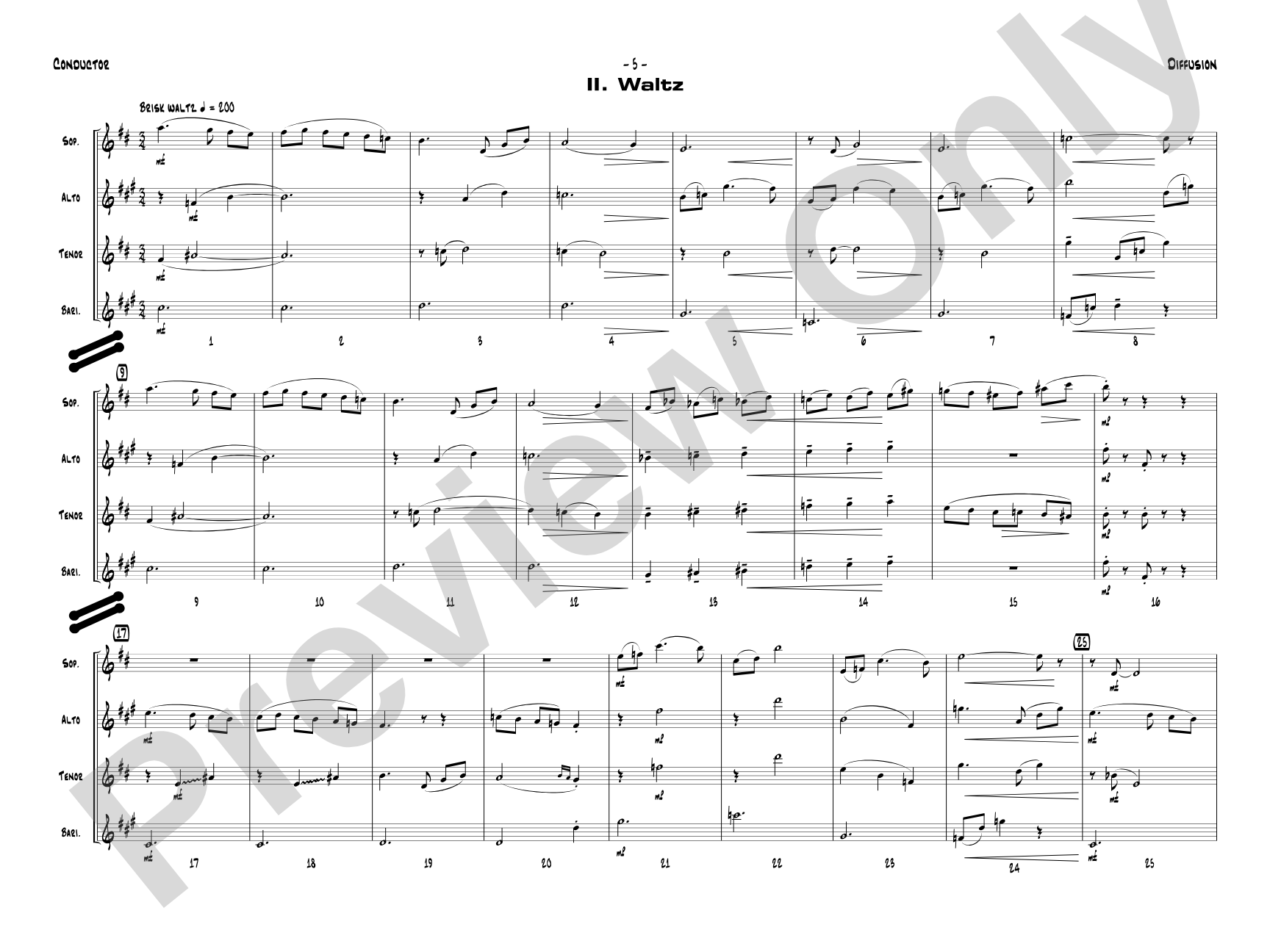
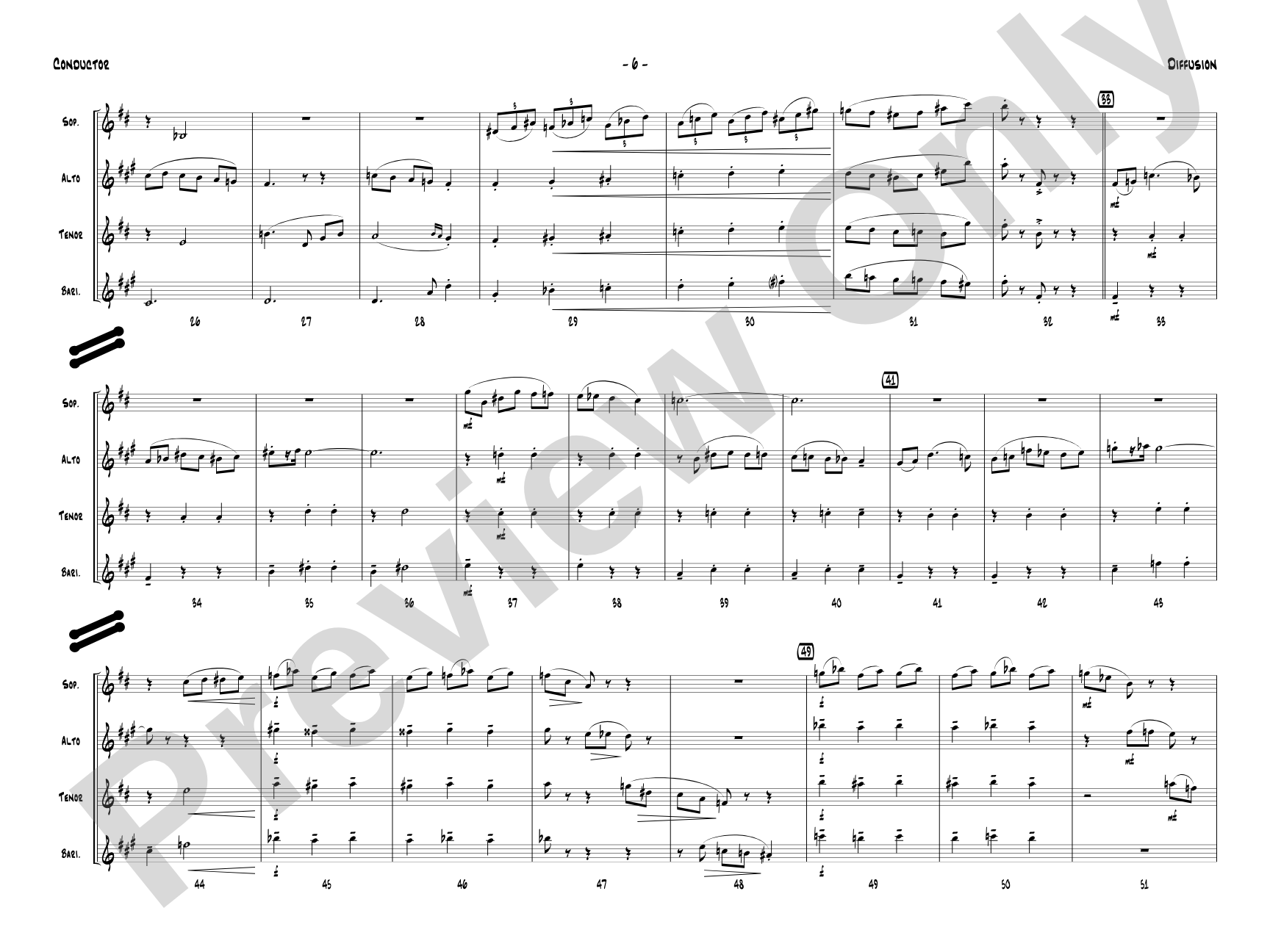
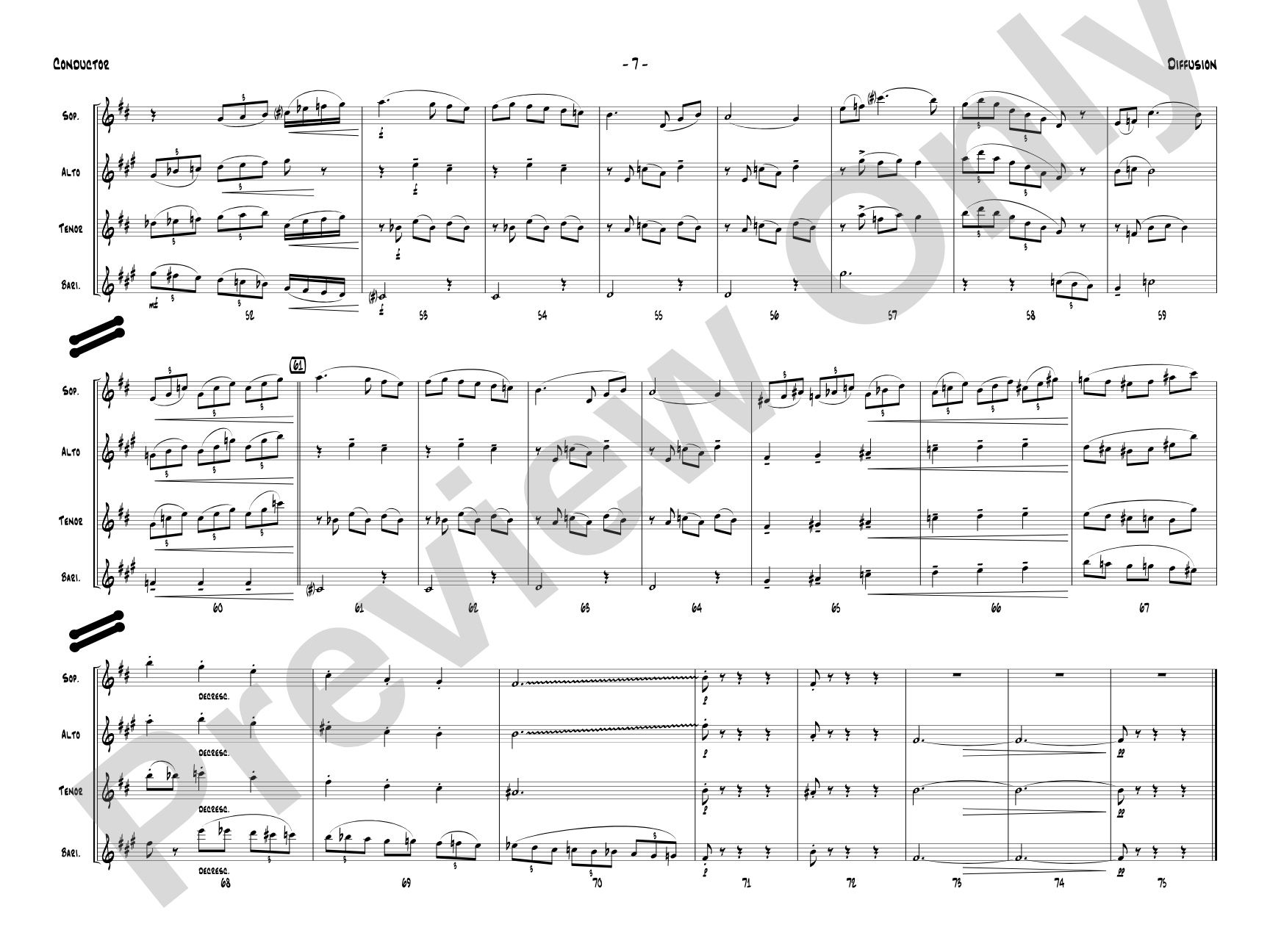
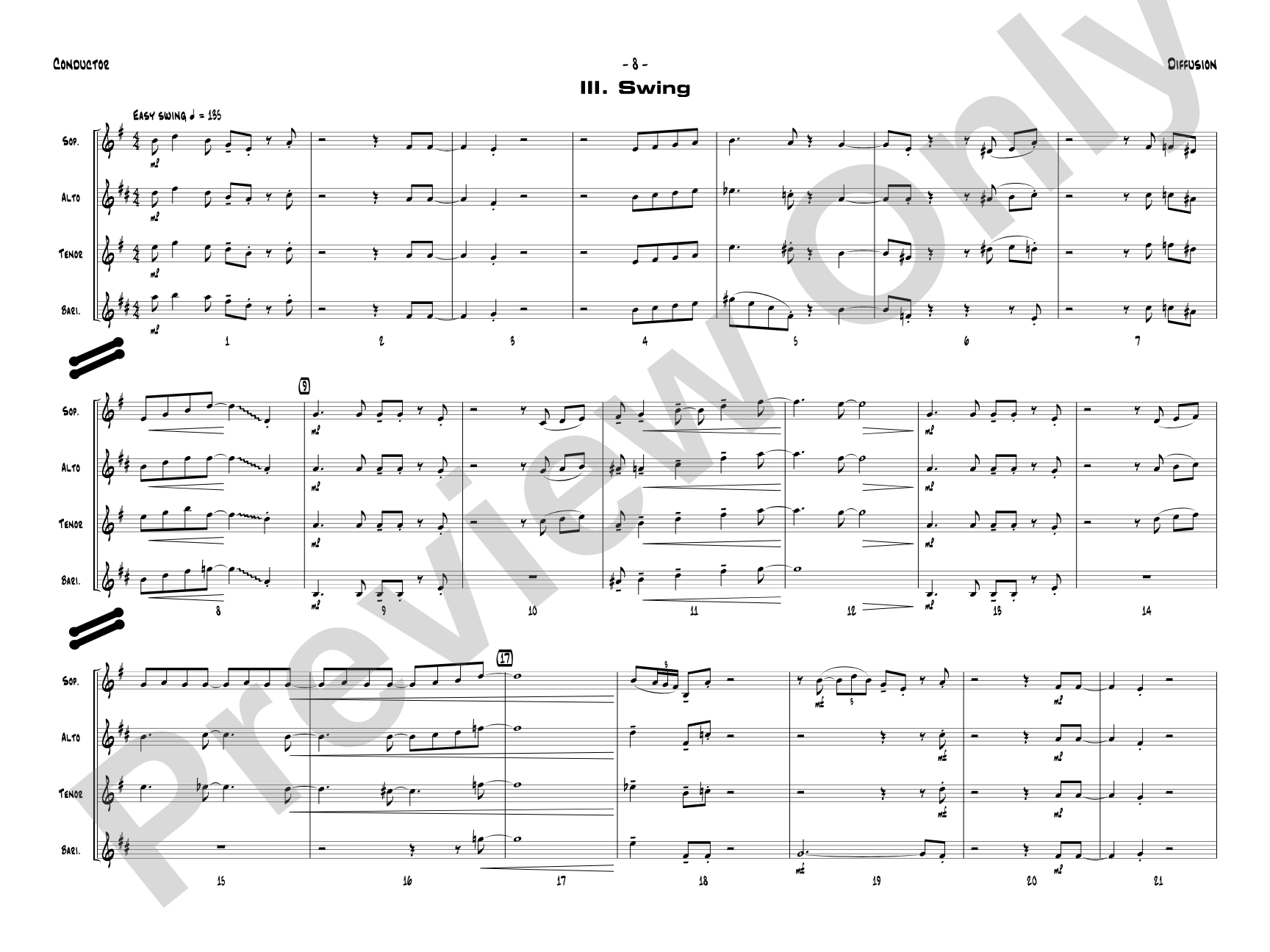
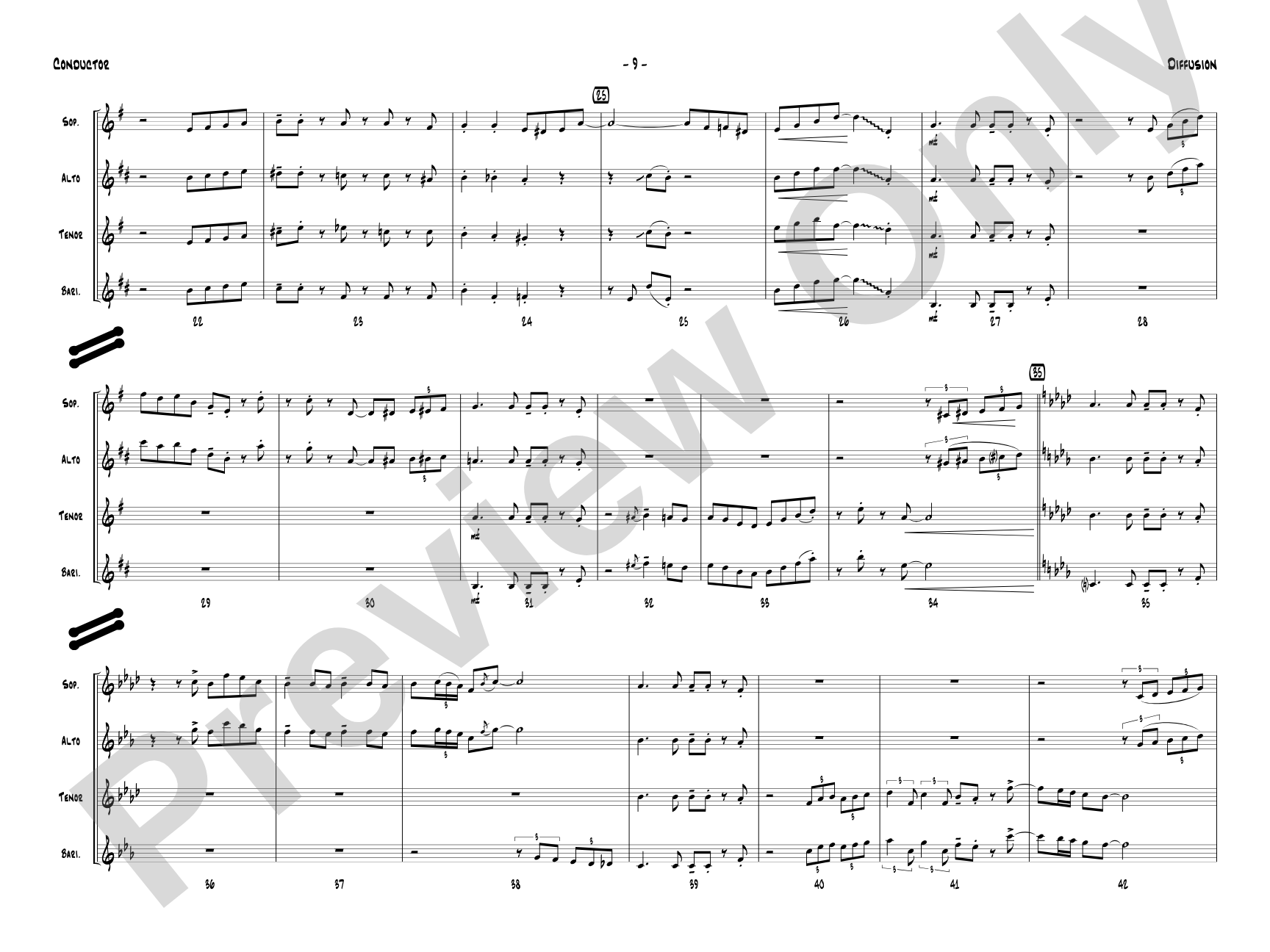
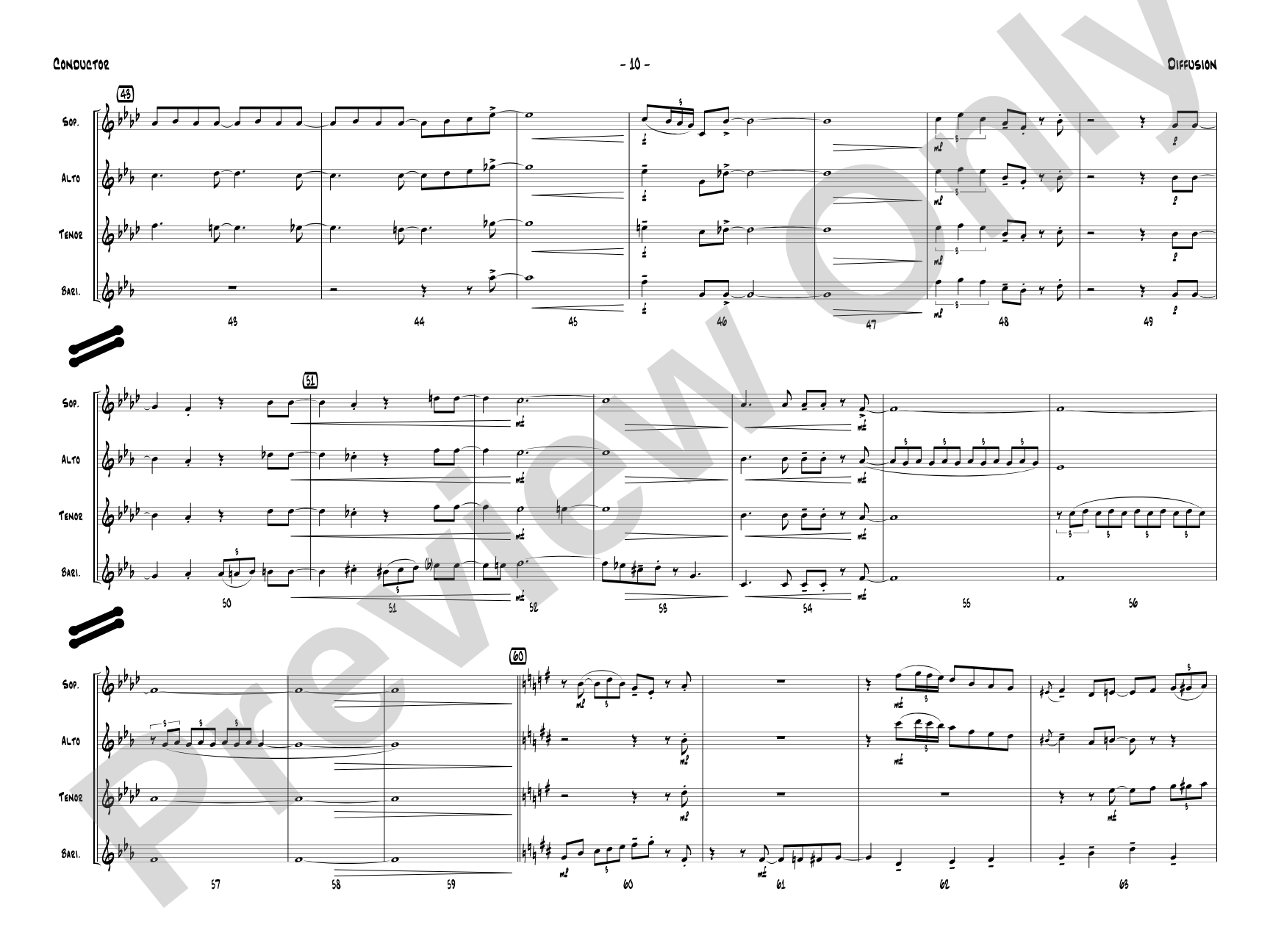
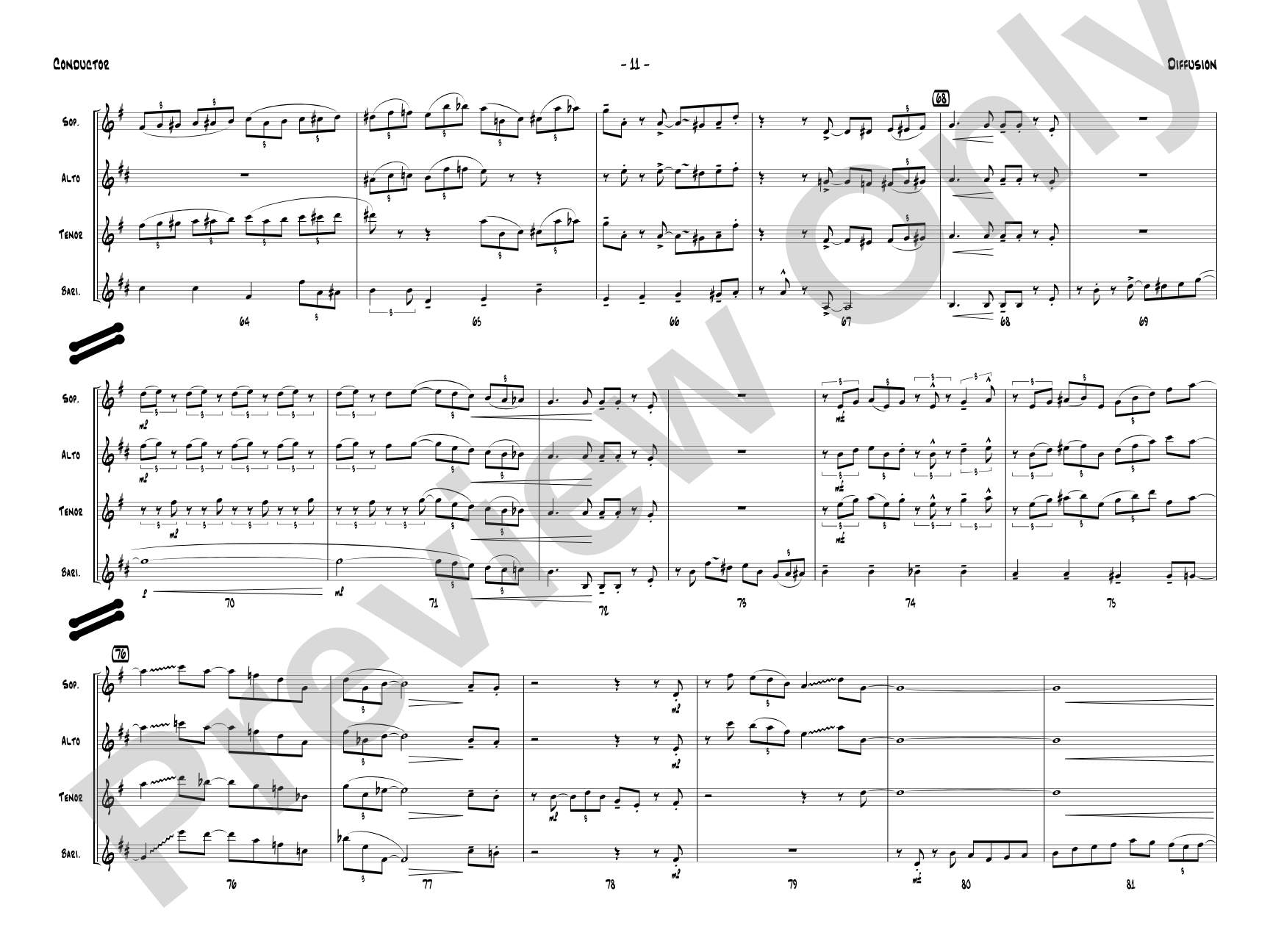
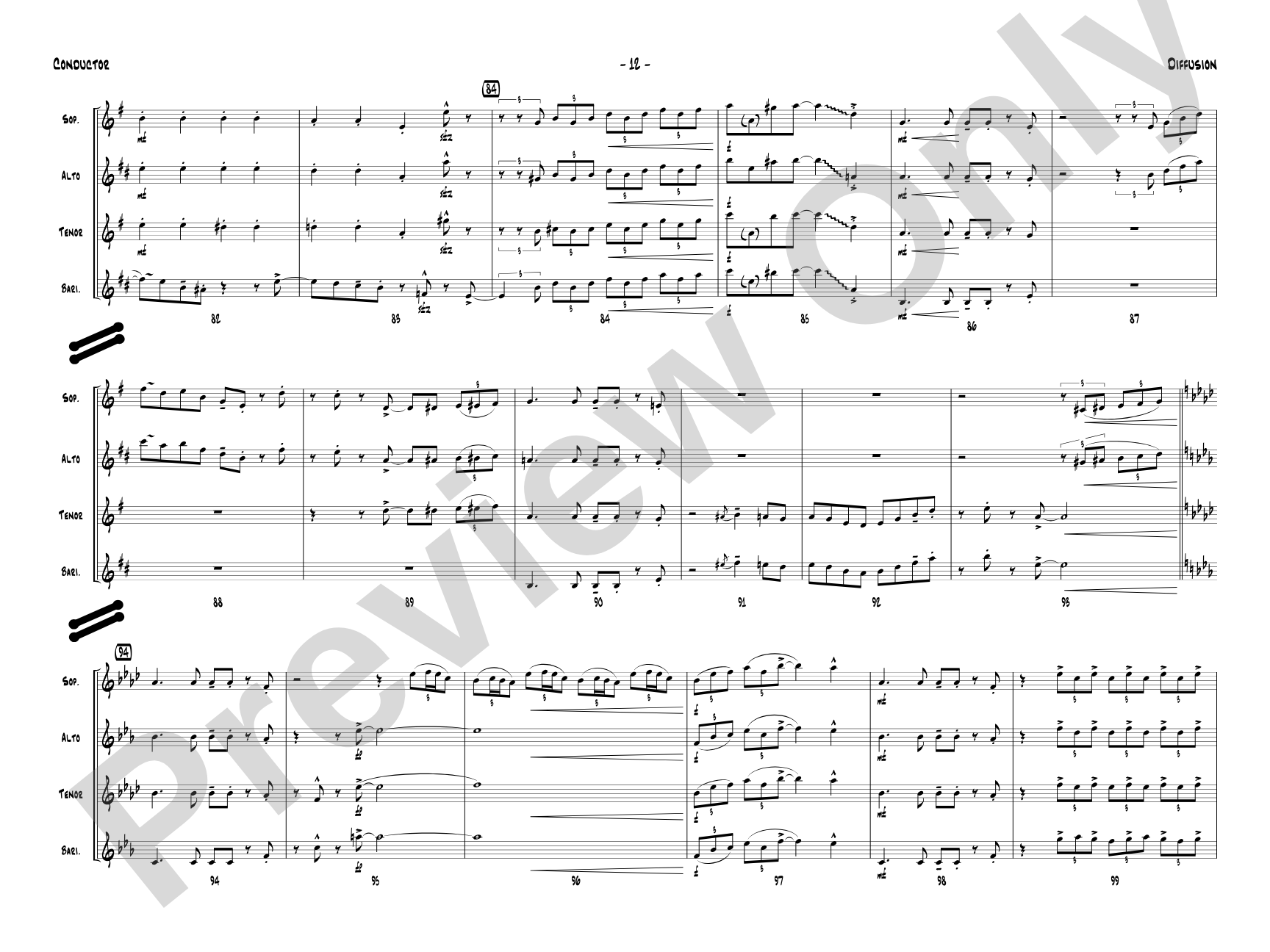
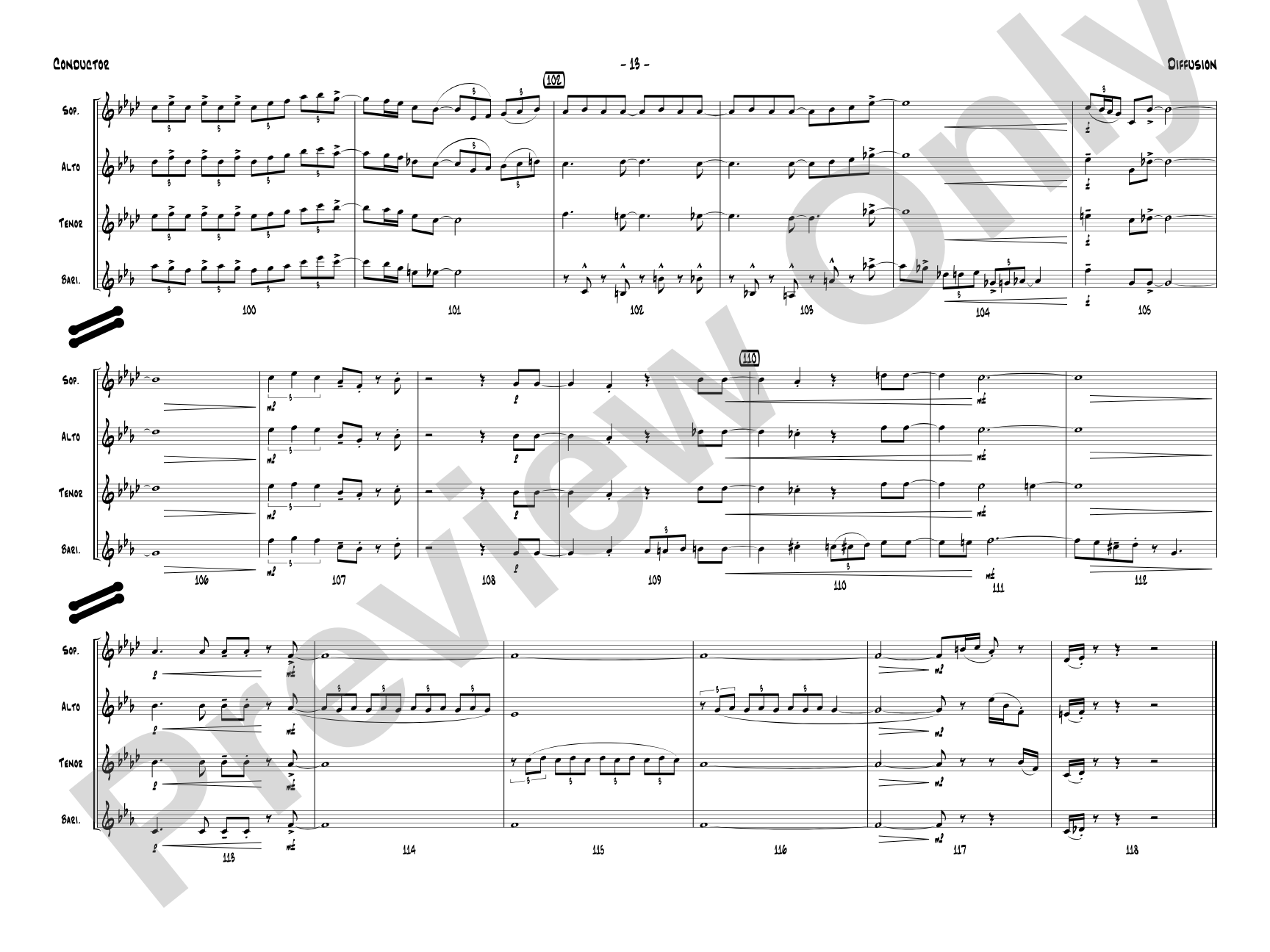
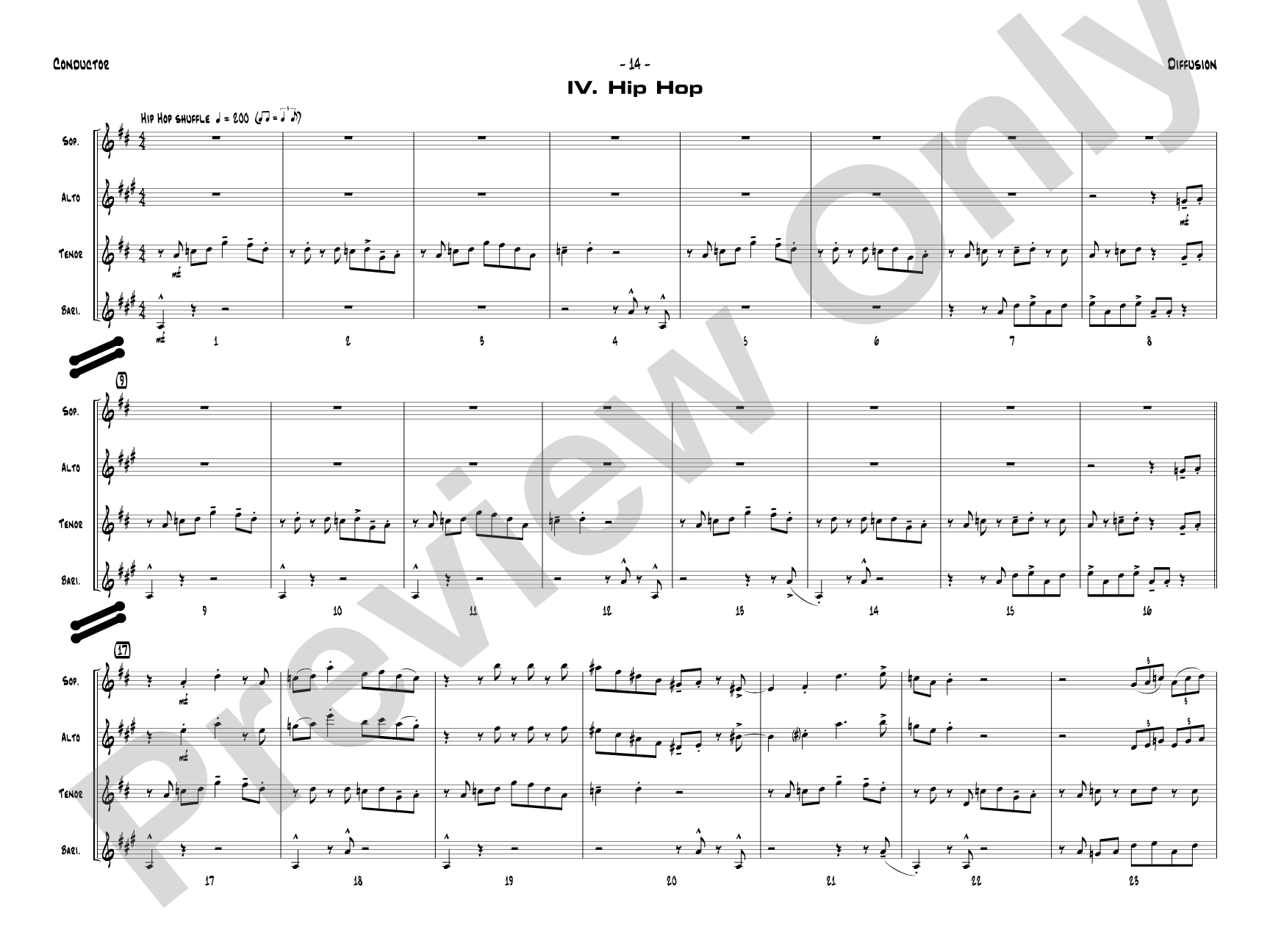
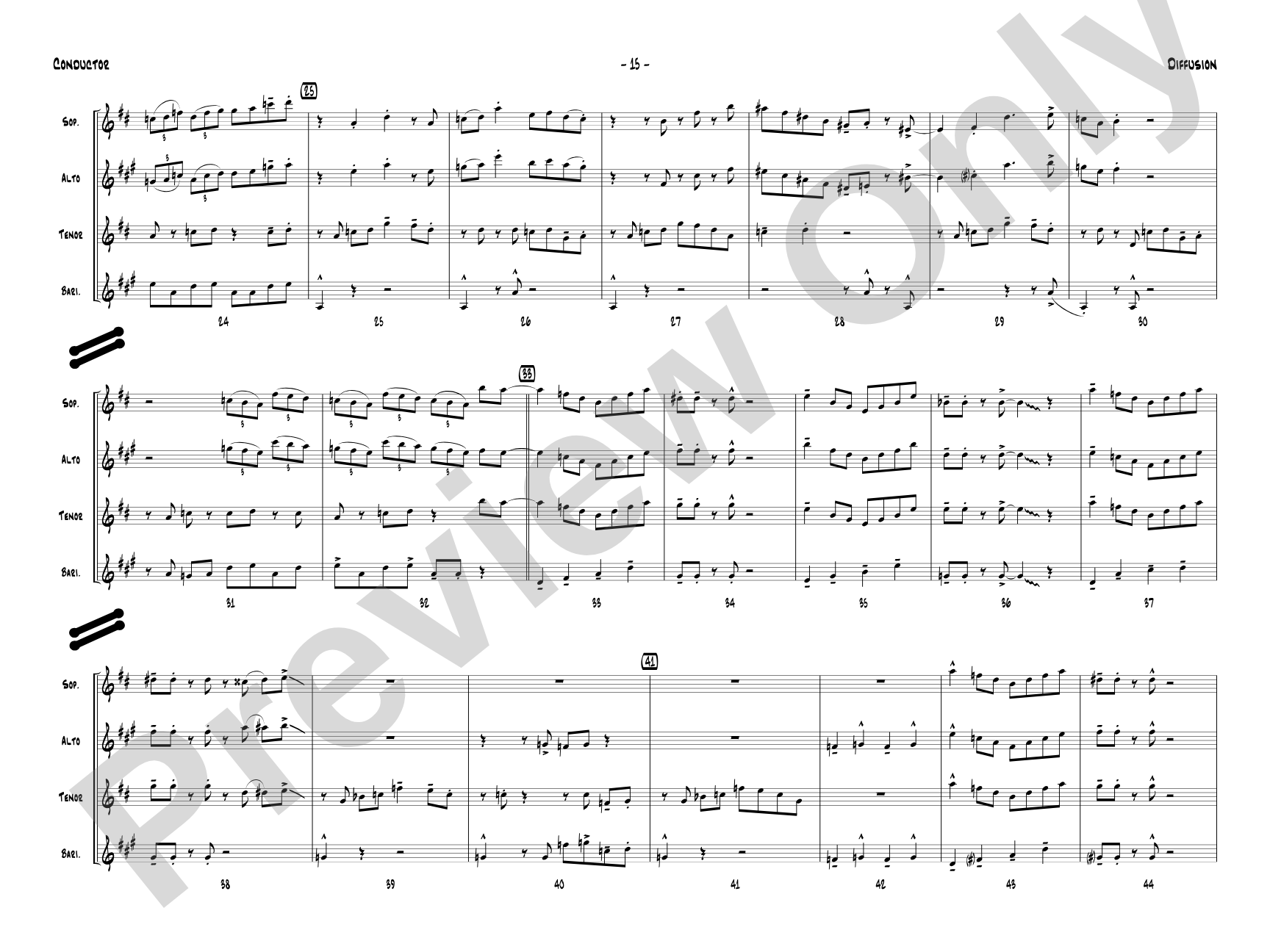
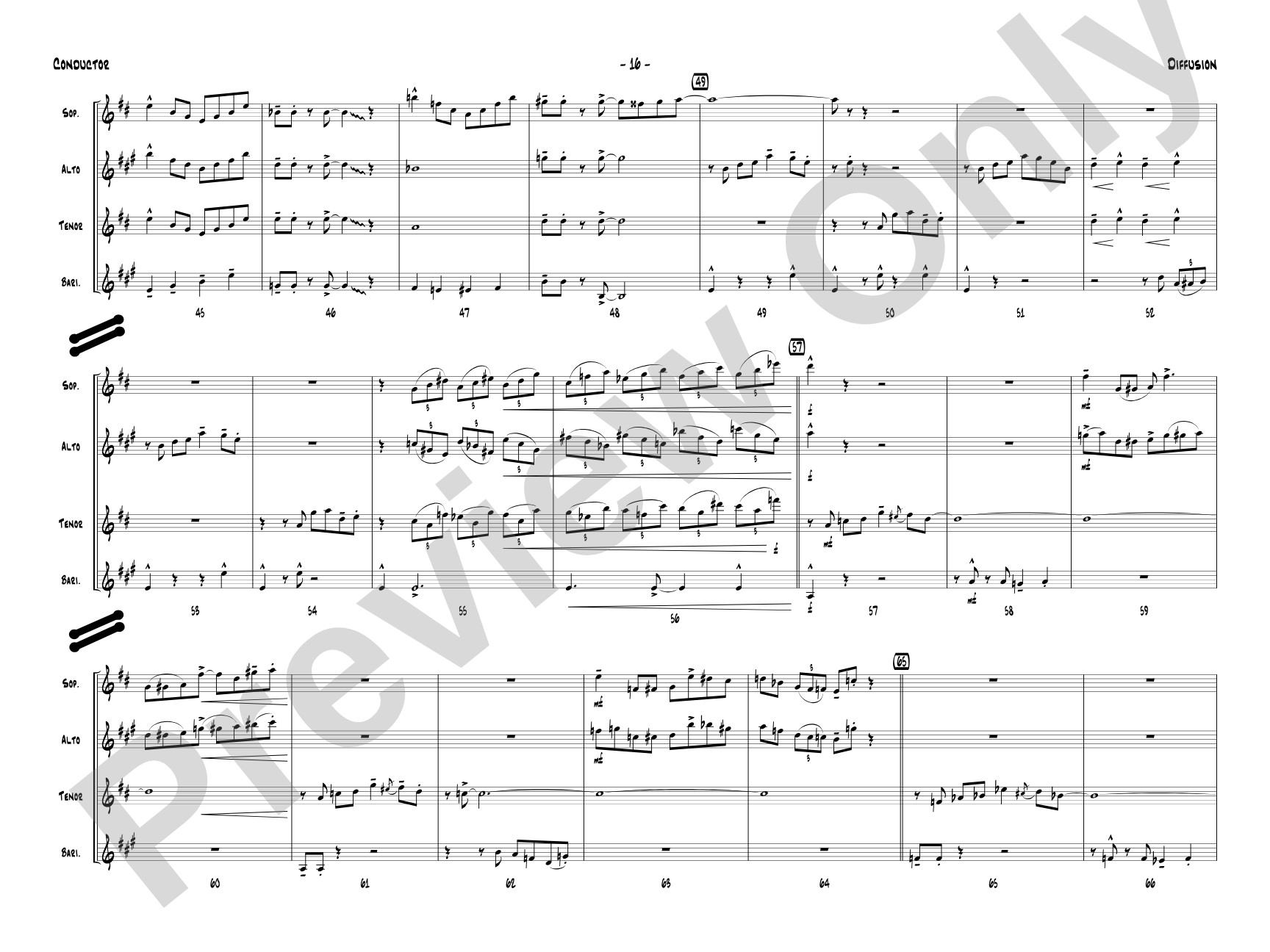
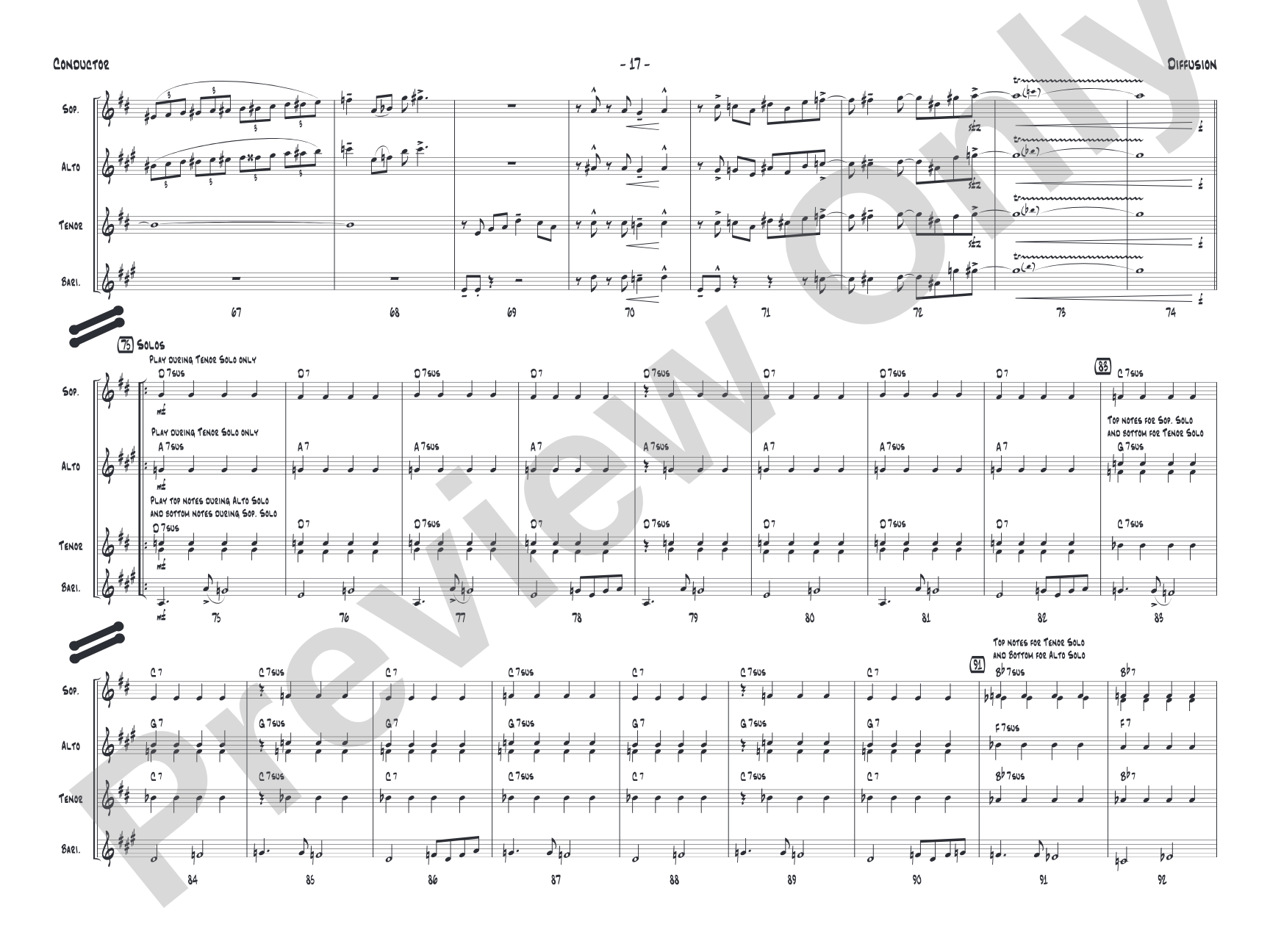
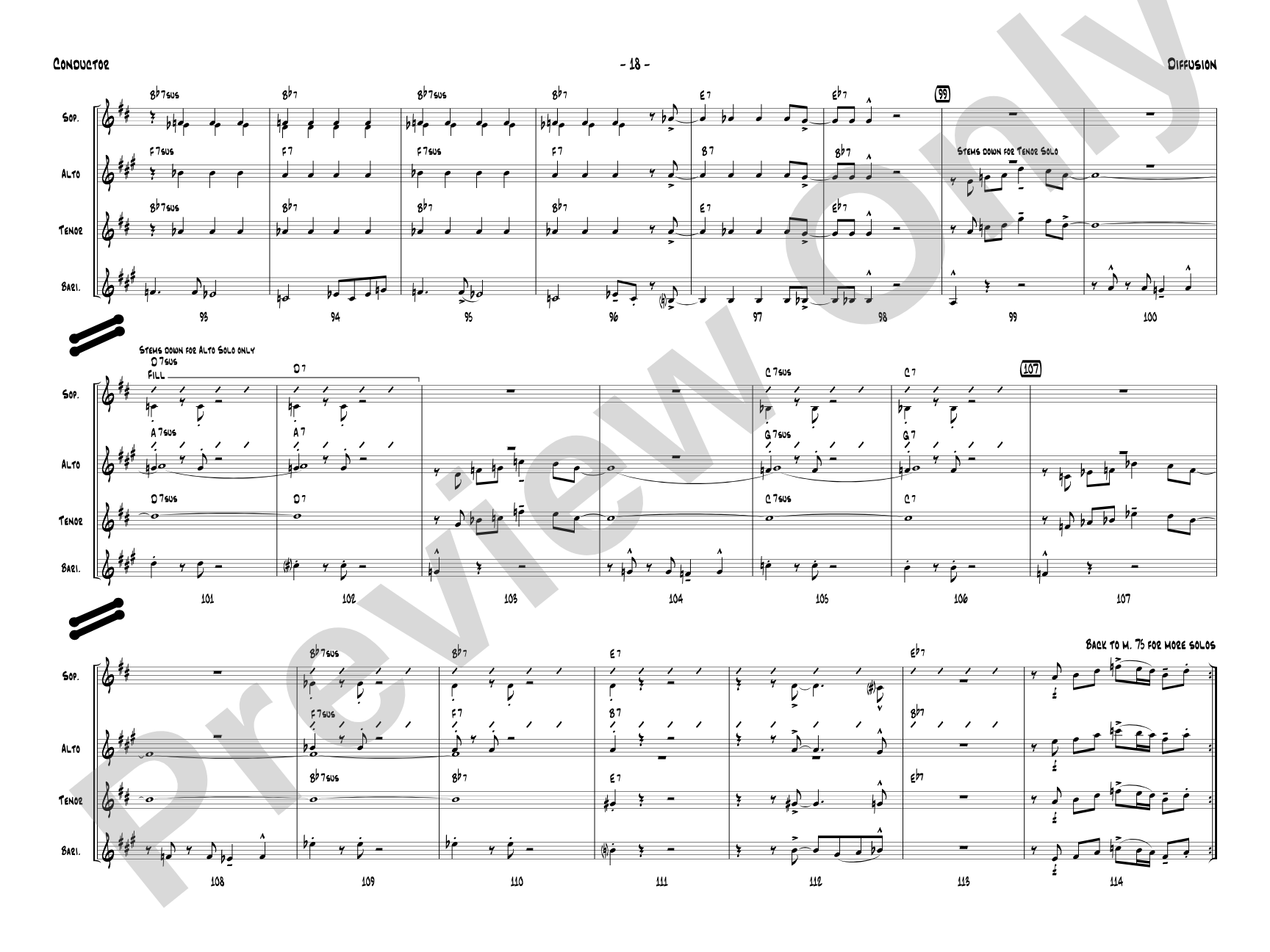
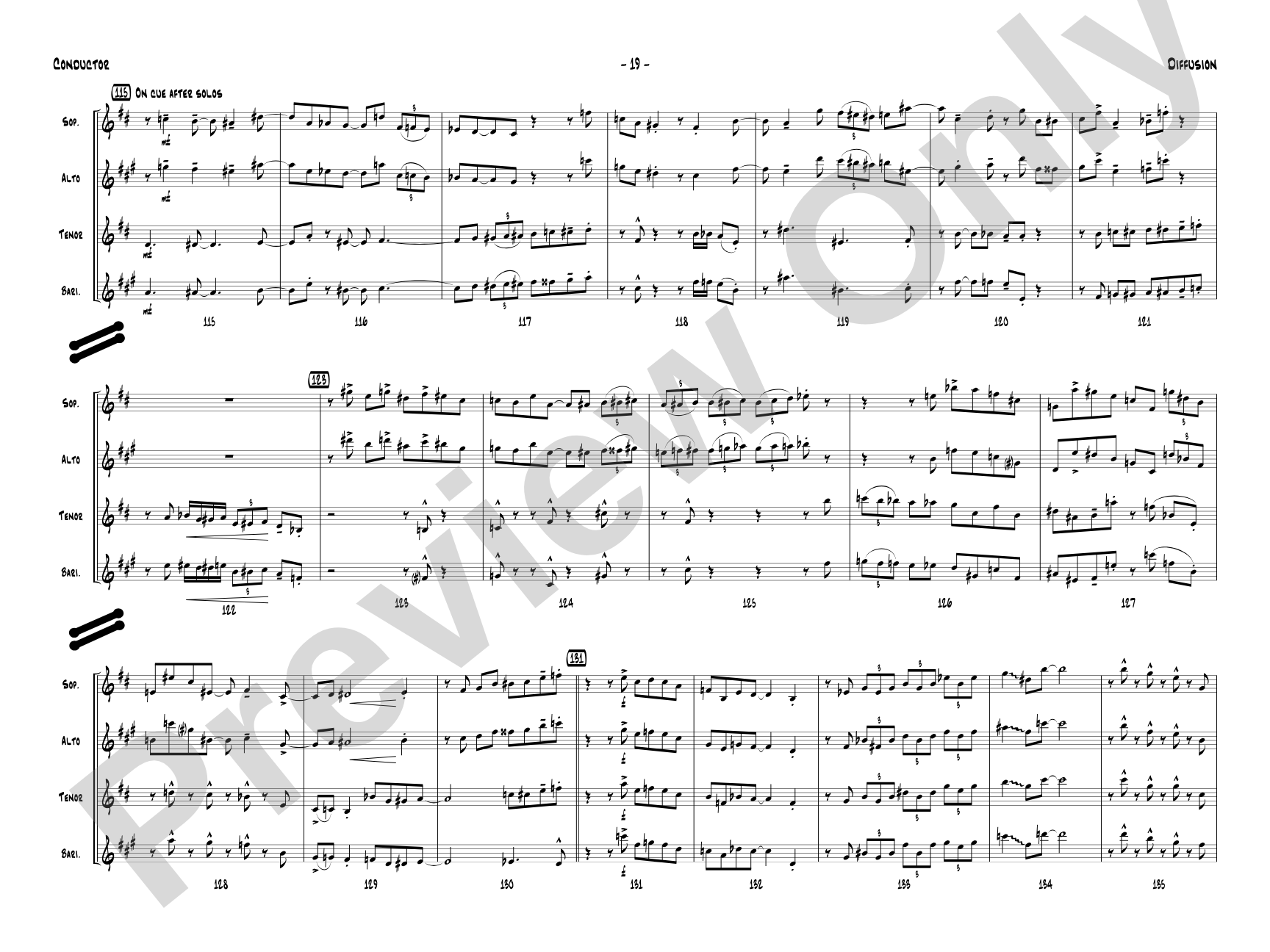
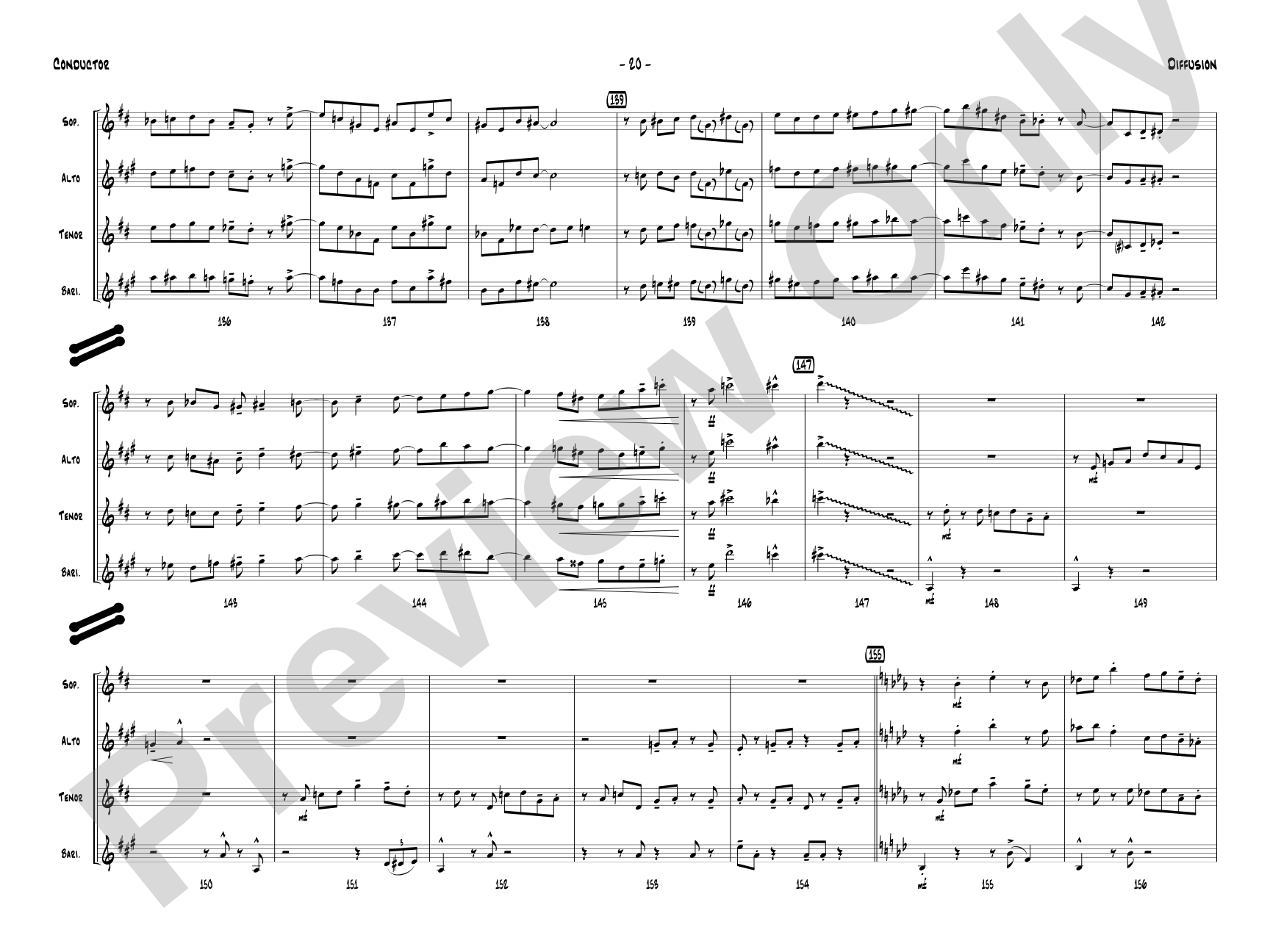
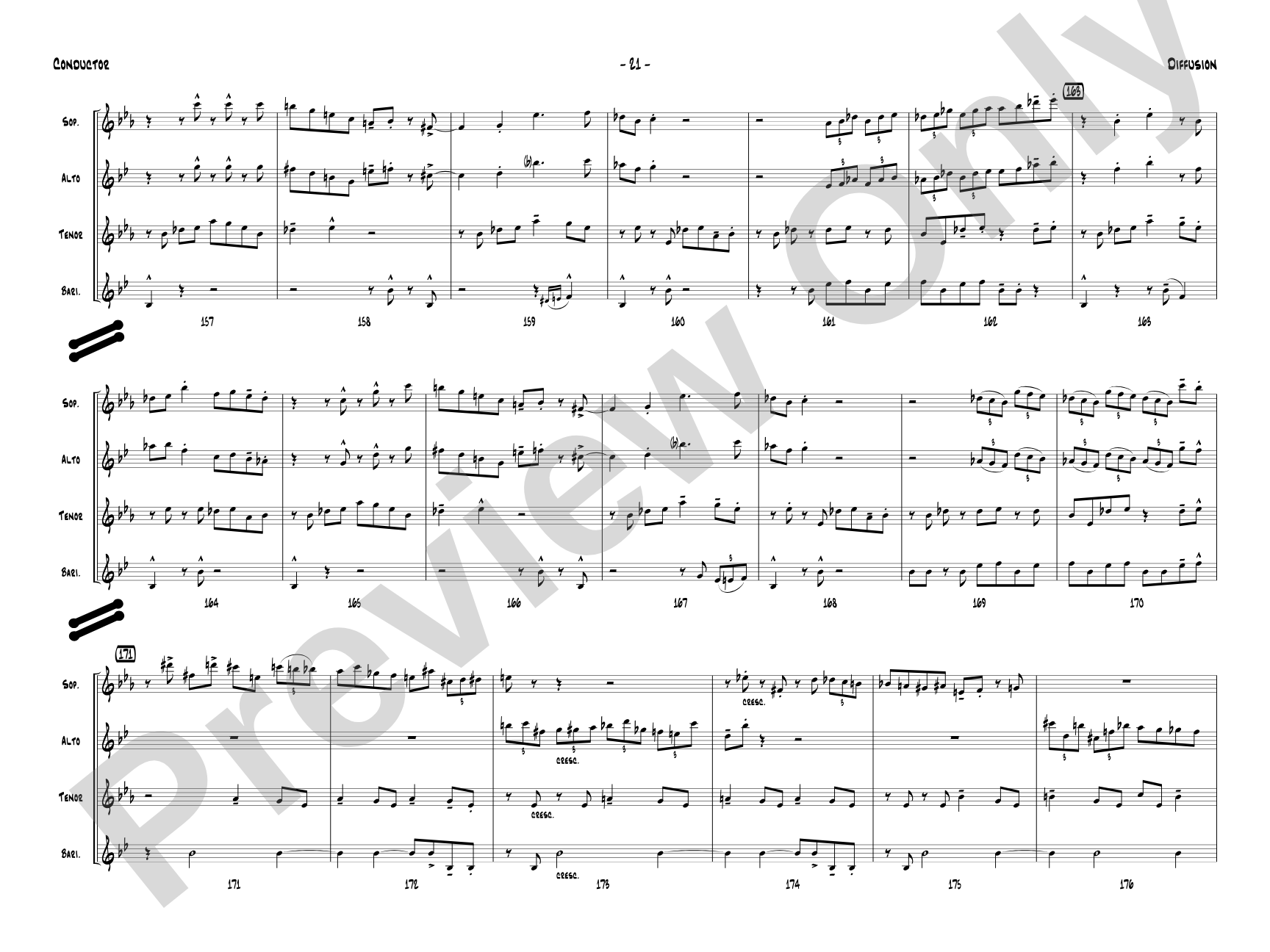
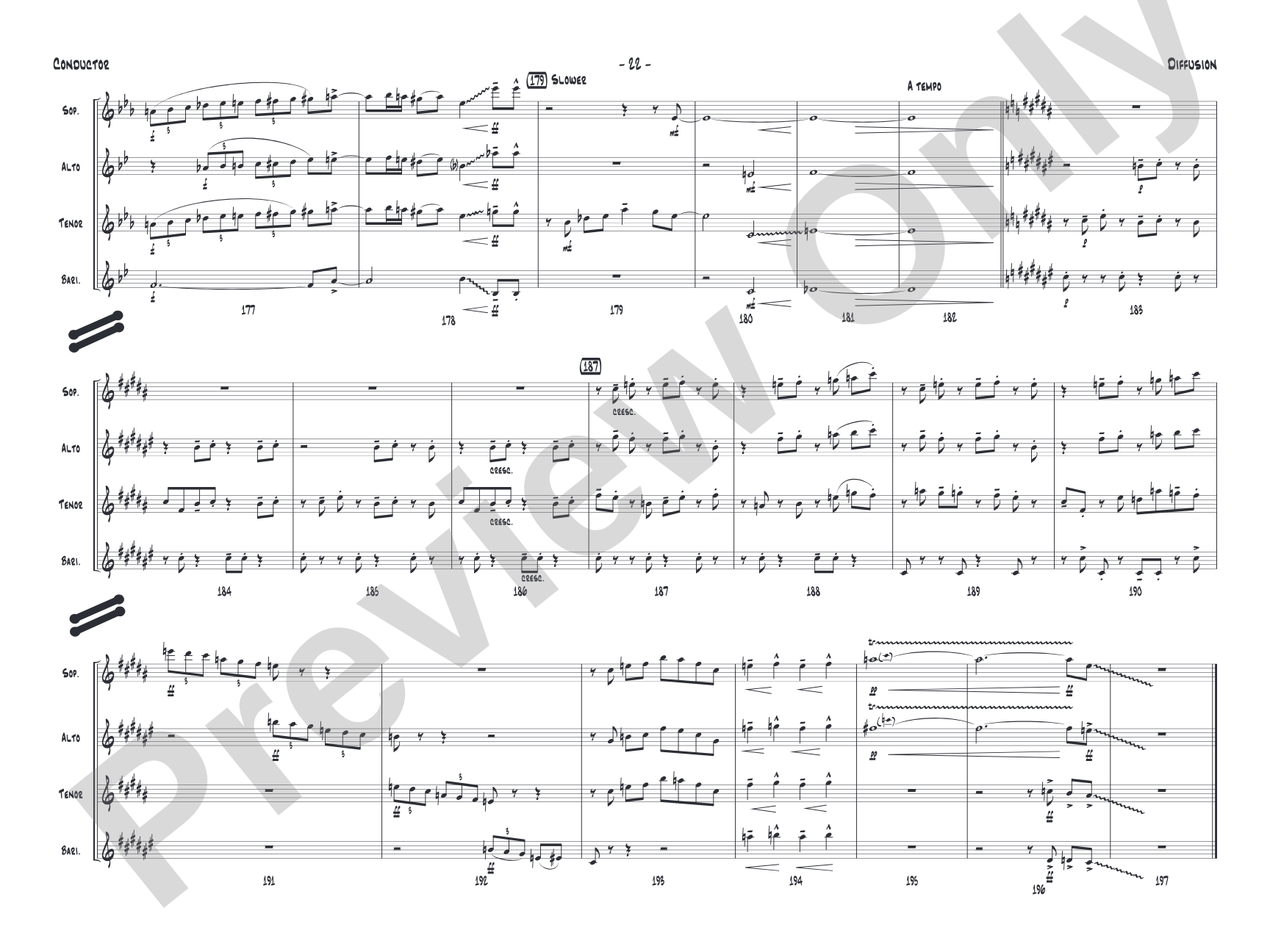

Diffusion for Sax Quartet: Saxophone Conductor Score & Parts
Arr. Gordon Goodwin
Grade: 5 (Advanced / Difficult)
Item: 00-PK-0003977
$70.00
Pickup currently not available
Buy Extra Parts (Digital PDF Download)
| Product | Price | Quantity |
|---|---|---|
| Diffusion for Sax Quartet: Score | $14.00 | |
| Diffusion for Sax Quartet: B-flat Soprano Saxophone | $5.99 | |
| Diffusion for Sax Quartet: E-flat Alto Saxophone | $5.99 | |
| Diffusion for Sax Quartet: B-flat Tenor Saxophone | $5.99 | |
| Diffusion for Sax Quartet: E-flat Baritone Saxophone | $5.99 |
Parts Added to Cart!
Description
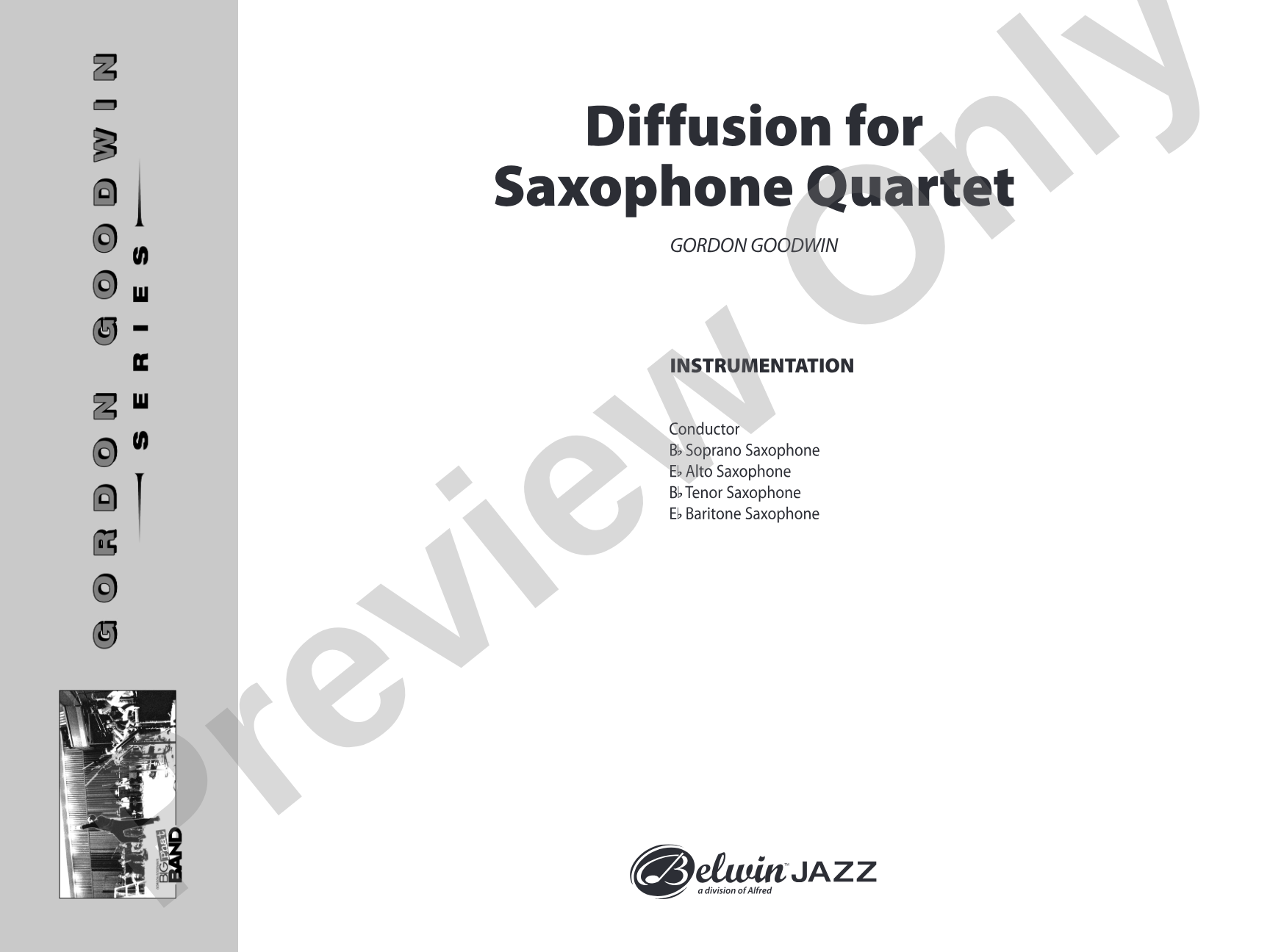
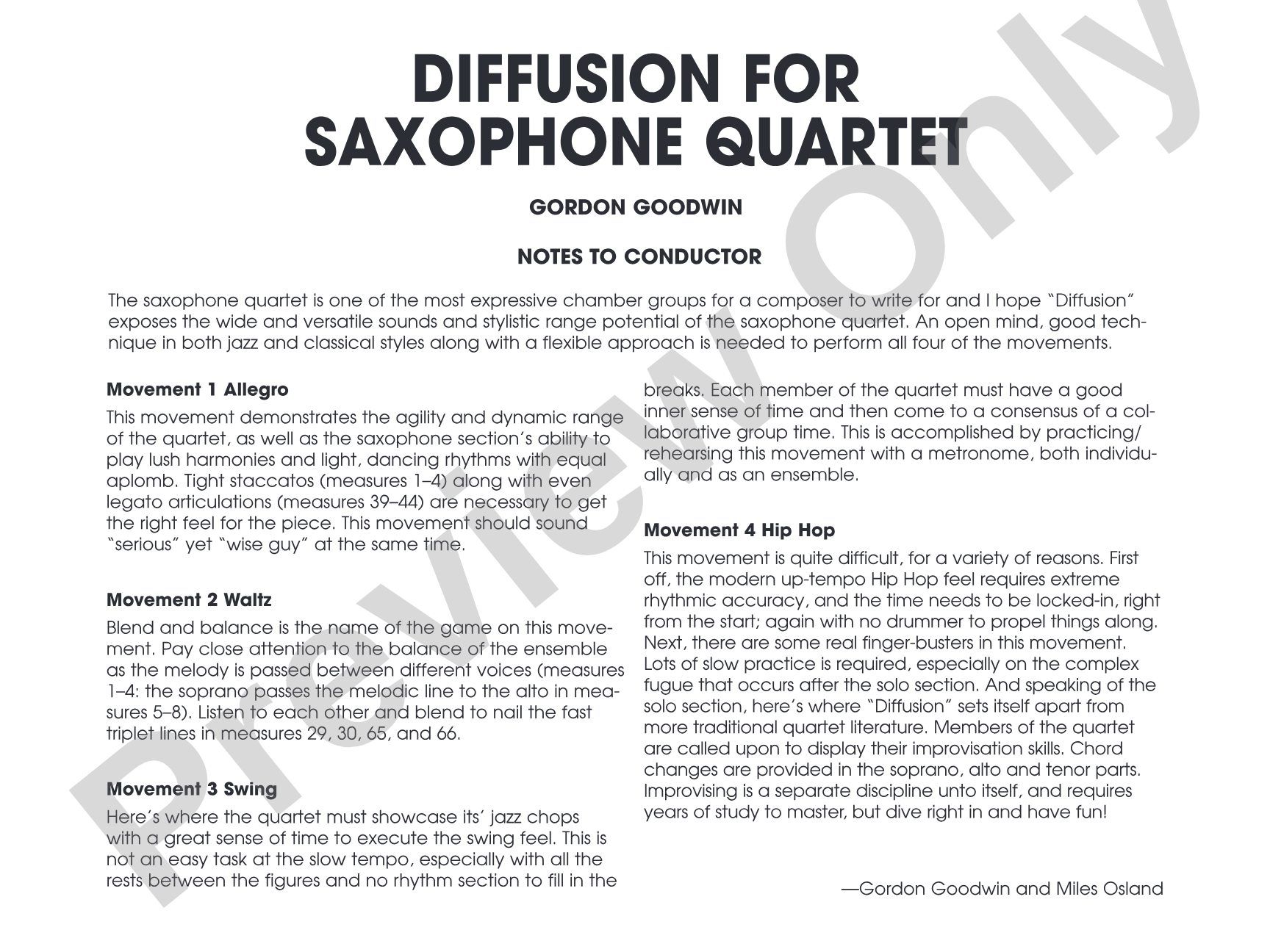
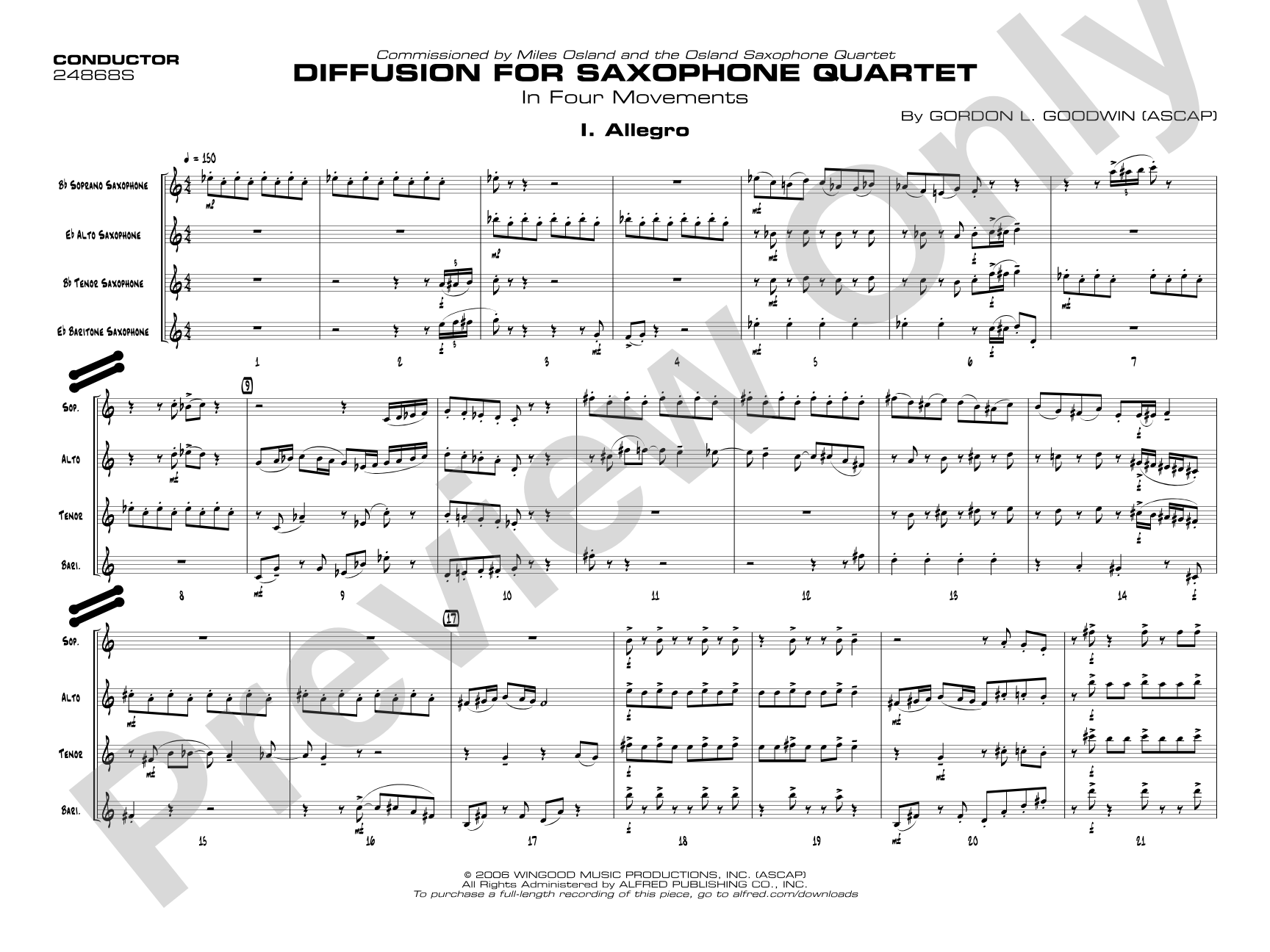
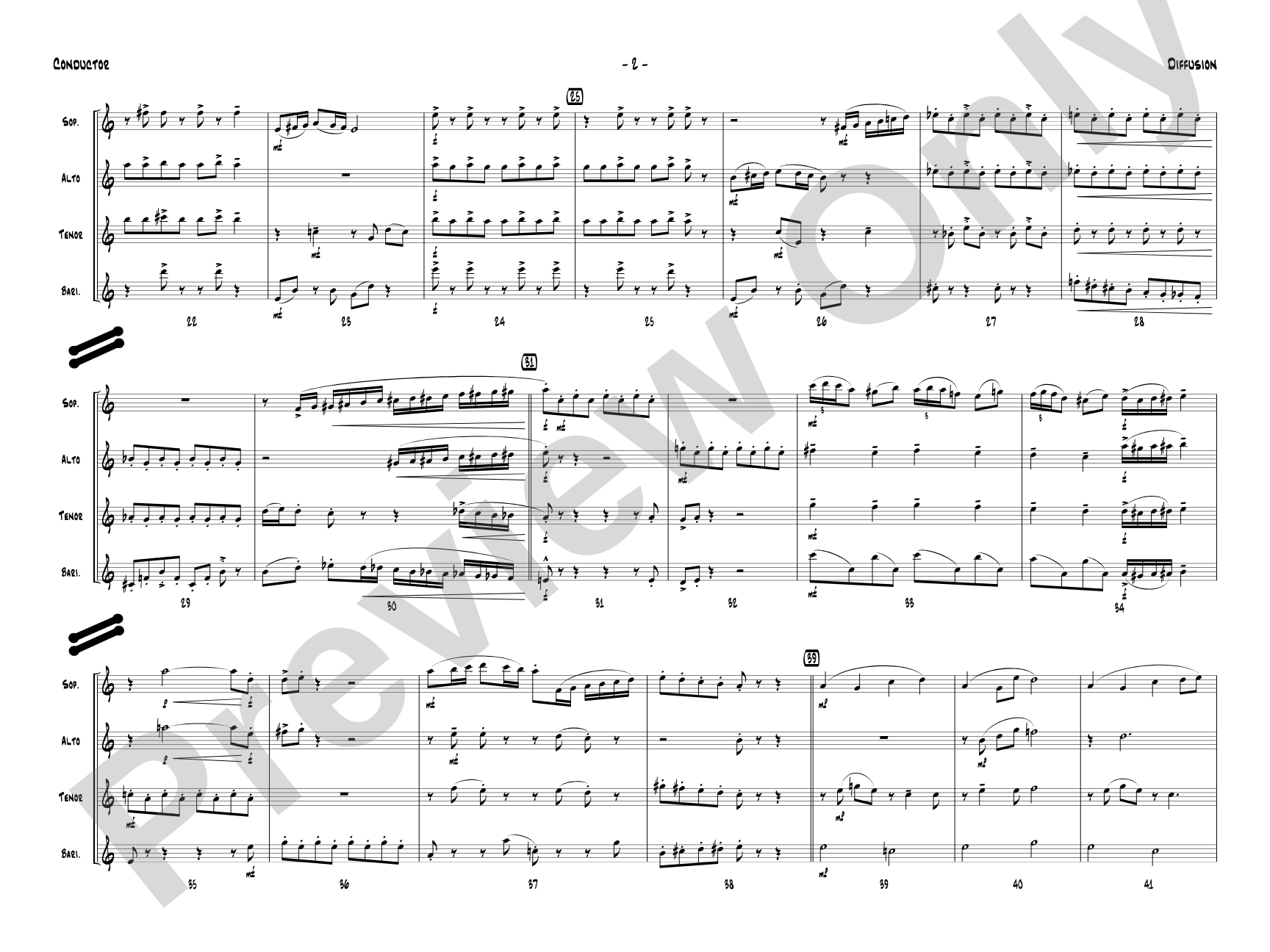
A challenging saxophone quartet written for soprano, alto, tenor and baritone saxophone, a cappella. The first two movements are classical in style and concept and movements 3/4 are played with a jazz concept to include some improvisation. An extraordinary yet superb composition.


Discover MakeMusic Cloud: thousands of interactive titles your students can play along with today.
Sample Audio
1
Audio File
--:--
0:00
0:00
Sample Video
No sample videos found.
Additional Details
Series:
Gordon Goodwin Series
Publisher:
Alfred Music
Page Count:
48
SKU:
00-PK-0003977
More about this title
About the Arranger: Gordon Goodwin

Gordon Goodwin began composing at age five, transcribing complete works rather than fragments. By thirteen, he had already written his first big band chart, Hang Loose, setting the trajectory for a career that would span film, television, and live performance. His film and television work has earned him three Emmy Awards and multiple Grammy nominations, with orchestrations featured in Bad Boys II, Con Air, Remember the Titans, Star Trek: Nemesis, and numerous other productions.
As a composer and arranger, Goodwin has written for an impressive roster of artists including Christina Aguilera, Quincy Jones, Ray Charles, and Toni Braxton. He has conducted major symphony orchestras across North America and Europe. Since 2000, he has led Gordon Goodwin's Big Phat Band, a Los Angeles-based jazz ensemble whose albums have consistently earned Grammy recognition and critical acclaim.
Why we love this
Diffusion showcases Goodwin's mastery of hybrid compositional thinking by balancing two distinct musical worlds within a single quartet. The classical architecture of the opening movements gives way to improvisation in the jazz movements, creating a arc that rewards both disciplined ensemble playing and spontaneous musicianship. This is the kind of piece that challenges saxophonists to be complete musicians.
What to expect
The opening movements unfold with classical sophistication, each voice contributing to seamless four-part writing. When the ensemble pivots to jazz in movements three and four, the energy shifts into something more visceral and conversational, with soloists trading ideas while others support and respond.
Who it's for
Advanced saxophone quartets seeking repertoire that stretches both classical ensemble technique and jazz vocabulary. Players at this level should have strong individual fundamentals and the confidence to navigate structured improvisation alongside composed material.
How to get the most out of it
- Establish rock-solid intonation in the classical movements before introducing rubato or expressive liberties; the quartet's balance depends on precision tuning across all four voices.
- Map out the improvisation passages in movements 3 and 4 during rehearsal so soloists understand harmonic anchors and section boundaries, then give performers freedom to develop their own lines in performance.
- Use the conductor score to rehearse ensemble entries and transitions between composed and improvised sections, paying special attention to how jazz phrasing affects rhythmic alignment.
How to use it
Program this on a recital that celebrates diverse saxophone styles or as part of a concert exploring contemporary chamber writing. Its blend of classical and jazz frameworks makes it an ideal bridge piece between straight classical and full jazz programming.
Skills your students will build
- Four-part ensemble blend and intonation tuning across soprano, alto, tenor, and baritone voices
- Reading and interpreting jazz notation and improvisation frameworks within a composed structure
- Balancing composed material with spontaneous improvisation in real time
- Navigating stylistic shifts between classical and jazz phrasing and articulation within a single work