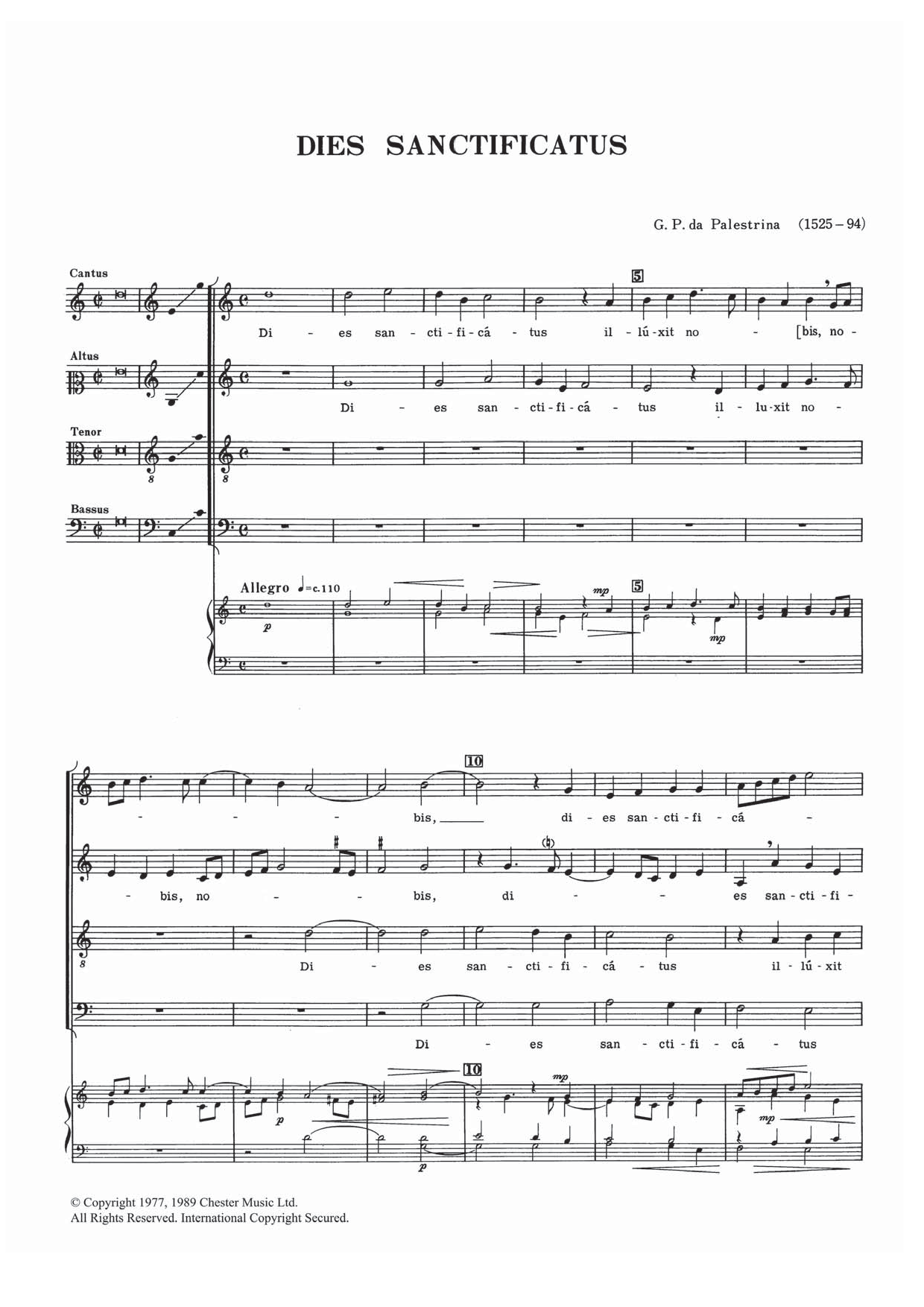
Dies Sanctificatus Sheet Music Preview

Dies Sanctificatus: SATB Choral Octavo

As performed by Giovanni Palestrina

Item: 35-DS00366720

Digital Download
$2.99
Description

Dies Sanctificatus: SATB Choral Octavo isn't in MakeMusic Cloud just yet...but it could be. Let us know you'd like to see it, and you'll help shape what comes next. In the meantime, start a free trial and dive into thousands of interactive titles your students can play along with today.

Sample Audio
No sample audio found.
Sample Video
Additional Details
Publisher: Hal Leonard
Page Count: 5
SKU: 35-DS00366720

More about this title

About the Artist: Giovanni Palestrina

Giovanni Palestrina (1525-1594) stands as one of the most influential composers of the Renaissance, reshaping sacred music during the Counter-Reformation. His approach to polyphonic writing balanced textual clarity with compositional elegance, establishing a model for church music that influenced generations of composers. Palestrina's mastery of voice leading and harmonic language made his work the gold standard for choral writing in seminaries and conservatories for centuries.

For choral directors and students, Palestrina represents the pinnacle of Renaissance craft. His music demonstrates how sophisticated counterpoint can serve spiritual expression rather than obscure it, making his works invaluable for teaching voice independence, smooth melodic phrasing, and the art of blending multiple lines into unified choral sound.

Why we love this

Palestrina's music teaches through its inherent musicality rather than technical demands. The writing feels inevitable; each voice knows exactly where it belongs, and singers discover that singing correctly means singing expressively. This is a work that rewards preparation and reveals new layers of understanding the more your choir rehearses it.

What to expect

Dies Sanctificatus radiates quiet reverence without sentimentality. The harmonies feel timeless, neither restless nor static; instead, they drift forward with purposeful grace. Singing it requires focus and control, but also a kind of surrender to the music's own elegant inevitability.

Who it's for

This octavo works for upper-level high school and collegiate choirs with solid fundamentals in Renaissance style. Singers need secure sight-reading skills and the maturity to blend with others, but the piece rewards even developing ensembles with early success because Palestrina's writing logic guides performers toward correct interpretation.

How to get the most out of it

  • Shape the phrases according to the text rather than the bar lines. Palestrina's barring often obscures the true harmonic rhythm, so follow the words and let the music breathe where the language naturally pauses.
  • Balance the soprano and alto lines equally with the tenors and basses. Too many choirs let the upper voices dominate, but Palestrina's genius lies in how all four voices create the harmonic color together.
  • Approach the suspensions with patience. These vertical tensions are what make Palestrina's voice leading so satisfying; resolve them cleanly and let your singers hear how the dissonance prepares the listener's ear for what comes next.
  • Maintain consistent vowel sounds across all voices within each chord. The blend Palestrina achieves depends on technical uniformity, especially on sustained notes.

How to use it

Open a concert with this work to establish an atmosphere of reflection and craftsmanship before moving to later repertoire. Its five pages fit perfectly in a longer program without demanding excessive rehearsal time relative to its impact, making it an ideal anchor for a Renaissance or sacred music set.

Skills your students will build

  • Renaissance-era voice leading and harmonic language
  • Singing sustained tones with consistent vibrato control
  • Navigating suspensions and their resolutions
  • Balancing independent melodic lines in four-part texture
  • Textual phrasing across bar lines
  • Reading and performing music with minimal expressive markings

You May Also Like