

Dies Irae: SATB Choral Octavo
By Ruth Morris Gray
Item: 00-PO-0003263

$2.05
Minimum order quantity: 20 copies
Pickup currently not available
Description
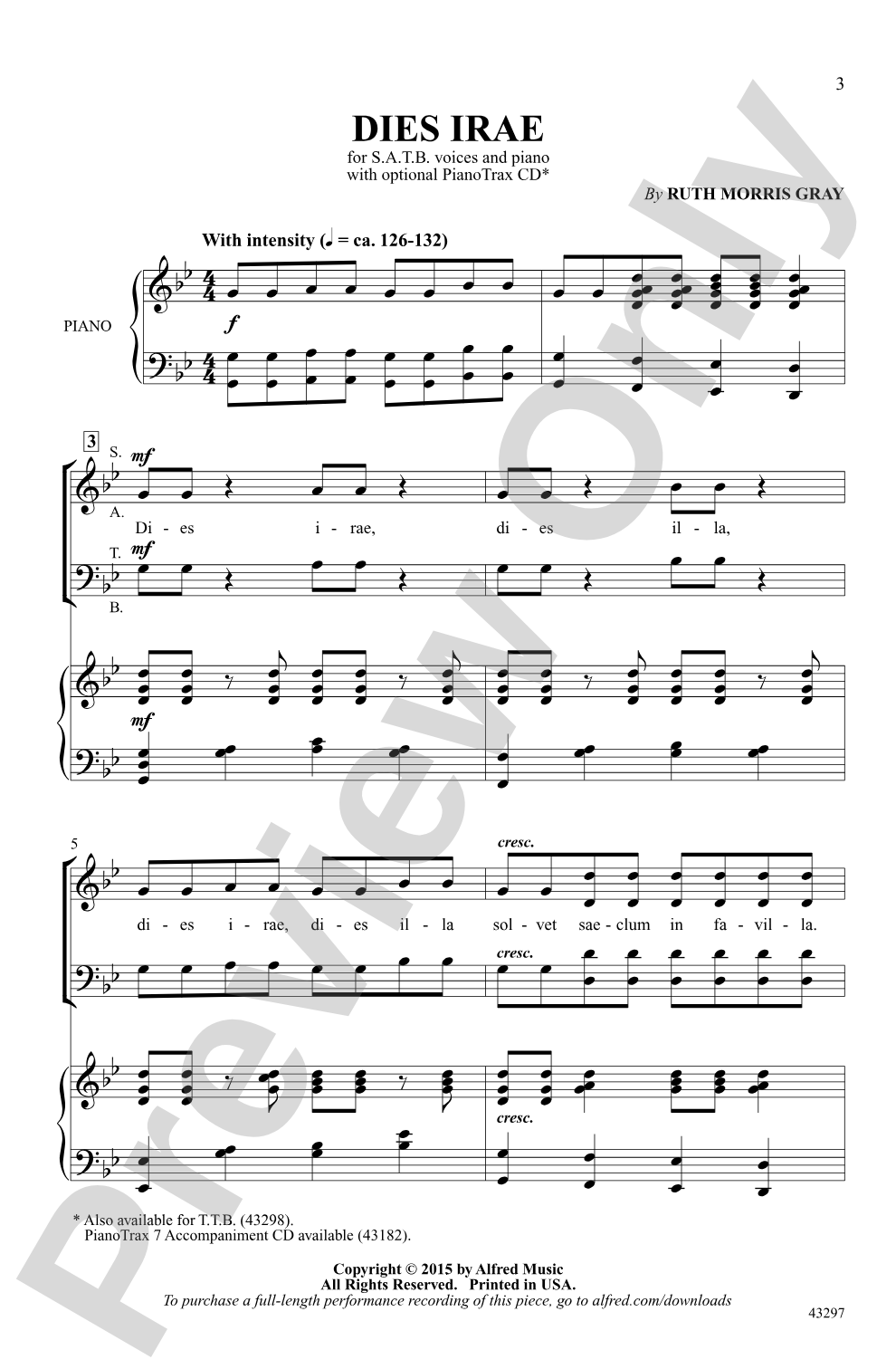
Powerful and intense! Angular phrases and percussive attacks add to the drama in this contemporary setting of the day of wrath text. A tour de force for accomplished choirs.


Don't just read it, hear it, play along with it, and watch your students grow with it. In MakeMusic Cloud, Dies Irae: SATB Choral Octavo comes alive with professional accompaniment, adjustable tempo, and built-in practice tools that turn solo practice into real progress.
Open in the Player
Jump straight in and assign it today.
Start Your Free Trial
Open this title and explore the full library in minutes.
Sample Audio
1
Audio File
--:--
0:00
0:00
Sample Video
Additional Details
Series:
Alfred Choral Designs
Publisher:
Alfred Music
Page Count:
12
SKU:
00-PO-0003263
More about this title
About the Composer: Ruth Morris Gray

Ruth Morris Gray has directed choirs at Rosemead High School in California since 2004, where she also teaches piano. Her compositional output spans more than 100 published choral works, demonstrating a sustained commitment to writing repertoire that challenges and engages singers at multiple levels.
Gray holds a Bachelor of Music in Piano Performance and Composition from Biola University, a Master of Arts in Music Composition from UC Santa Barbara, and a California Single Subject Music Credential from California State University, Northridge. Her training across performance, composition, and pedagogy informs her distinctive approach to choral writing.
Why we love this
Gray's setting cuts through sentimentality with angular, dissonant writing that makes the Dies Irae text feel genuinely urgent rather than rote. The percussive attacks and contemporary harmonic language give accomplished ensembles a vehicle for real dramatic power, making this a smart choice for choirs ready to move beyond prettier liturgical settings.
What to expect
Jagged and unrelenting, like staring at something terrible and refusing to look away. The contemporary setting strips away any Gothic comfort and replaces it with sharp angles and raw vocality that makes the text about judgment and wrath feel present and personal rather than historical.
Who it's for
Advanced high school choirs, college choirs, and community ensembles with strong music-reading skills and experience with contemporary harmonic language. This work demands singers who can sustain focus through dissonance and commit to the drama without over-interpreting.
How to get the most out of it
- Shape the angular phrases as deliberate gestures rather than smoothing them over; the awkwardness is the point and reinforces the text's intensity.
- Bring out the percussive attacks crisply and with precision, treating them as rhythmic punctuation that drives the piece forward.
- Balance clarity of ensemble sound with the dramatic intent; this isn't about blending into a wash, but about maintaining definition across all four voices even during the most intense moments.
- Prepare singers for the harmonic language by drilling sustained tones against dissonant intervals so they hear and trust the sonorities Gray is building.
How to use it
This works as a powerful centerpiece in a concert that explores different historical approaches to the Dies Irae, contrasting nicely with earlier liturgical settings. Alternatively, pair it with other contemporary sacred or secular texts to build a program around timely, unsettling themes.
Skills your students will build
- Reading and sustaining dissonant intervals with confidence
- Executing rhythmic precision and percussive articulation in complex harmonic contexts
- Maintaining ensemble cohesion through angular, non-traditional melodic phrases
- Interpreting contemporary choral writing with dramatic intensity and intentionality