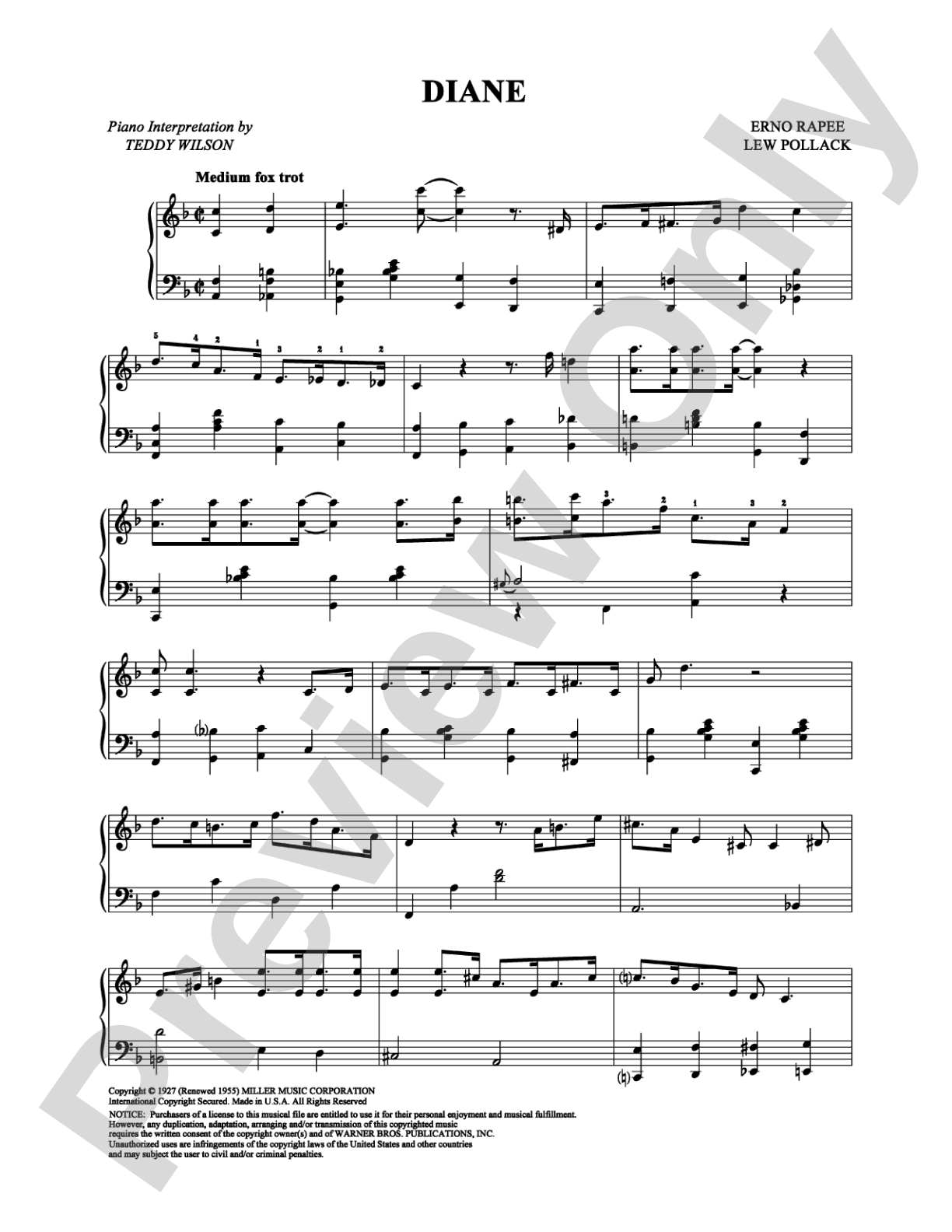
Diane: Piano Digital Sheet Music

Diane: Piano Digital Sheet Music

Lew Pollack, Teddy Wilson, Erno Rapee

Item: 00-PS-0000620

Digital Download
$3.99
Description

Diane: Piano Digital Sheet Music isn't in MakeMusic Cloud just yet...but it could be. Let us know you'd like to see it, and you'll help shape what comes next. In the meantime, start a free trial and dive into thousands of interactive titles your students can play along with today.

Sample Audio
No sample audio found.
Sample Video
Additional Details
SKU: 00-PS-0000620

More about this title

About the Artist: Teddy Wilson

Teddy Wilson (1912-1986) was a pianist and bandleader whose sophisticated touch and harmonic sensibility shaped the sound of swing jazz. He performed and recorded with some of the era's most celebrated musicians, including Benny Goodman, Duke Ellington, and Billie Holiday, and became known for his ability to accompany singers with sensitivity while maintaining strong rhythmic and harmonic control.

Wilson's piano work emphasizes clarity and taste over flash. His arrangements and solo interpretations reveal a deep understanding of harmony and song structure, making his recordings valuable models for students learning how jazz musicians approach standard material with intelligence and restraint.

Why we love this

Teddy Wilson's interpretation of "Diane" offers students a masterclass in swing comping and melodic sensibility. The performance demonstrates how a skilled pianist voices chords, manages space in the rhythm section, and phrases a melody with both lyricism and rhythmic precision, making it an excellent reference recording for understanding jazz piano practice.

What to expect

"Diane" unfolds with a warm, unhurried elegance. Wilson's touch is refined and conversational; the melody sits naturally in the hand while the harmonic foundation stays grounded and supportive. The overall feeling is one of intimate musicianship, where every note counts and space matters as much as sound.

Who it's for

Jazz pianists working on swing repertoire, intermediate and advanced students studying jazz comping and song interpretation, and anyone looking to understand how a master pianist approaches standards with taste and harmonic sophistication. This recording serves equally well as a practice reference or a model for performance and stylistic development.

How to get the most out of it

  • Listen closely to how Wilson voices his chords and uses inner-voice movement rather than dense block harmonies; this restraint and sophistication should inform your own voicing choices.
  • Pay attention to the swing feel and how Wilson pushes and pulls the rhythm subtly against the pulse; avoid playing metronomically straight eighth notes.
  • Study the balance between Wilson's left hand accompaniment and right hand melody; the supporting harmony should never overpower the tune.
  • Notice how silence and space function in the arrangement; Wilson's economy of notes creates impact and lets the song breathe.

How to use it

Use this recording as a reference when teaching jazz standards or swing-era repertoire in private lessons or jazz ensembles. It pairs well with transcription exercises that focus on voicing and comping vocabulary. Students can also study the recording alongside lead sheets to understand how a seasoned musician interprets a song beyond the printed notation.

Skills your students will build

  • Swing rhythm and phrasing (pushing and pulling against the beat)
  • Jazz chord voicing and substitution
  • Balancing accompaniment and melody
  • Listening to and transcribing jazz piano comping
  • Song interpretation and harmonic development

You May Also Like