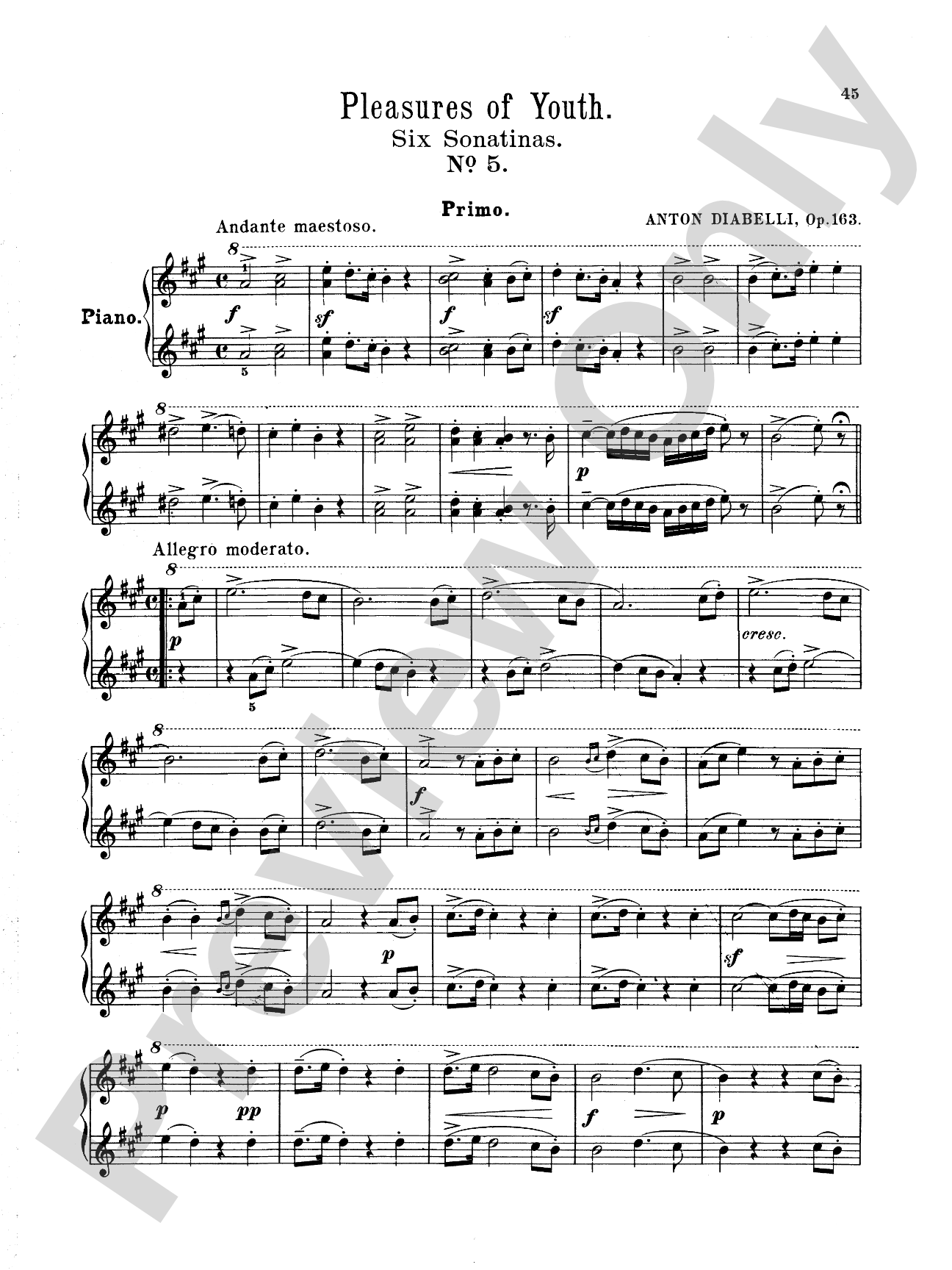
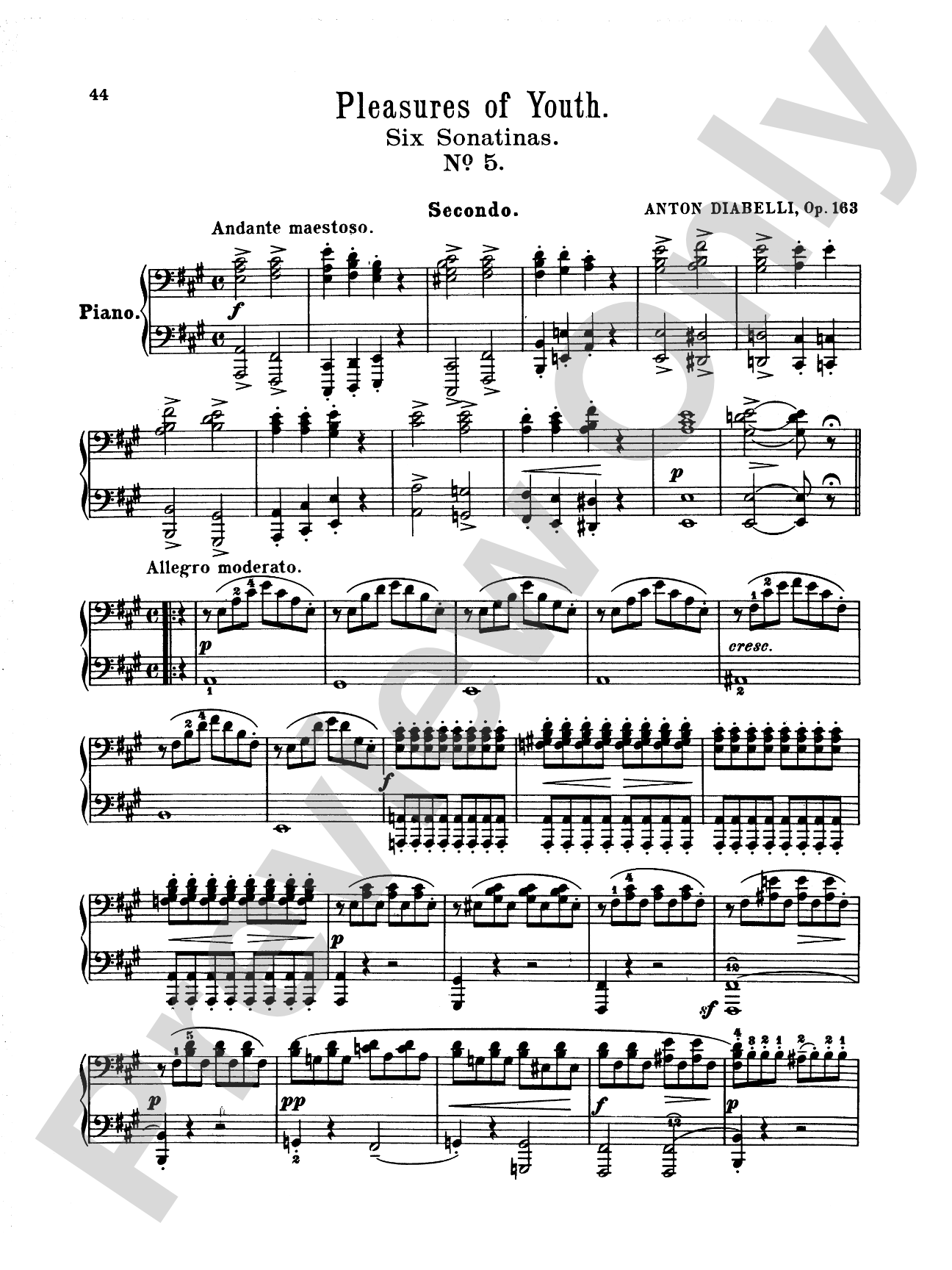
Diabelli: Pleasures of Youth (Six Sonatinas on Five Notes) Sheet Music Preview

Diabelli: Pleasures of Youth (Six Sonatinas on Five Notes)

Six Sonatinas on Five Notes, Op. 163

By Anton Diabelli

Level: Intermediate / Advanced

Item: 00-PC-0006976

Digital Download
$1.99
Description
Expertly arranged Piano Sonatinas by Anton Diabelli from the Kalmus Edition series. These Intermediate / Advanced Sonatinas are from the Classical and Romantic eras.

Don't just read it, hear it, play along with it, and watch your students grow with it. In MakeMusic Cloud, Diabelli: Pleasures of Youth (Six Sonatinas on Five Notes) comes alive with professional accompaniment, adjustable tempo, and built-in practice tools that turn solo practice into real progress.

Sample Audio
No sample audio found.
Sample Video
Additional Details
Series: Kalmus Edition
Publisher: Alfred Music
Page Count: 64
SKU: 00-PC-0006976

More about this title

About the Composer: Anton Diabelli

Anton Diabelli (1781-1858) was an Austrian composer and music publisher whose prolific output shaped pedagogical piano literature for generations. Though often remembered for his role in publishing Beethoven's monumental 33 Variations on a Waltz by Diabelli, he was himself a serious craftsman of accessible yet musically substantive works for developing pianists. His sonatinas balance technical clarity with genuine compositional invention, making them staples of intermediate repertoire.

Why we love this

Diabelli's sonatinas for four hands offer that rare combination of clarity and musical substance that keeps students engaged while building real competencies. The duet format demands listening and coordination between partners without requiring advanced technique, making these pieces rewarding for both confident intermediates and advancing students who need to develop ensemble awareness.

What to expect

These sonatinas evoke the clarity and elegance of the Classical style while incorporating the harmonic richness and expressive warmth that defines the Romantic transition. The constraint of five notes per hand creates inventive writing that sounds effortless once learned, offering genuine musical satisfaction without overwrought difficulty.

Who it's for

Intermediate to advanced piano students ready to explore duet playing with substantial four-hand repertoire. Teachers seeking Romantic-era sonatinas that challenge coordination and listening without demanding virtuosic technique will find these pieces ideal for recital preparation or collaborative study.

How to get the most out of it

  • Balance the primo and secondo parts by listening across the keyboard; the secondo grounds harmonic support while the primo carries melody, so resist the urge to force the higher part into dominance.
  • Establish a steady pulse before adding expressive shaping; these Classical-era works benefit from secure timing that supports both players' independence.
  • Work the hand crossings and register shifts separately at first, then integrate them into the full tempo to avoid hesitation in performance.

How to use it

Feature these as duet showcase pieces in student recitals, or use them in a masterclass setting to develop ensemble communication. They also work well alongside other intermediate Classical sonatinas when building a unit on form and development within an intermediate curriculum.

Skills your students will build

  • Coordinating independent hand parts and rhythmic ensemble between two players
  • Reading and executing Classical period phrasing and articulation conventions
  • Managing hand crossings and register shifts in four-hand writing
  • Developing harmonic awareness through supporting and leading voice interaction

You May Also Like