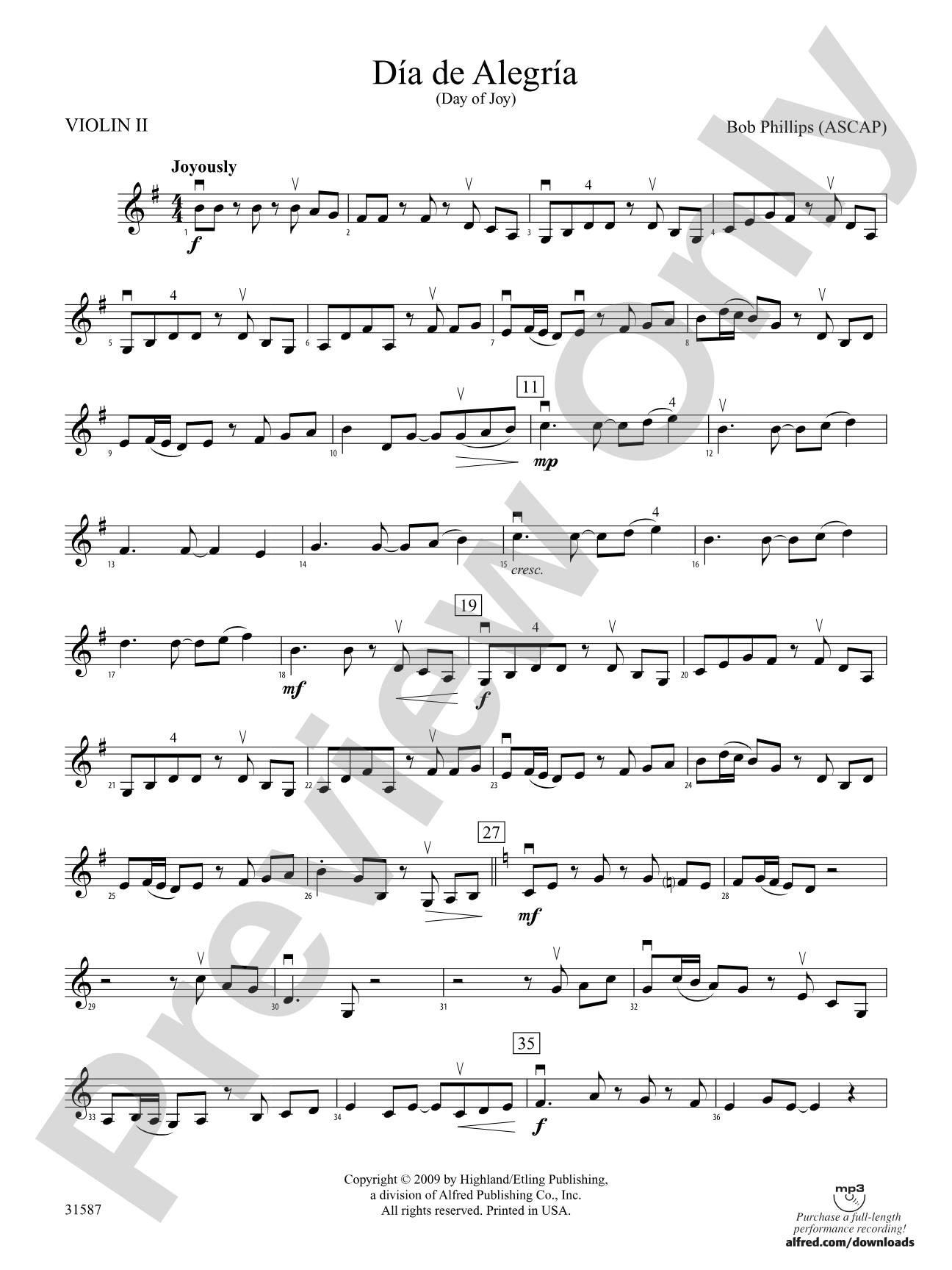
Día de Alegría (Day of Joy): 2nd Violin Sheet Music Preview

Día de Alegría (Day of Joy): 2nd Violin

By Bob Phillips

Grade: 2.5

Item: 00-PC-0001754_VN2

Digital Download
$5.99
Description
Revel in the celebration of life and new beginnings! While evoking a Latin feeling, this piece crosses all boundaries with the high-energy boundless joy found in all sections. In the key of G Major, all in first position, Día de Alegría is highly playable and comes together quickly. Students will ask to play this one again and again. This title is available in MakeMusic Cloud.

Don't just read it, hear it, play along with it, and watch your students grow with it. In MakeMusic Cloud, Día de Alegría (Day of Joy): 2nd Violin comes alive with professional accompaniment, adjustable tempo, and built-in practice tools that turn solo practice into real progress.

Sample Audio
0:00
0:00
Sample Video
Additional Details
Series: Highland/Etling String Orchestra
Publisher: Alfred Music
Page Count: 124
SKU: 00-PC-0001754_VN2

More about this title

About the Composer: Bob Phillips

Bob Phillips

Bob Phillips (b. 1953) has shaped string education through decades of innovative teaching, conducting, and composing. A former director of the Saline Fiddlers Philharmonic and builder of a 700-student string program in Michigan, Phillips authored the foundational Sound Innovations series across all six levels and created the genre-crossing Philharmonic collections (Jazz, Rock, Mariachi, Latin, and Fiddle). His published works number over 200 across orchestras and bands, and he has conducted at regional and national honors ensembles from Michigan to California, serving for 12 years as resident conductor and arranger for Wintergrass in Seattle.

An award-winning ASCAP composer whose pieces are performed by thousands of students annually, Phillips demonstrates a distinctive ability to blend classical technique with eclectic musical styles. His instructional DVDs and clinics have reached educators nationwide, establishing him as both a leading voice in string pedagogy and a practical composer who writes with classroom realities in mind.

Why we love this

Phillips crafts a piece that arrives fully formed at Grade 2.5. The Latin idiom sits naturally under student fingers in first position with G Major as home base, yet the compositional voice feels genuine and energetic rather than watered down. Directors report that ensembles genuinely request repeats, which rarely happens at this level.

What to expect

Warmth, motion, and uncomplicated joy. The piece radiates optimism through bright string textures and rhythmic vitality without requiring technical heroics. From the first rehearsal, students feel the forward momentum and the genuine celebration woven into the score.

Who it's for

Conductors of young string ensembles (roughly three to five years of study) who need a concert piece that teaches musicianship while celebrating what students can actually accomplish. This works equally well for contest settings and concert programs where you want genuine applause and visible student enthusiasm.

How to get the most out of it

  • Keep the rhythmic pulse steady and bright without rushing; Latin grooves lose their character when accelerated under pressure.
  • Balance the melody between sections so that the joy comes through clearly rather than getting buried in harmonic support.
  • Experiment with vibrato sparingly in the opening sections to let the youth and freshness of the writing breathe.
  • Use full bows on longer notes to sustain the celebratory energy across phrase endings.

How to use it

Program this as a opener or midconcert brightener alongside classical standards to demonstrate your ensemble's stylistic range. It pairs well with more lyrical pieces, offering visual and sonic contrast while remaining accessible enough to learn quickly before a performance season.

Skills your students will build

  • Rhythmic precision in Latin-influenced patterns and syncopations
  • First-position intonation in a tonally clear context (G Major)
  • Ensemble balance between melody and harmonic accompaniment
  • Stylistic interpretation beyond the classical repertoire
  • Sustained focus during a mid-length concert work (124 pages of score material)

You May Also Like