
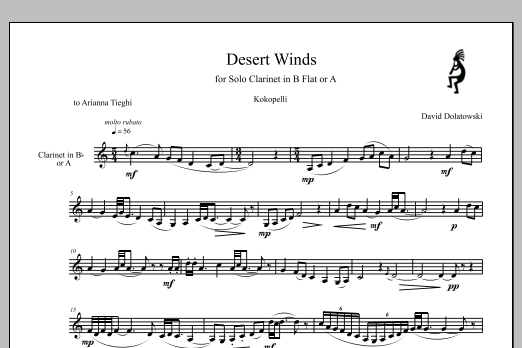

Desert Winds for Clarinet in B-flat or A
Arranged by David Dolatowski
Item: 35-PK00269677
$2.30
Pickup currently not available
Buy Extra Parts (Digital PDF Download)
| Product | Price | Quantity |
|---|---|---|
| Desert Winds for Clarinet in B-flat or A - Full Score | $2.15 | |
| Desert Winds for Clarinet in B-flat or A - Full Score | $2.15 |
Parts Added to Cart!
Description
Desert Winds, for solo clarinet, was composed in 2012 for Italian clarinetist,
Arianna Tieghi, and may be performed on the B Flat, or A instrument. The work is in two movements, representing the American Desert Southwest.
Kokopelli, the title of the first movement, is named after the legend of a mythical spirit creature known to many Native Americans in the Southwest region of the United States. In this movement, the clarinet imitates the sound and style of the Native American flute. Only the five tones (plus octaves) of the native flute are used, producing a pentatonic minor tonality. The 5/4 meter, along with the "molto rubato" tempo marking creates the impression that this piece is improvised.
Gecko, the title of the second movement, is named after a lizard type creature common the to American Desert Southwest. Duration: 05:00


Desert Winds for Clarinet in B-flat or A isn't in MakeMusic Cloud just yet...but it could be. Let us know you'd like to see it, and you'll help shape what comes next. In the meantime, start a free trial and dive into thousands of interactive titles your students can play along with today.
Request This Title
Tell us you want it.
Start Your Free Trial
Explore everything that's ready to play right now.
Sample Audio
No sample audio found.
Sample Video
No sample videos found.
Additional Details
Publisher:
Hal Leonard
SKU:
35-PK00269677
More about this title
Why we love this
Dolatowski's writing respects the clarinet's lyrical voice while demanding genuine musicianship. The pentatonic constraint in the first movement forces students to listen more critically to phrasing and breath placement rather than relying on harmonic context, and the 5/4 meter paired with rubato creates rhythmic challenges that develop real ensemble awareness when performed with accompaniment.
What to expect
The first movement evokes the dry, open landscape of the American Southwest through spare melodic gestures and a floating sense of time. The second movement likely offers contrasting character and energy, though the program notes focus primarily on the opening section's mystical, wandering quality.
Who it's for
Advanced high school clarinetists and college students seeking solo repertoire that combines contemporary compositional techniques with cultural narrative. This work rewards players who can balance technical control with expressive interpretation.
How to get the most out of it
- Treat the Kokopelli movement as pure storytelling. The five-note palette is your constraint, not your limitation; focus on dynamic shaping and rubato to create narrative arc within those tones.
- Practice the 5/4 meter against a steady pulse first, then gradually introduce the rubato. This prevents the improvised feel from becoming sloppy.
- Research the Native American flute's actual timbre and articulation patterns. Your sound choices in movement one should reflect that inspiration, not just the pitch set.
How to use it
Feature this as a recital centerpiece or chamber concert solo that introduces audiences to contemporary clarinet writing informed by cultural sources. Its five-minute duration makes it ideal for a mixed program balancing classical and modern works, and the two-movement structure gives you programming flexibility.
Skills your students will build
- Performing in 5/4 meter with expressive rubato
- Phrasing within a restricted pitch set (pentatonic minor)
- Imitating non-Western instrumental timbres and articulation
- Building narrative arc through dynamic and tonal control rather than harmonic movement
- Reading and interpreting molto rubato notation