
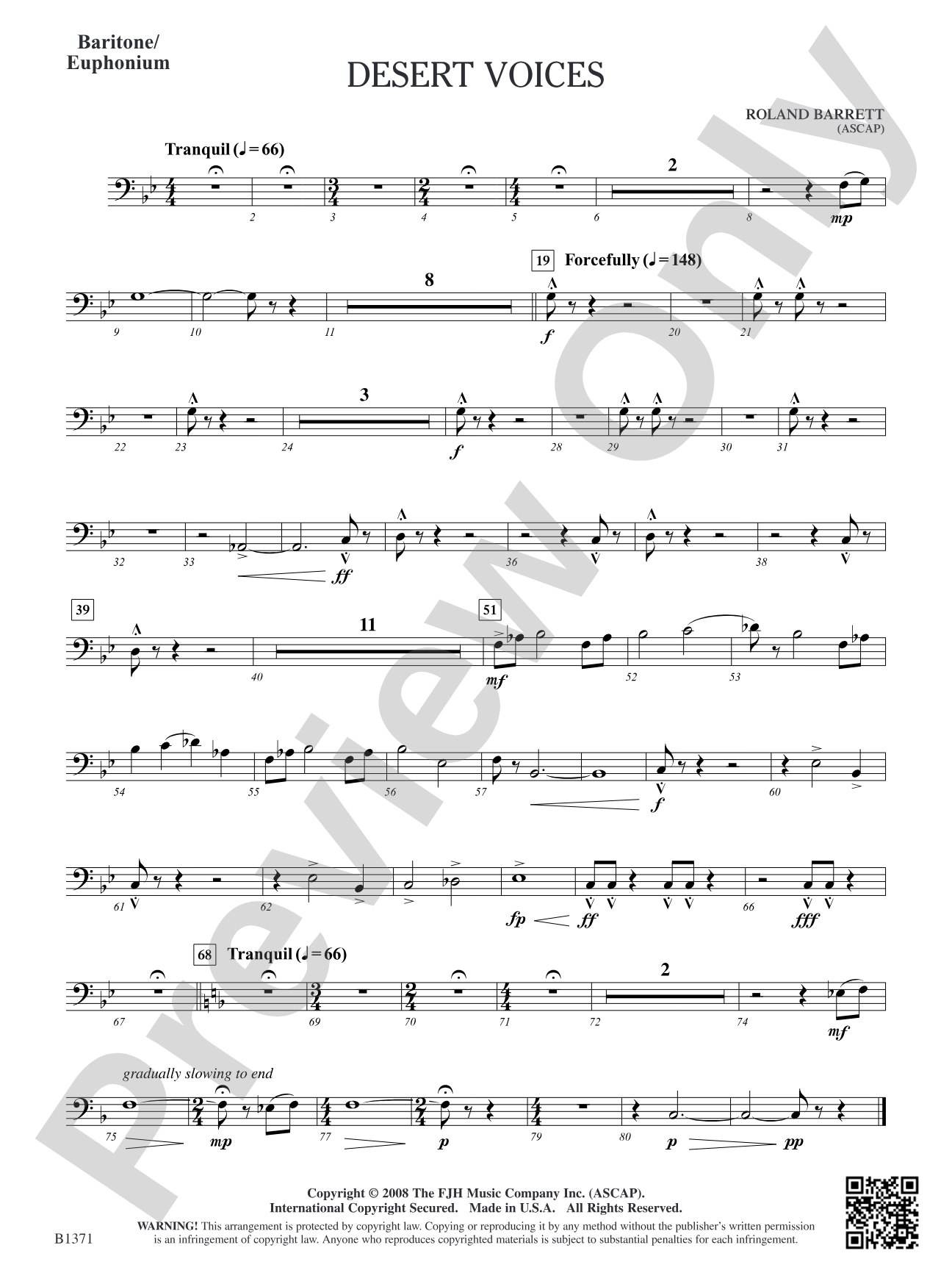

Desert Voices: Baritone/Euphonium
By Roland Barrett
Grade: 2.5
Item: 98-PC-DB1371_BBC1
$7.00
Pickup currently not available
Description
Depicting life in the desert, this captivating work begins with the haunting sounds of a baron desert as relentless heat hits it by day. At night, exotic plants and animals spring to life, portrayed with rhythmic vitality and bold musical statements. The work ends as softly as it began, with the relentless sun once again beating down on the parched desert. Intense and captivating!


Desert Voices: Baritone/Euphonium isn't in MakeMusic Cloud just yet...but it could be. Let us know you'd like to see it, and you'll help shape what comes next. In the meantime, start a free trial and dive into thousands of interactive titles your students can play along with today.
Request This Title
Tell us you want it.
Start Your Free Trial
Explore everything that's ready to play right now.
Sample Audio
1
Audio File
--:--
0:00
0:00
Sample Video
No sample videos found.
Additional Details
Series:
FJH Young Band
Publisher:
The FJH Music Company, Inc.
SKU:
98-PC-DB1371_BBC1
More about this title
About the Composer: Roland Barrett

Roland Barrett has been on the faculty at the University of Oklahoma since 2001, where he teaches music theory and composition with a concentration on twentieth-century topics. Before joining the university, he spent fifteen years as Assistant Director of Bands, a background that shapes his deep understanding of ensemble writing and pedagogy. He continues as the musical arranger for the Pride of Oklahoma marching band.
Barrett's catalog includes over two hundred published works and arrangements for symphonic band, chamber ensembles, and marching band. His compositions have been performed by the Dallas Wind Symphony and by countless All-State and All-Region honor bands, and his music has appeared on NPR and at major conventions including the Midwest Band & Orchestra Convention and the International Trumpet Guild. He is a multiple recipient of the ASCAP Plus award.
Why we love this
Barrett captures the full dramatic arc of desert life with vivid orchestration and structural clarity that keeps a Grade 2.5 ensemble engaged throughout. The piece moves confidently between evocative landscape painting and rhythmic energy, giving young musicians genuinely expressive material to sink their teeth into without overwhelming them technically. This is the kind of programmatic work that reminds students why they love playing in band.
What to expect
The desert unfolds in three acts: scorching stillness at dawn, a burst of life and motion under the stars, and a return to that merciless quiet. The music breathes with both desolation and vitality, using rhythm and orchestration to paint a landscape that shifts from stark to animate to serene. You hear the relentless geometry of heat and the exotic dance of nocturnal creatures, all contained in one cohesive musical statement.
Who it's for
This work fits well in the repertoire of emerging concert bands working at the Grade 2.5 level who want material with real musical substance. It suits directors who program around a theme or seek pieces that develop students' ability to shape long-form narratives. The contest/festival designation makes it especially valuable for bands preparing for competitive events.
How to get the most out of it
- Shape the opening desert imagery with a lean, exposed sound; resist the urge to swell too quickly and let the heat simmer rather than blaze.
- Anchor the rhythmic vitality of the middle section with a steady conductor pulse; the ensemble will respond to your clarity, not your energy.
- Balance the ensemble during the nighttime section so that thematic material passes between voices without getting buried; the bold statements need contrast to land.
- Return to the opening character for the closing pages; mirror the soft dynamic and sparse texture of the beginning to create architectural satisfaction.
How to use it
This piece works beautifully as a contest selection, where its structural clarity and programmatic appeal engage both judges and audiences. It also pairs well in a concert devoted to descriptive or landscape-inspired music, or as a centerpiece that shows your band's range from soft, controlled playing to energetic, rhythmically sophisticated passages. Save it for mid-year or spring when your ensemble has developed the maturity to sustain its narrative arc.
Skills your students will build
- Dynamic control and sustained soft playing in exposed writing
- Rhythmic precision and coordination during syncopated passages
- Ensemble balance across changing orchestrations and textures
- Shaping musical phrases to support programmatic intent
- Responding to conductor direction for tempo and expressive nuance