
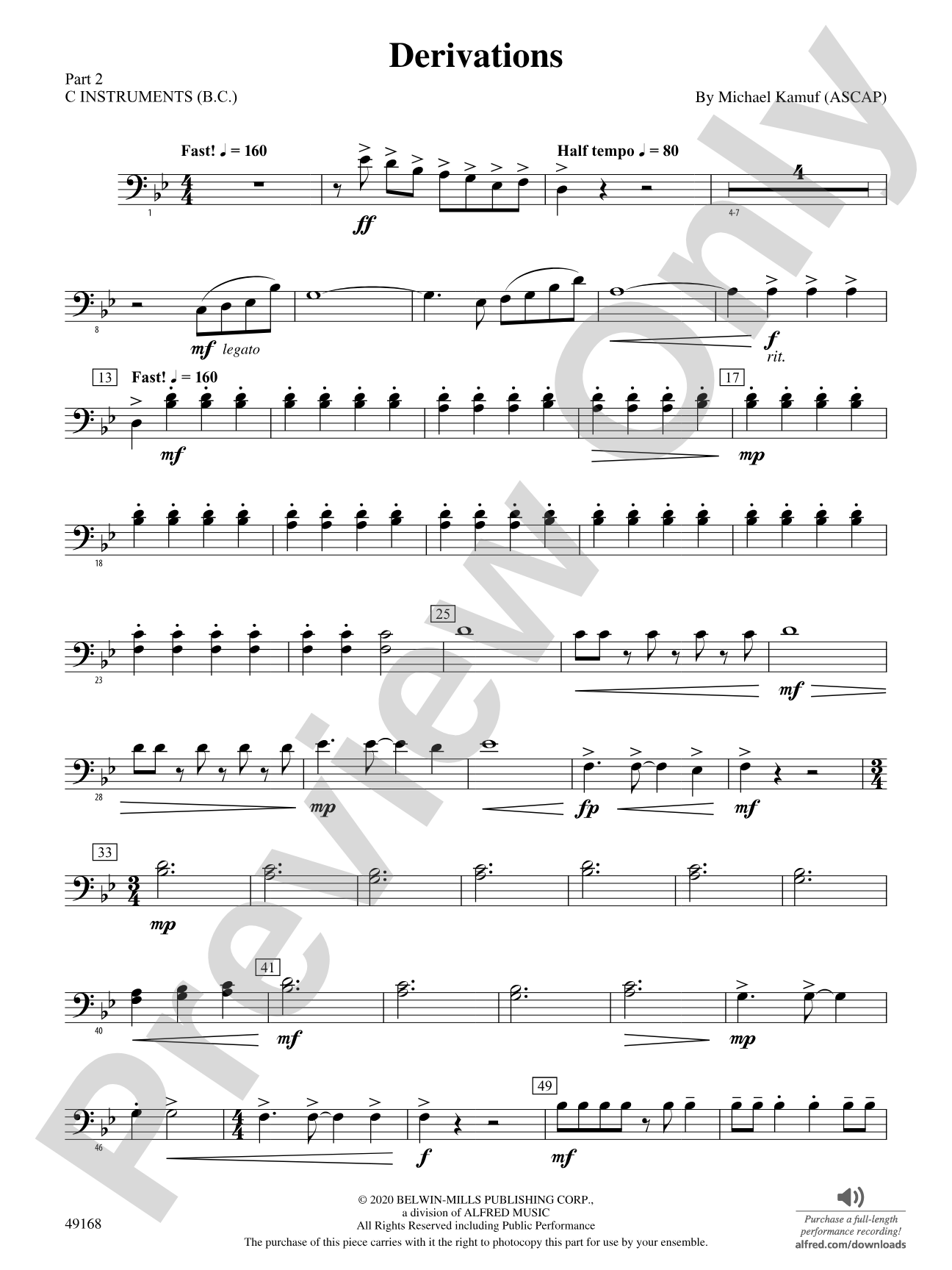

Derivations: Part 2 - C Instruments (B.C.)
By Michael Kamuf
Grade: 2 (Easy)
Item: 00-PC-0018501_PART2_CBC
$3.00
Pickup currently not available
Description
This version of Derivations by Michael Kamuf is part of our Belwin FLEX offerings and is designed with maximum flexibility for use by any mix of instruments---wind, strings, and percussion, including like- or mixed-ensembles with as few as 5 players. The suggested instrumentation and a customizable Teacher Map will help you plan out how to best assign parts to suit your ensemble's needs. It also comes with supplemental parts for maximum flexibility. With the purchase of this piece, permission is granted to photocopy the parts as needed for your ensemble. A percussion accompaniment track is also available as a free download. String parts have been carefully edited with extra fingerings and appropriate bowings to support students in mixed ensembles playing in less familiar keys.
After a mysterious introduction, Kamuf's original work takes off with contrasting themes in both 4/4 and 3/4. Bold melodies, contemporary harmonies, and driving percussion combine to create a perfect opening or closing selection for your next concert or festival performance. Relentless! (3:00)
Percussion Accompaniment Track Downloads:
with click
without click.
This title is available in MakeMusic Cloud.


After a mysterious introduction, Kamuf's original work takes off with contrasting themes in both 4/4 and 3/4. Bold melodies, contemporary harmonies, and driving percussion combine to create a perfect opening or closing selection for your next concert or festival performance. Relentless! (3:00)
Percussion Accompaniment Track Downloads:
with click
without click.
This title is available in MakeMusic Cloud.
Don't just read it, hear it, play along with it, and watch your students grow with it. In MakeMusic Cloud, Derivations: Part 2 - C Instruments (B.C.) comes alive with professional accompaniment, adjustable tempo, and built-in practice tools that turn solo practice into real progress.
Open in the Player
Jump straight in and assign it today.
Start Your Free Trial
Open this title and explore the full library in minutes.
Sample Audio
1
Audio File
--:--
0:00
0:00
Sample Video
No sample videos found.
Additional Details
Series:
Belwin Young Band
Publisher:
Alfred Music
Page Count:
170
SKU:
00-PC-0018501_PART2_CBC
More about this title
About the Composer: Michael Kamuf

Michael Kamuf earned Bachelor of Music degrees in Jazz Performance and Music Education from the Dana School of Music at Youngstown State University, followed by a Master of Arts in Instrumental Conducting from George Mason University. His compositions and arrangements have been performed by prestigious ensembles including the Woody Herman and Glenn Miller Orchestras, the USAF Airmen of Note, and the US Navy Commodores, as well as by noted soloists such as James Moody, Eddie Daniels, and Sean Jones.
Kamuf taught instrumental music in Montgomery County Public Schools for thirty years, serving for twenty-seven of those years as Director of Bands and Orchestras at John T. Baker Middle School in Damascus, Maryland, where he built consistently award-winning ensembles and fostered commissions for young concert bands. He is an exclusive composer and arranger for the Belwin Division of Alfred Music Publishing, with additional publications through UNC Jazz Press, Neil A. Kjos Music, and FJH Music Company. With over 100 titles in print, many of his jazz ensemble arrangements have become standard repertoire for young ensembles. Kamuf currently leads the Mike Kamuf Little Big Band in the Baltimore and Washington, DC region.
Why we love this
Derivations gives mixed ensembles genuine musicianship without compromising on arrangement quality. The Teacher Map and supplemental parts mean you spend rehearsal time on musicality, not logistics; the flexible scoring handles instrumentation mismatch gracefully while the string parts include fingerings and bowings that acknowledge students playing outside their usual key centers. This is concert-ready material that sounds polished because Kamuf writes with real knowledge of what young players need.
What to expect
Derivations opens in shadow and intrigue before exploding into bright, driving energy. Contemporary harmonic language gives it sophistication while the rhythmic vitality and contrasting sections keep players engaged; it feels modern and purposeful, never generic.
Who it's for
Directors of mixed ensembles, community bands with fluid instrumentation, and middle school programs where students play different instruments or where orchestral and band students rehearse together. This piece shines in settings where you have flexibility but not unlimited choice in who plays what.
How to get the most out of it
- Balance the mysterious introduction by keeping the ensemble tightly unified; use the click track during early rehearsals to establish the atmospheric opening before building into the contrasting themes.
- Attend to the meter changes (4/4 and 3/4) as compositional features, not obstacles; mark them clearly in parts and rehearse transitions without stopping so students hear them as intentional shifts.
- Let the percussion drive the energy during the relentless sections; lock your wind and string sections to that pulse rather than pulling tempo back.
- Shape the bold melodies with clear phrase direction rather than metronomic playing; even at Grade 2 level, these lines reward musical breathing and dynamic shaping.
How to use it
Program it as an opening number to set an energetic tone for your concert, or use it as a closing piece that sends audiences out on a high note. Its three-minute length and flexible instrumentation also make it an ideal choice for regional festivals and adjudicated events where ensemble size or composition may shift between performances.
Skills your students will build
- Reading and performing in contrasting meters (4/4 and 3/4)
- Playing in less familiar key signatures with support from edited fingerings and bowings
- Balancing melodic and accompaniment roles within a mixed instrumentation
- Maintaining rhythmic precision and ensemble unity during energetic, percussion-driven passages
- Interpreting contemporary harmonic language and its effect on phrase shaping