
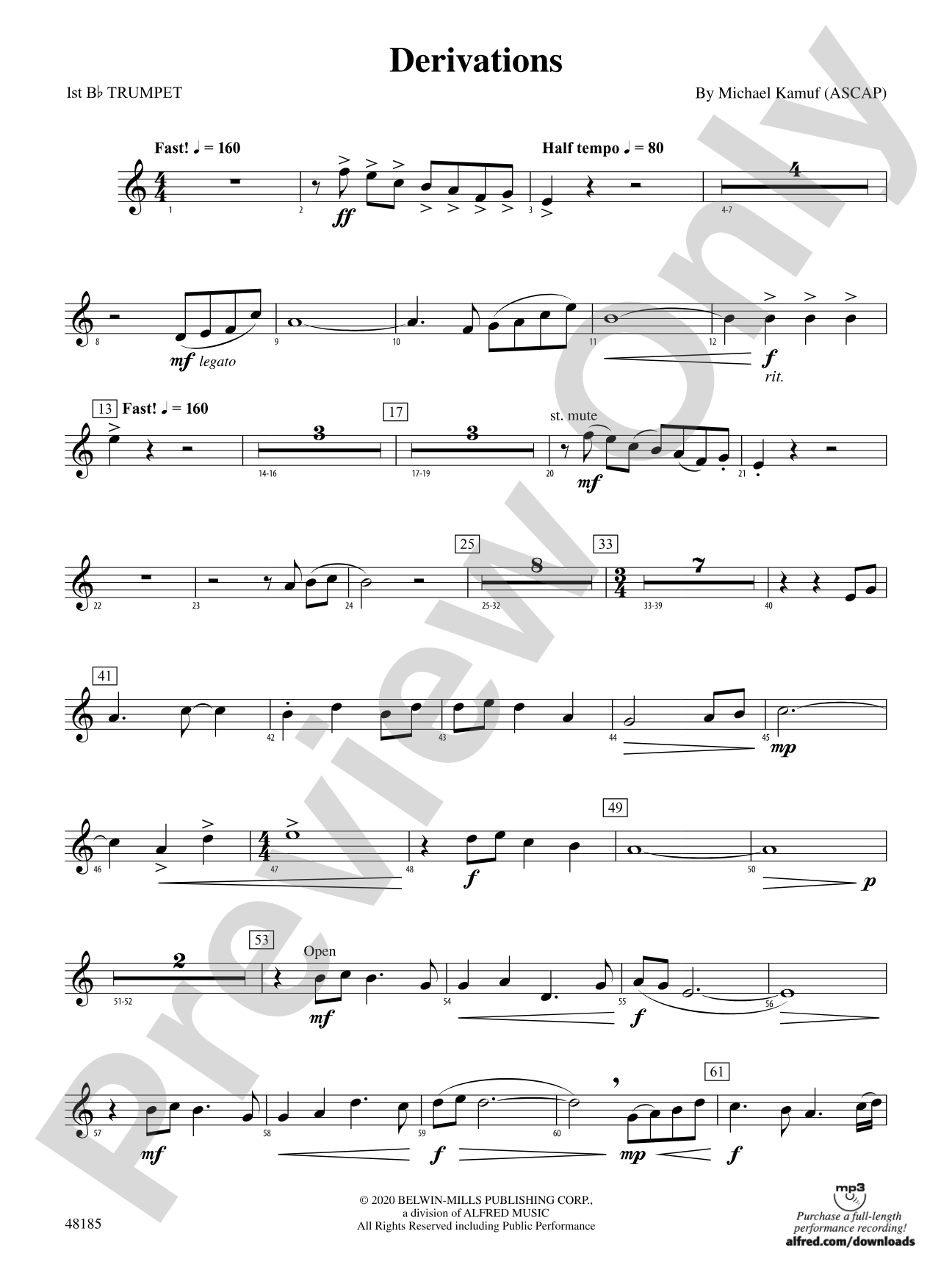

Derivations: 1st B-flat Trumpet
By Michael Kamuf
Grade: 2 (Medium Easy)
Item: 00-PC-0018554_T1
$3.00
Pickup currently not available
Description
After a mysterious introduction, this original work takes off with contrasting themes in both 4/4 and 3/4. Bold melodies, contemporary harmonies, and driving percussion combine to create a perfect opening or closing selection for your next concert or festival performance. Relentless! (3:00) This title is available in MakeMusic Cloud.


Don't just read it, hear it, play along with it, and watch your students grow with it. In MakeMusic Cloud, Derivations: 1st B-flat Trumpet comes alive with professional accompaniment, adjustable tempo, and built-in practice tools that turn solo practice into real progress.
Open in the Player
Jump straight in and assign it today.
Start Your Free Trial
Open this title and explore the full library in minutes.
Sample Audio
1
Audio File
--:--
0:00
0:00
Sample Video
Additional Details
Series:
Belwin Young Band
Publisher:
Alfred Music
Page Count:
264
SKU:
00-PC-0018554_T1
More about this title
About the Composer: Michael Kamuf

Michael Kamuf earned degrees in Jazz Performance and Music Education from Youngstown State University's Dana School of Music, followed by a Master of Arts in Instrumental Conducting from George Mason University. His compositions and arrangements have been performed by major ensembles including the Woody Herman and Glenn Miller Orchestras, the USAF Airmen of Note, and soloists such as James Moody, Eddie Daniels, and Sean Jones. Over 100 of his works are currently in print across jazz, orchestra, and concert band catalogs.
Kamuf spent thirty years teaching instrumental music in Montgomery County, Maryland Public Schools, where he served as Director of Bands and Orchestras and Music Department Chairperson at John T. Baker Middle School for twenty-seven of those years. Under his leadership, the Baker ensembles earned consistent festival recognition and commissioned multiple works for young concert bands. He is an exclusive writer for the Belwin Division of Alfred Music and leads the Mike Kamuf Little Big Band in the Baltimore and Washington, DC region.
Why we love this
Kamuf's gift for accessible yet engaging writing shines here. The piece opens with genuine intrigue before launching into material that feels energetic without demanding technical virtuosity from Grade 2 players, making it an ideal vehicle for building ensemble confidence while delivering real concert impact.
What to expect
Derivations launches with an intriguing moment of mystery before exploding into kinetic forward motion. The interplay between contrasting meters and bold melodic lines, buoyed by insistent percussion, creates a contemporary sound that feels fresh without losing sight of accessibility.
Who it's for
Concert bands at the Grade 2 level who want to program something with genuine contemporary energy and structural sophistication. It works equally well for groups seeking a strong opening piece that grabs attention or a closing selection that leaves audiences energized.
How to get the most out of it
- Balance the mysterious introduction to set up the dramatic shift into the driving themes that follow; the contrast between these sections makes both more effective.
- Lock in the rhythm section early. The percussion drive is essential to the piece's forward momentum, so establish those grooves before layering in the melodic material.
- Emphasize the contrasts between 4/4 and 3/4 sections without exaggerating tempo changes. These shifts should feel natural within the overall arc.
- Allow the bold melodies to sing through the ensemble; resist over-balancing the contemporary harmonies that support them.
How to use it
Program this as your concert opener to establish energy and capture immediate engagement, or place it near the end of a set where its relentless drive leaves a vivid final impression. It pairs well alongside both traditional and contemporary repertoire, functioning as a strong anchor for a mixed program.
Skills your students will build
- Reading mixed meters (4/4 and 3/4) within a single work
- Balancing contemporary harmonies while maintaining clear melodic line
- Rhythmic precision and ensemble cohesion in driving, percussion-led textures
- Dynamic control and contrast between distinct musical sections