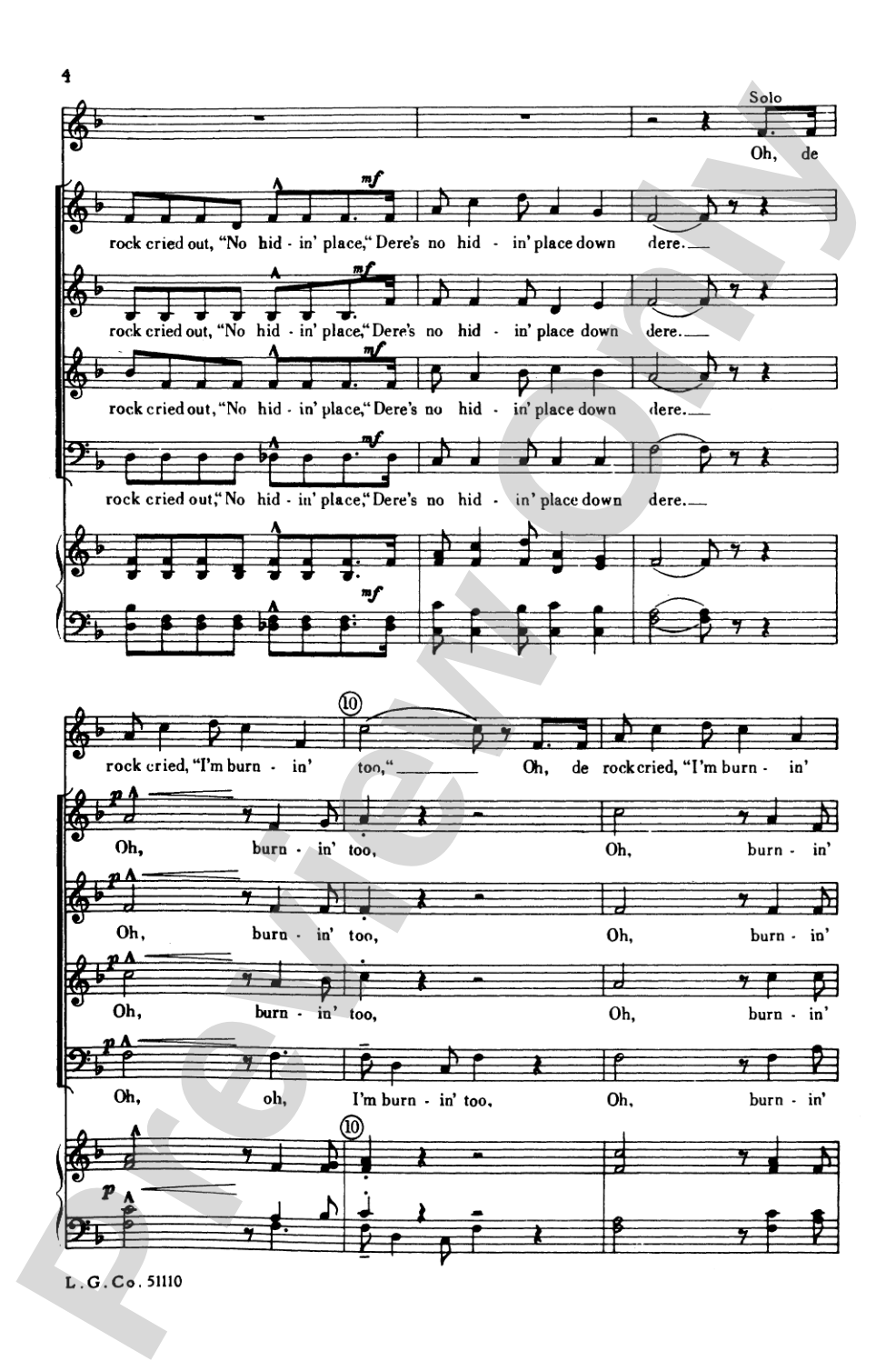
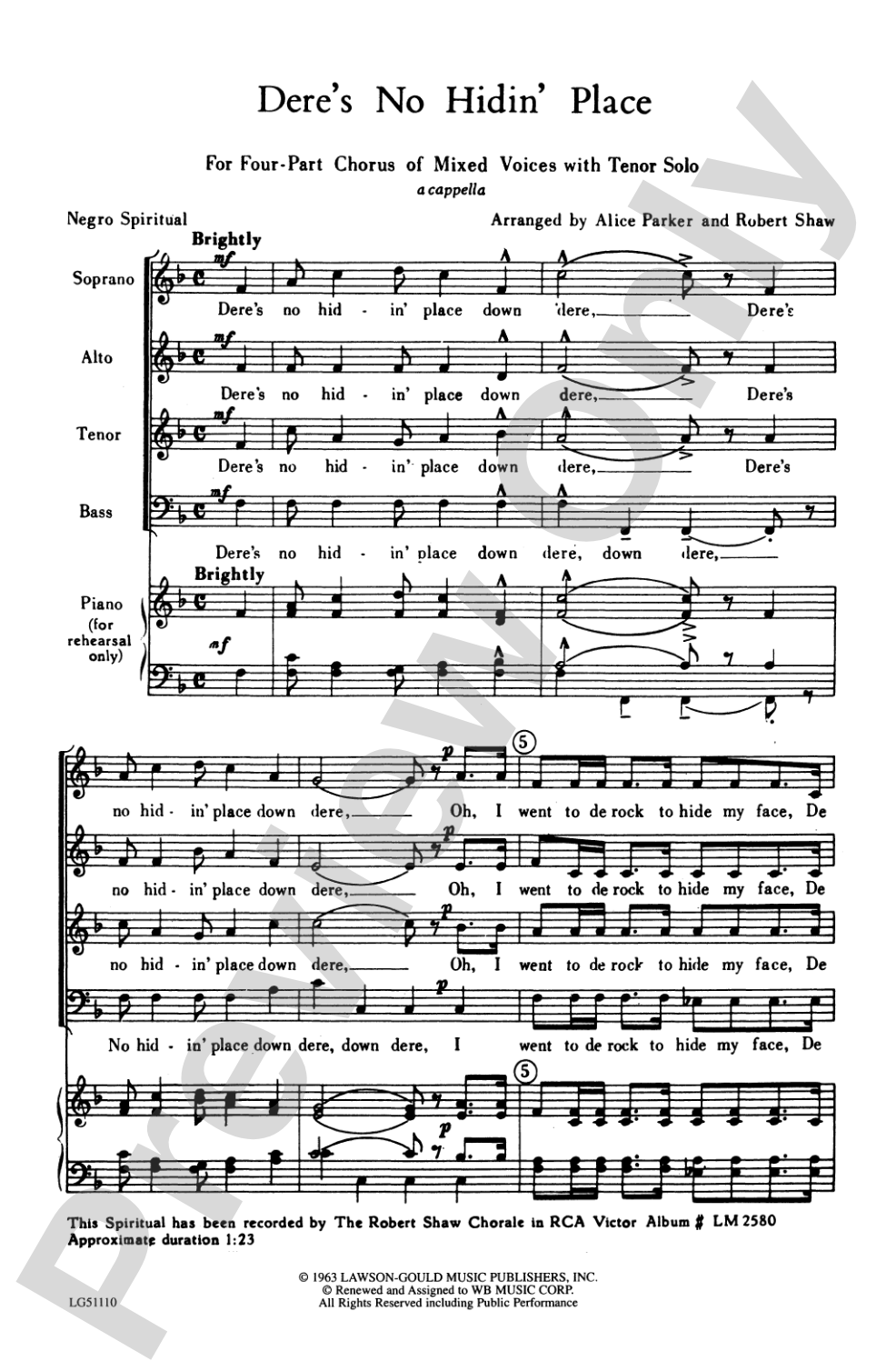
Dere's No Hidin' Place Sheet Music Preview

Dere's No Hidin' Place: SATB, a cappella Choral Octavo

Arr. Robert Shaw and Alice Parker

Item: 00-PO-0002650

Digital Download
$2.25

Minimum order quantity: 20 copies

Description

Dere's No Hidin' Place: SATB, a cappella Choral Octavo isn't in MakeMusic Cloud just yet...but it could be. Let us know you'd like to see it, and you'll help shape what comes next. In the meantime, start a free trial and dive into thousands of interactive titles your students can play along with today.

Sample Audio
No sample audio found.
Sample Video
Additional Details
Series: Alfred Archive Edition: Lawson-Gould Music Publishers
Publisher: Alfred Music
Page Count: 12
SKU: 00-PO-0002650

More about this title

About the Arranger: Robert Shaw

Robert Shaw (1916-1999) was a visionary choral conductor and arranger whose interpretations of American spirituals set the standard for generations of choirs. His meticulous approach to voicing and his deep respect for the spiritual tradition shaped how this music is sung and understood in concert settings today. Shaw's arrangements balance scholarly precision with emotional authenticity, making the spiritual repertoire accessible to choirs of varying sizes and experience levels.

Why we love this

Shaw's arrangement honors the spiritual's harmonic language while crafting independent lines that keep all four voices engaged. The a cappella setting strips away accompaniment and demands genuine blend and intonation from your ensemble, making this a cornerstone piece for developing vocal maturity. At 12 pages, it's substantial enough to reward rehearsal time without becoming unwieldy.

What to expect

The spiritual's quiet dignity and quiet resistance emerge through layered harmonies that feel both ancient and intimate. Singing without accompaniment creates vulnerability and presence, grounding singers in the emotional truth of the text. The a cappella texture allows the words to resonate with unfiltered clarity and power.

Who it's for

This octavo suits advanced or maturing SATB choirs with secure intonation and the stamina to sustain a cappella singing. It works equally well for concert choirs, festival competitors, and community or church ensembles committed to the spiritual tradition. Directors looking to program meaningful American repertoire with pedagogical substance will find this arrangement both musically and spiritually rewarding.

How to get the most out of it

  • Build the foundation in the lower voices first. The bass and tenor lines carry harmonic weight that soprano and alto lines depend on; lock these parts before full-section blending.
  • Shape the piece through dynamic gradation rather than sudden shifts. Spirituals breathe through subtle shifts in intensity, and small dynamic changes between phrases create natural momentum.
  • Prioritize vowel unification across the ensemble. Without accompaniment, mismatched vowels create holes in the sonority; spend rehearsal time on consistent vowel production within and across sections.
  • Let the text inflection guide phrasing. The spiritual's narrative strength emerges when singers understand and inhabit the meaning of each phrase, not just the notes.

How to use it

Anchor a program around African American spirituals and work this arrangement alongside complementary concert repertoire to create a thematic or historical arc. Its concert-ready finish and festival-approved structure make it an excellent choice for competitions where authentic interpretation and choral technique are equally valued. In a church or spiritual context, it serves as a bridge between traditional hymnody and contemporary choral literature.

Skills your students will build

  • Singing independently in a cappella settings without relying on instrumental support
  • Blending vowels and tone across SATB voicing in the absence of accompaniment
  • Sustaining intonation across longer phrases without harmonic reinforcement
  • Interpreting spirituals with cultural authenticity and historical awareness
  • Building harmonic awareness through inner-part independence and balance

You May Also Like