
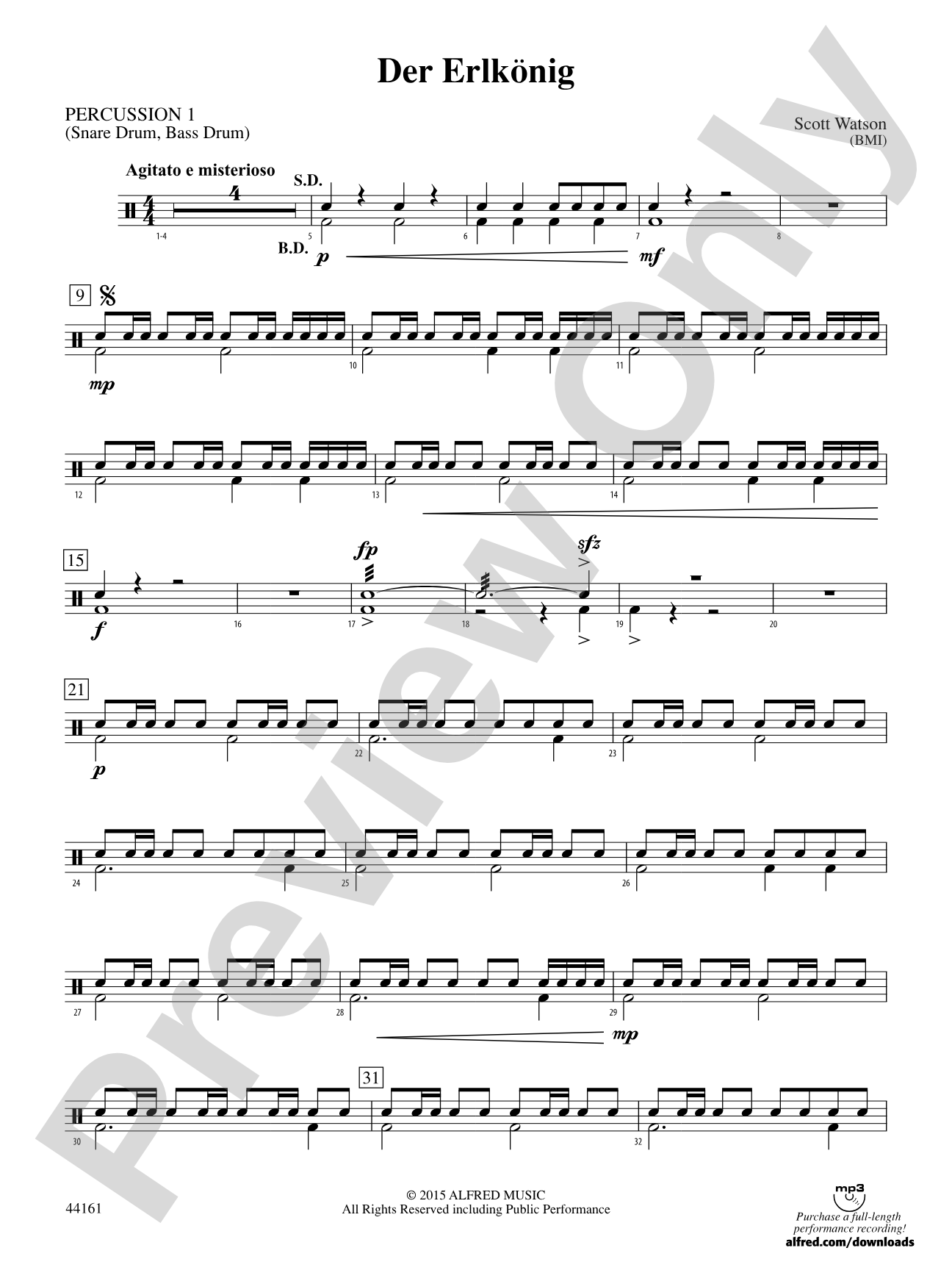

Der Erlkönig: 1st Percussion
By Scott Watson
Grade: 2 (Medium Easy)
Item: 00-PC-0017011_PC1
$3.00
Pickup currently not available
Description
Der Erlkönig, or "The Elf King," is based on Johann Goethe's late 18th-century poem of the same name in which a father and his young son ride home on horseback one dark and eerie night. The father tries to calm the increasingly fearful son by explaining everything the boy reports as simply leaves rustling in the wind or willows moving in the fog. Nonetheless, the father rides faster and faster home only to find the boy is dead in his arms when they arrive. Goethe's dark and gothic tale is brought to spine-tingling life in this harrowing, fast-paced tone poem for band. (3:20) This title is available in MakeMusic Cloud.


Don't just read it, hear it, play along with it, and watch your students grow with it. In MakeMusic Cloud, Der Erlkönig: 1st Percussion comes alive with professional accompaniment, adjustable tempo, and built-in practice tools that turn solo practice into real progress.
Open in the Player
Jump straight in and assign it today.
Start Your Free Trial
Open this title and explore the full library in minutes.
Sample Audio
1
Audio File
--:--
0:00
0:00
Sample Video
No sample videos found.
Additional Details
Series:
Challenger Band Series
Publisher:
Alfred Music
Page Count:
226
SKU:
00-PC-0017011_PC1
More about this title
About the Composer: Scott Watson

Scott Watson has spent four decades shaping young musicians. After 35 years leading the instrumental program at Parkland School District in Allentown, Pennsylvania (where he directed the high school bands and built the elementary strings/band curriculum), he joined Cairn University as Associate Professor of Music. His compositional output exceeds 120 published works across concert band, string orchestra, and chamber settings at all ability levels.
Watson's voice as a composer draws equally from two worlds: the contemporary concert art music tradition and the practical demands of the school band room. His works have been performed internationally and at major American venues including the Academy of Music in Philadelphia, the Midwest Clinic in Chicago, and the White House. He serves as exclusive composer and clinician for Alfred Publications, contributes to their Sound Innovations series, and authored Using Technology to Unlock Musical Creativity, published by Oxford University Press. More of his work can be found at www.scottwatsonmusic.com.
Why we love this
Watson captures Goethe's psychological horror without resorting to cheap effects. The score builds genuine tension through orchestration and pacing decisions that feel inevitable rather than forced, making this Grade 2 work sound far more sophisticated than its level suggests. Your band will find the ride genuinely exciting, and audiences will understand immediately why they should be unsettled.
What to expect
The piece unfolds like a dark fairy tale told at full gallop. What begins as a father's reassuring explanations dissolves into mounting dread as the forest itself seems to close in, culminating in a moment of terrible silence. The music captures both the physical rush of the ride and the psychological space where a child's fear becomes prophecy.
Who it's for
This work suits concert bands at the Grade 2 level who are ready for repertoire with genuine dramatic weight. It works equally well for directors building a program that reaches beyond typical light contest fare and for bands preparing literature that challenges ensemble cohesion and musical storytelling alongside technical facility.
How to get the most out of it
- Balance the father's steady rhythmic foundation against the increasingly agitated motion in the upper voices; the contrast between these layers drives the narrative forward.
- Keep the opening section grounded and matter-of-fact in tone so that the boy's growing panic reads as a genuine departure rather than the piece's default character.
- Communicate the accelerating tempo to your ensemble as part of the father's physical desperation, not merely as a metronome marking; they should feel the urgency building toward the final arrival.
- Shape the final moments with care. The moment of realization at journey's end requires clarity and restraint to land with full impact.
How to use it
Program this as a centerpiece for a concert themed around art songs, tone poems, or literature in music; it pairs naturally with other programmatic works from the Romantic era adapted for band. The 3:20 duration makes it ideal for contest or festival submission, where its combination of accessibility and genuine artistic ambition will impress both judges and listeners. Its dramatic arc also works well closing a first half or opening a second half when you want to reset audience attention.
Skills your students will build
- Sustaining ensemble cohesion through accelerating tempo changes
- Shaping narrative tension through dynamic contrast and orchestration balance
- Reading and executing rapid rhythmic figures at increasing speeds
- Responding to expressive conducting that conveys psychological rather than purely technical information