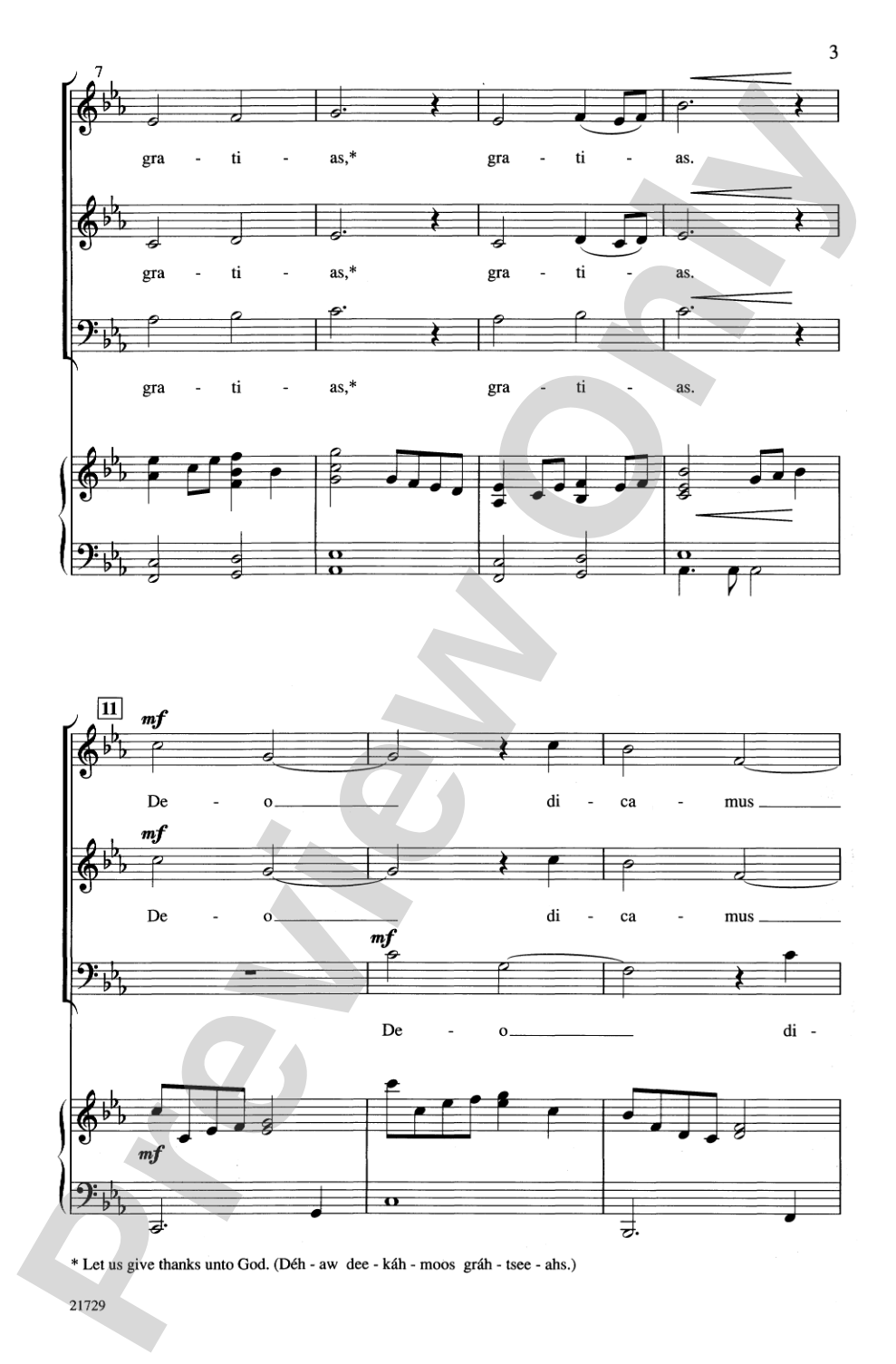
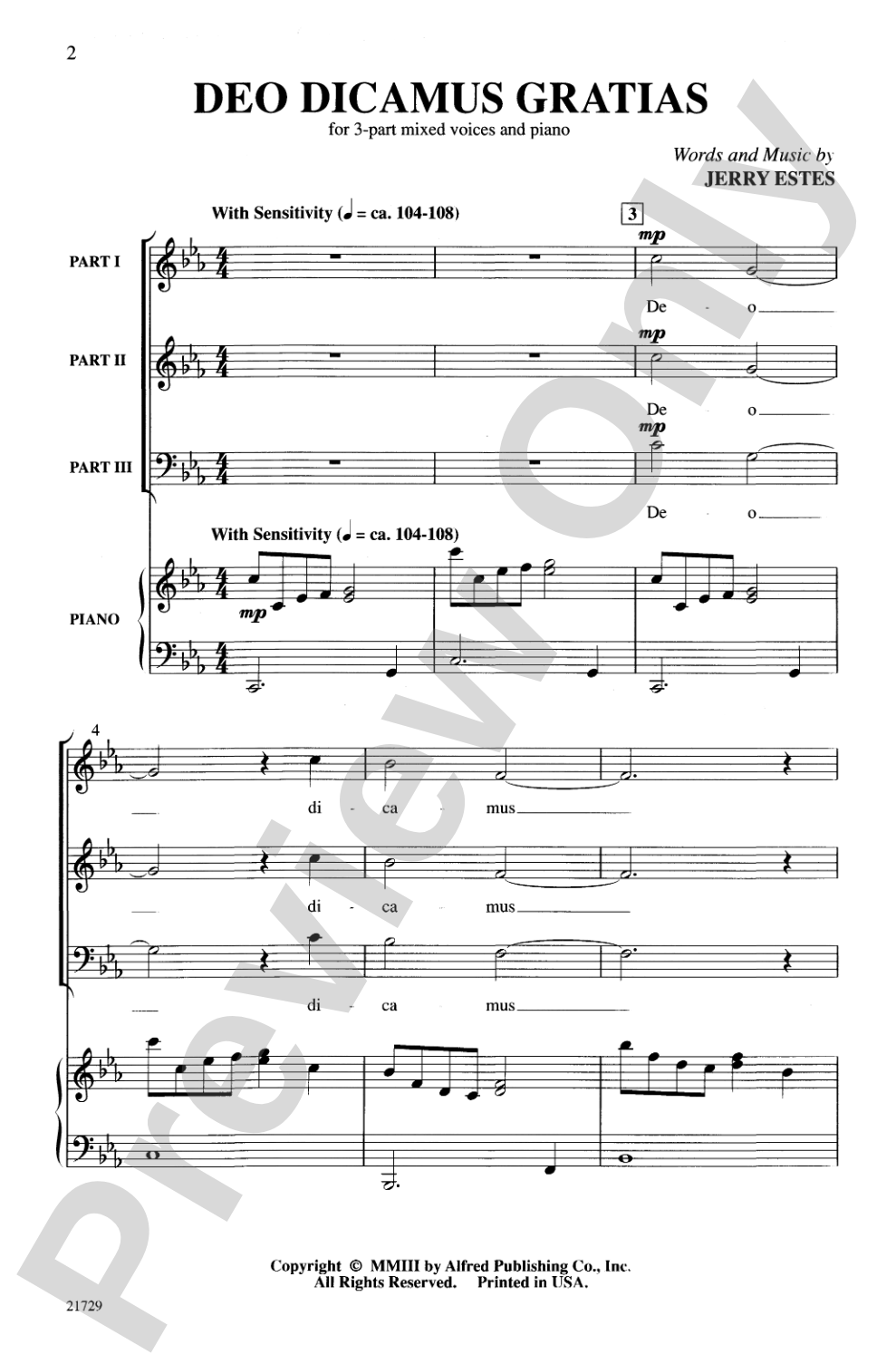
Deo Dicamus Gratias Sheet Music Preview

Deo Dicamus Gratias: 3-Part Choral Octavo

Music by Jerry Estes

Item: 00-PO-0004289

Digital Download
$2.25

Minimum order quantity: 20 copies

Description
A new choral work by Jerry Estes with sensitivity and warmth to spare. A brief Latin text is repeated throughout, set with the perfect balance of unison and chordal singing. Listen to the wonderful sonorities as the parallel seventh chords ascend at each cadence. Singable and comfortable. Dynamic contrasts add sparkle and interest, and a clean piano accompaniment supports the chorus.

Deo Dicamus Gratias: 3-Part Choral Octavo isn't in MakeMusic Cloud just yet...but it could be. Let us know you'd like to see it, and you'll help shape what comes next. In the meantime, start a free trial and dive into thousands of interactive titles your students can play along with today.

Sample Audio
0:00
0:00
Sample Video
Additional Details
Series: Alfred Archive Edition: Alfred Choral Designs
Publisher: Alfred Music
Page Count: 12
SKU: 00-PO-0004289

More about this title

About the Composer: Jerry Estes

Jerry Estes

Jerry Estes brings classroom experience directly into his compositions. A vocal music teacher at Wydown Middle School, where he works with grades 6-8, Estes earned his B.M.E. with vocal emphasis from Southwest Baptist University and later completed his M.M. at Southern Illinois University. His work is recognized by MENC and ASCAP.

Estes writes with an understanding of what young singers can accomplish and what they need to feel confident. His pieces balance accessibility with genuine musicality, rooted in years of leading singers through repertoire that matters.

Why we love this

Estes captures something essential in this piece: liturgical text set without sentimentality, paired with harmonies that sound richer than they are to sing. The parallel seventh chords ascending into each cadence create shimmer and forward motion that give singers something to hear themselves doing well. For middle school and high school ensembles alike, this is the kind of work that builds genuine musicianship while remaining genuinely singable.

What to expect

Warm and unhurried. The repeated Latin text creates a meditative quality, while the parallel sevenths ascending at cadences add luminosity and forward motion. This is music that feels supportive under the voice, never fighting against the singer.

Who it's for

This octavo serves middle school and early high school choral programs looking for sacred repertoire with real musical substance. It works equally well for contest and festival settings or for concert programming, offering singers an experience of beautiful harmony without requiring advanced vocal technique.

How to get the most out of it

  • Shape each ascending seventh chord progression with slight dynamic lift rather than sudden forte; let the harmonic momentum carry the line naturally.
  • Balance the repeated Latin text by varying articulation and resonance slightly with each restatement; avoid mechanical repetition through subtle shifts in vowel warmth.
  • Support unison passages with a full, grounded tone before the choir opens into harmony; the contrast will feel cleaner and more intentional.
  • Use the piano accompaniment to anchor phrase endings; ensure singers hear where the harmonic progression lands before the next phrase begins.

How to use it

Program this as a centerpiece for a sacred or holiday concert, or pair it with other Latin texts for a thematic set. Its moderate length (12 pages) and accessible voicing make it ideal for mixed ability ensembles in spring festivals or end-of-year performances.

Skills your students will build

  • Singing parallel seventh chord progressions and hearing harmonic function
  • Balancing unison and three-part textures within a single piece
  • Sustaining repeated text with musical freshness and variation
  • Following piano accompaniment cues to clarify harmonic movement

You May Also Like