

Deep River: SATB, a cappella Choral Octavo
Traditional Spiritual / arr. R. Nathaniel Dett, ed. Marques L. A. Garrett
Item: 00-PO-0006859
$2.05
Minimum order quantity: 20 copies
Pickup currently not available
Related Items
Deep River: SATB, a cappella Choral Octavo |
$2.05
|
View |
Description
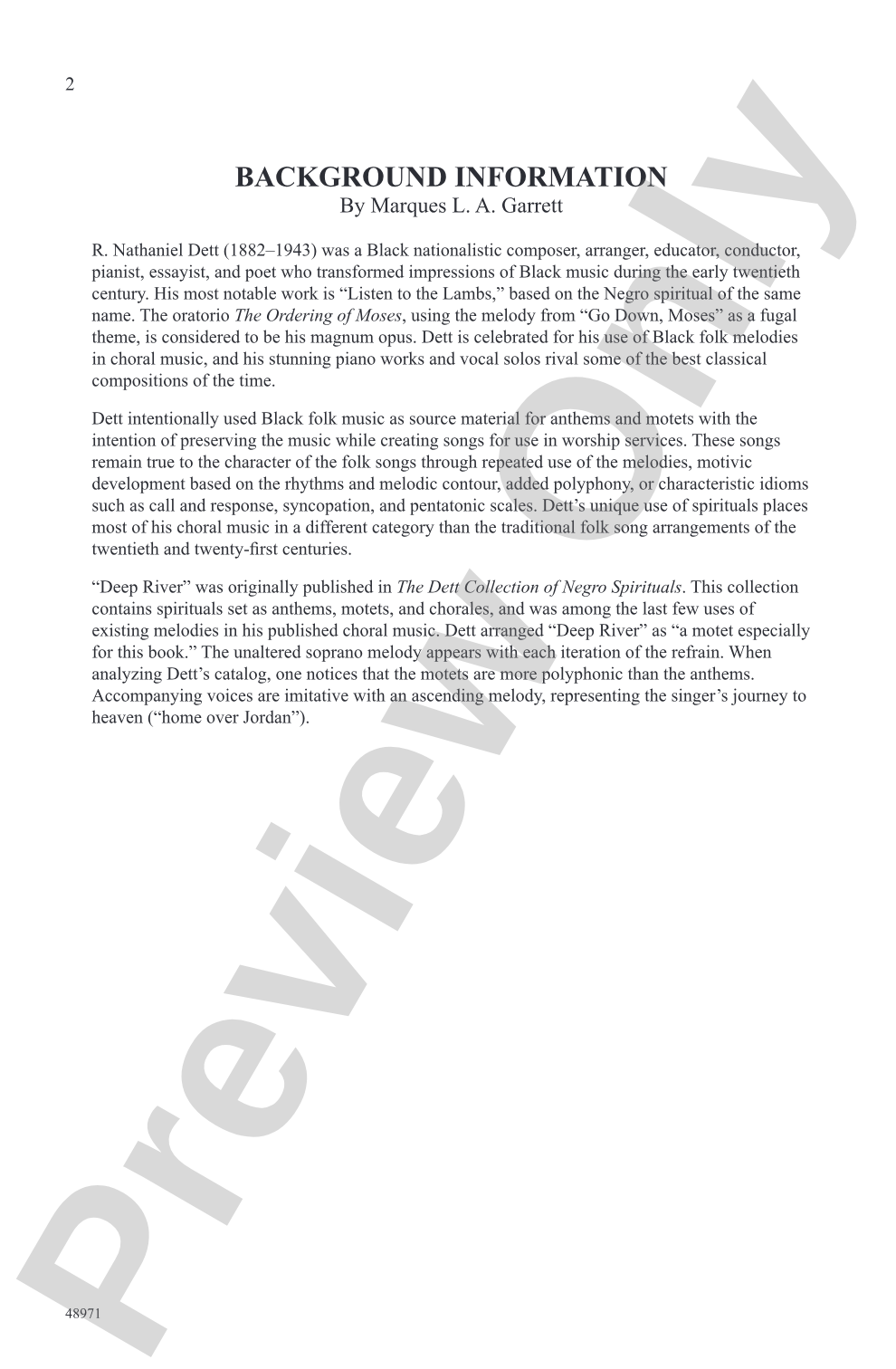
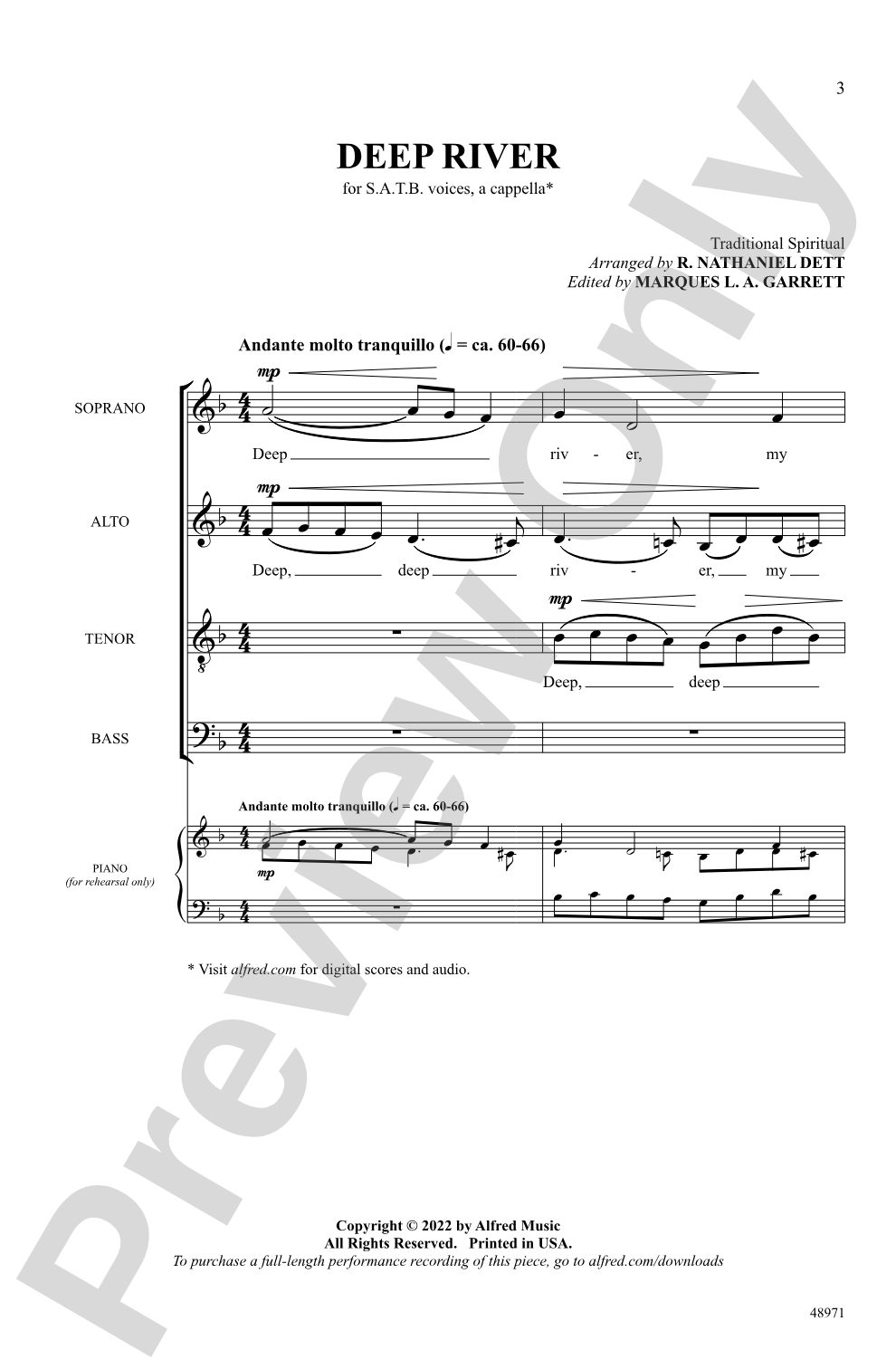
This a cappella arrangement was originally published in The Dett Collection of Negro Spirituals (1936). Share this impressive work with today's choirs in a carefully crafted new edition by Dr. Marques L. A. Garrett. The motet-like setting features an unaltered soprano melody that appears with each iteration of the refrain. Accompanying voices are imitative, with an ascending melody to represent the singer's journey to heaven ("home over Jordan"). Publication includes brief background information to provide introductory context about R. Nathaniel Dett, a Black nationalistic composer, educator, conductor, and writer who transformed impressions of Black music during the early twentieth century.


Deep River: SATB, a cappella Choral Octavo isn't in MakeMusic Cloud just yet...but it could be. Let us know you'd like to see it, and you'll help shape what comes next. In the meantime, start a free trial and dive into thousands of interactive titles your students can play along with today.
Request This Title
Tell us you want it.
Start Your Free Trial
Explore everything that's ready to play right now.
Sample Audio
1
Audio File
--:--
0:00
0:00
Sample Video
Additional Details
Series:
Lawson-Gould
Publisher:
Alfred Music
Page Count:
12
SKU:
00-PO-0006859
More about this title
About the Arranger: R. Nathaniel Dett
R. Nathaniel Dett (1882-1943) was a composer, arranger, conductor, and educator whose work fundamentally shaped how Black classical music was understood and valued in early twentieth-century America. A graduate of Oberlin Conservatory, Dett held teaching and conducting positions at Hampton Institute for over two decades, where he developed arrangements of spirituals that honored their harmonic and artistic depth rather than perpetuating minstrelsy stereotypes. His scholarly approach to Black musical traditions earned him recognition as both a nationalist voice and a serious musician whose legacy extends far beyond his lifetime.
Dett's arrangements prioritize the spiritual as concert art. He understood that spirituals contained the emotional and technical sophistication of any European choral tradition, and his settings reflect that conviction. The 1936 collection from which this arrangement derives represents decades of his work preserving and elevating these songs for choral performance.
Why we love this
Dett's setting treats the spiritual as a serious choral work worthy of concert halls and festivals. The ascending melodic writing in the accompanying voices creates a tangible sense of spiritual ascent that singers feel immediately, and the return of the unaltered soprano melody provides architectural clarity that makes the piece accessible to singers of varying experience. You get a motet-like sophistication without sacrificing the directness and emotional power that makes spirituals resonate with audiences.
What to expect
The piece embodies spiritual yearning through its harmonic language and upward-moving lines, creating a sense of purposeful ascent. There is both intimacy in the a cappella writing and grandeur in the architecture, a balance that honors the spiritual's roots while claiming its place in the concert repertoire.
Who it's for
This piece suits choirs with solid blend and intonation skills and at least one year of choral experience. Mixed ensembles preparing for festival or concert settings will find the motet-like construction rewarding, whether for a sacred music program or a concert exploring American choral traditions.
How to get the most out of it
- Balance the soprano melody carefully against the imitative voices beneath it; the melody should soar without drowning out the harmonic motion that supports the text's journey.
- Work the ascending melodic lines through the lower voices as deliberate musical movement, not accompaniment. Each voice should feel its own upward trajectory.
- Shape phrases across the refrain repetitions to build momentum toward the text's promise of home, allowing the harmonic language to evolve subtly with each return.
- Let the a cappella texture demand precision in ensemble tuning and blend. Clean consonants and sustained vowels will amplify both the spiritual's intimacy and its grandeur.
How to use it
Program this alongside other spirituals or American choral works to build a thematic concert focused on Black classical music and its innovations. It also works powerfully as a festival or competition selection where judges appreciate harmonic sophistication and careful arrangement. The 12 pages and moderate length make it a substantive choice without dominating a full concert program.
Skills your students will build
- Reading imitative melodic lines across multiple voice parts
- Sustaining blend and intonation without instrumental support
- Shaping long phrases through harmonic progression
- Interpreting spiritual tradition as concert art
- Balancing melody and accompanying voices in a cappella texture