
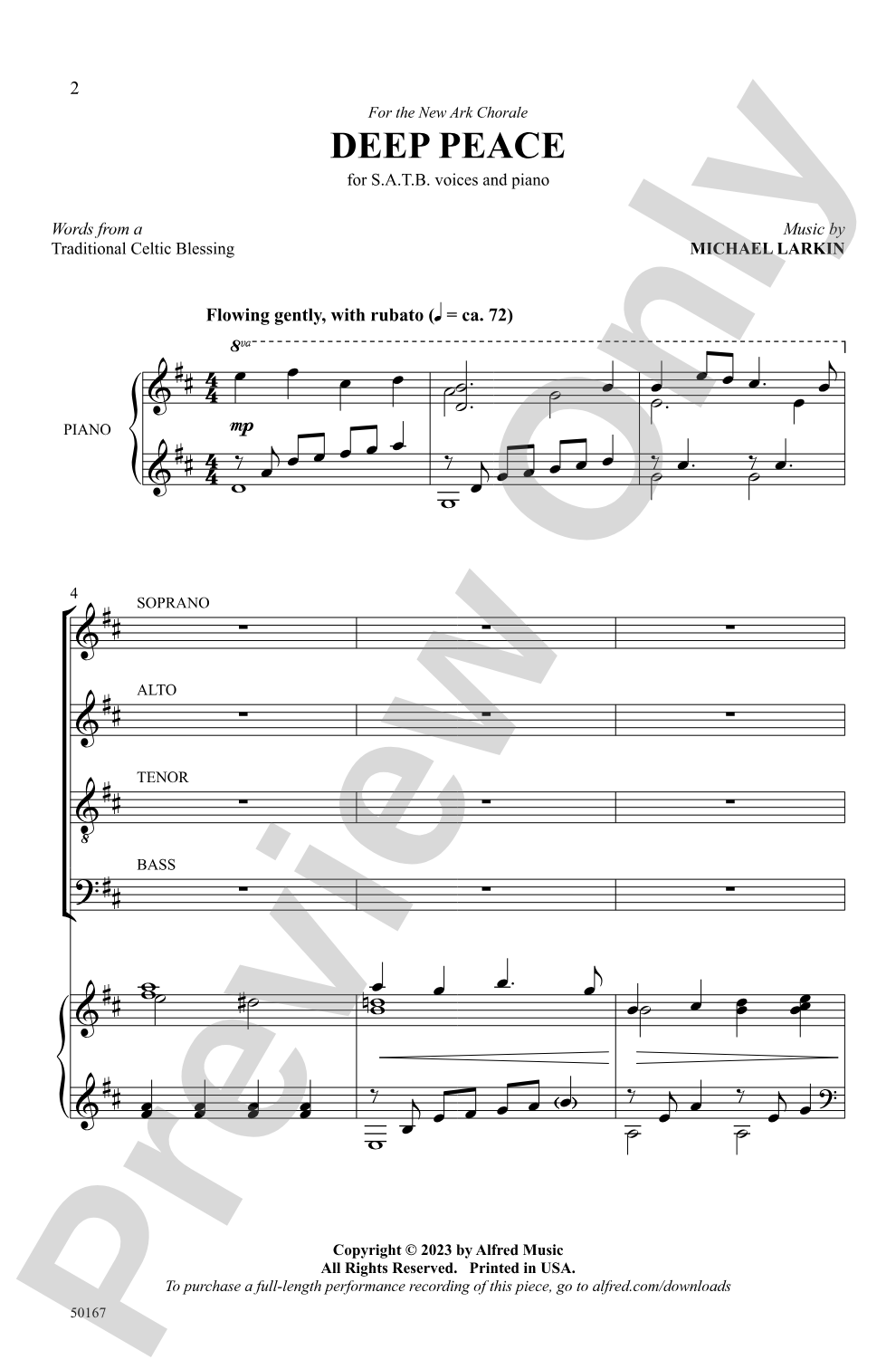
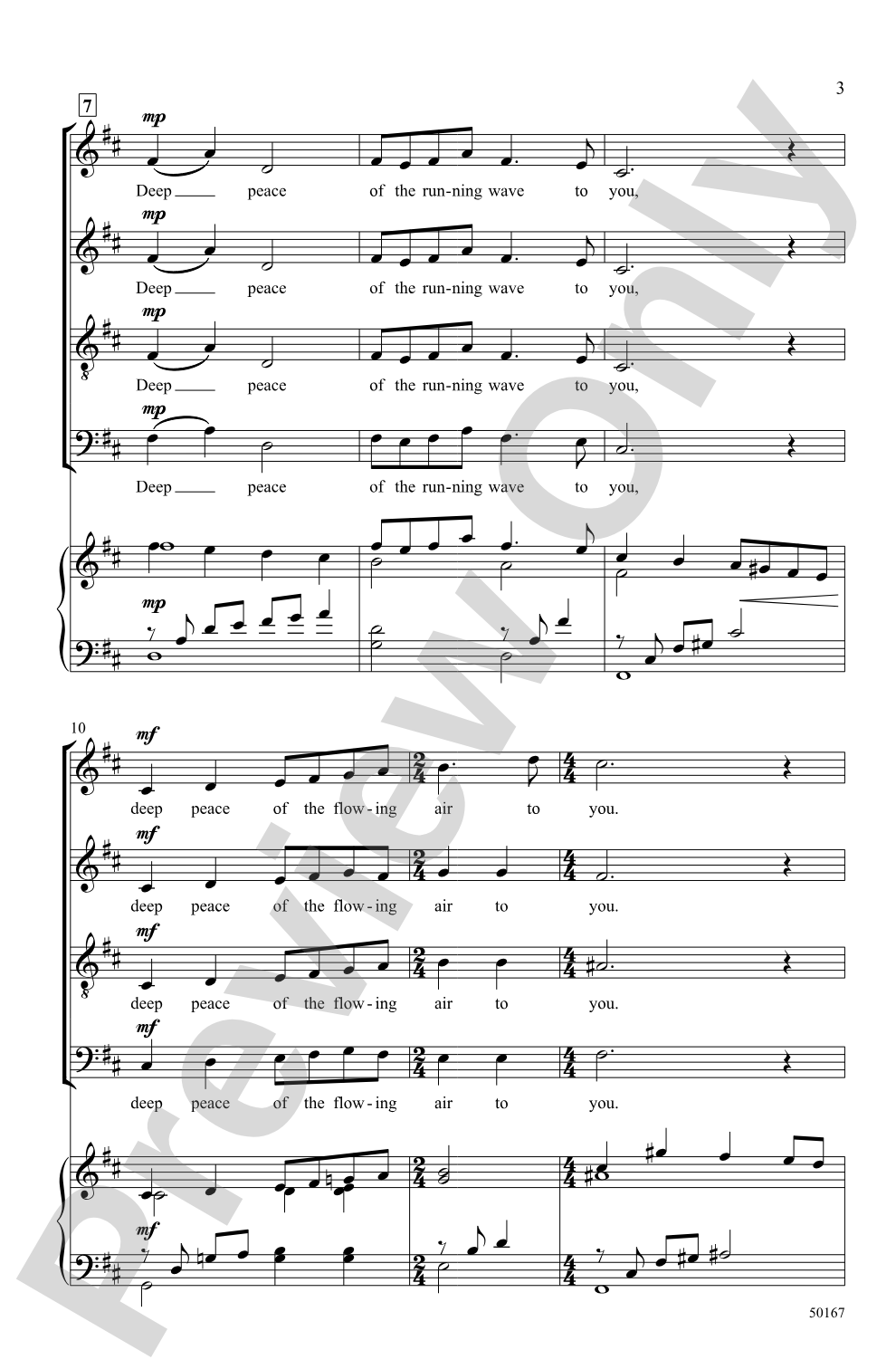

Deep Peace: SATB Choral Octavo
Words from a Traditional Celtic Blessing / music by Michael Larkin
Item: 00-PO-0007032
$2.05
Minimum order quantity: 20 copies
Pickup currently not available
Related Items
Deep Peace: SATB Choral Octavo |
$2.05
|
View |
Description
Here's an expressive, through-composed setting that evokes the awe of moon and stars through sweeping legato vocal lines, a rich harmonic landscape, and a gentle piano underscore. At just under three minutes in length, it makes a superb choice for a concert closer, benediction or signature send-off.


Deep Peace: SATB Choral Octavo isn't in MakeMusic Cloud just yet...but it could be. Let us know you'd like to see it, and you'll help shape what comes next. In the meantime, start a free trial and dive into thousands of interactive titles your students can play along with today.
Request This Title
Tell us you want it.
Start Your Free Trial
Explore everything that's ready to play right now.
Sample Audio
1
Audio File
--:--
0:00
0:00
Sample Video
Additional Details
Series:
Lawson-Gould
Publisher:
Alfred Music
Page Count:
8
SKU:
00-PO-0007032
More about this title
About the Composer: Michael Larkin

Michael Larkin brings three decades of leadership in vocal and choral music education to his compositional work. As former chairperson of the Vocal/Choral Department at the Music School of Delaware and a distinguished voice faculty member there, he shaped generations of singers and musicians. He currently directs the New Ark Chorale, one of the region's most respected choral ensembles, and serves as music director of both the Brandywine Pops Orchestra and St. Barnabas Episcopal Church in Wilmington, Delaware.
Larkin's prolific output exceeds 300 compositions published by major American houses. His work as a baritone soloist, guest conductor, and festival clinician has established him as a trusted voice in choral music. His compositions reflect deep knowledge of vocal writing and a commitment to repertoire that serves both the educational and artistic needs of singers.
Why we love this
Larkin writes for the voice with genuine elegance. The sweeping legato lines and sophisticated harmonies create a piece that sounds far more substantial than its brief length, making it an ideal closer for any concert where you need impact without overextending your program. Choirs consistently respond to the intrinsic singability of his writing, and this octavo delivers exactly that combination of musical substance and practical accessibility.
What to expect
There's a hushed reverence here, as though the choir is sharing something intimate about stillness and wonder. The harmonic language feels modern and contemplative without becoming austere, inviting singers and listeners alike into a moment of genuine reflection.
Who it's for
Choirs at the intermediate to advanced level looking for programming that offers both musical sophistication and vocal warmth. This piece serves equally well in concert settings, worship contexts, and festival performances where an expressive, memorable closer is needed.
How to get the most out of it
- Shape the legato lines through the harmonic progressions rather than treating each phrase as isolated. The through-composed texture requires singers to understand how their voice part connects to the evolving harmonic landscape.
- Balance the piano underscore carefully so it supports without overwhelming. The accompaniment should feel like a gentle foundation, not a competing voice.
- Allow space for the awe you're evoking. Resist the urge to rush; let the harmonic richness breathe between phrases.
- Attend to vowel consistency across the SATB texture, particularly in sustained passages where blend directly affects the emotional impact.
How to use it
Program this as your final piece on a concert to leave audiences in a reflective space. Its brevity makes it perfect for benediction use in worship settings, or as the signature send-off on a graduation program where you want something more distinctive than the standard closing hymn.
Skills your students will build
- Sustaining legato line through harmonic changes
- Blend and balance in rich, chromatic choral textures
- Phrasing across through-composed form without traditional sectional markers
- Dynamic control and vocal space in expressive, slow music