
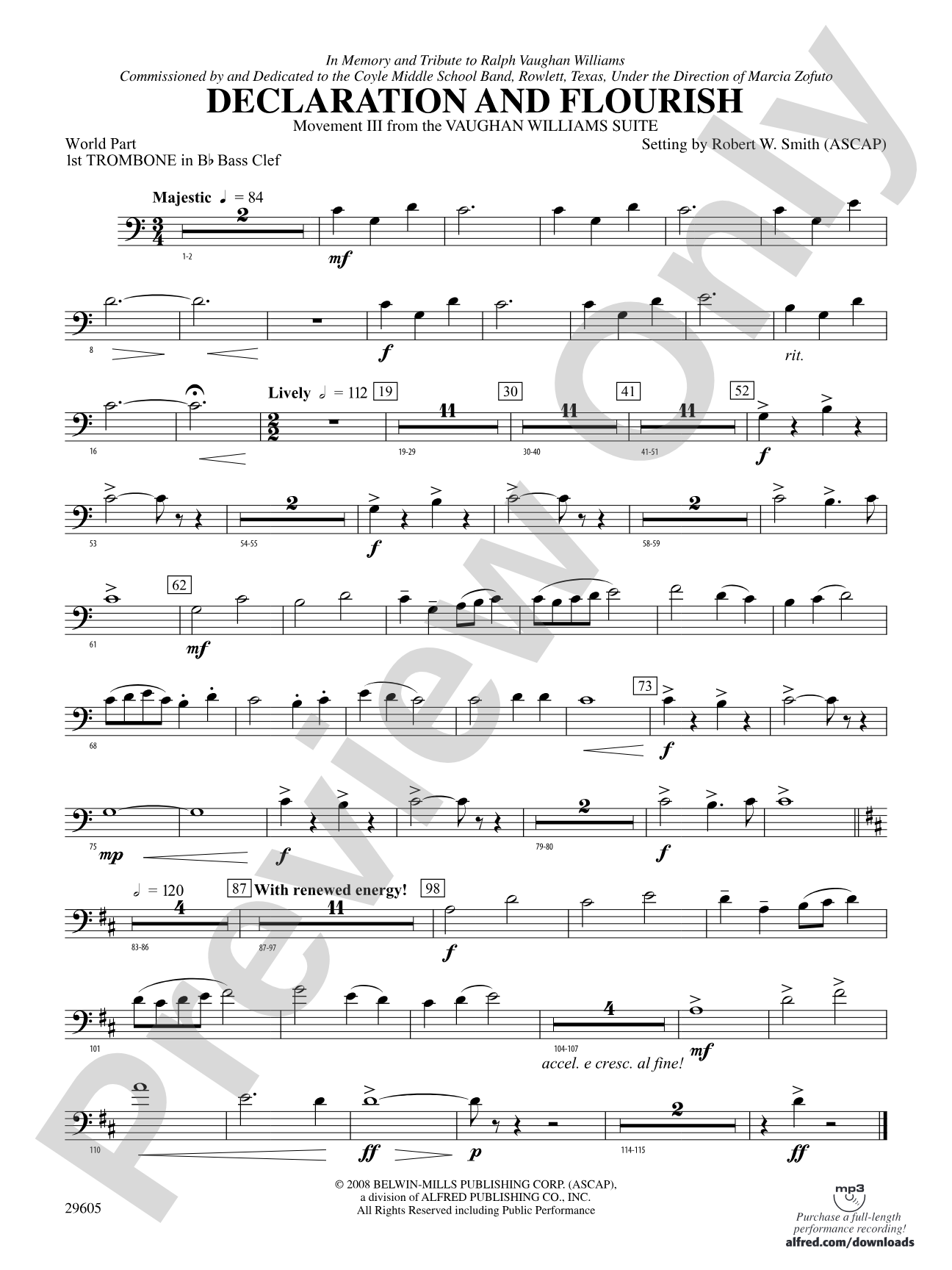

Declaration and Flourish (Movement III from the Vaughan Williams Suite): (wp) 1st B-flat Trombone B.C.
By Robert W. Smith
Grade: 3 (Medium Easy)
Item: 00-PC-0001495_wpTN1BC
$3.00
Pickup currently not available
Description
The final installment of Robert W. Smith's Vaughan Williams Suite was inspired by both "Flourish for Wind Band" and "English Folk Song Suite." As the title implies, the work is bold and compelling. Consider programming the entire Suite which includes "Wassail" (24758) and "Greensleeves: A Fantasia for Band" (26749). (2:46)


Don't just read it, hear it, play along with it, and watch your students grow with it. In MakeMusic Cloud, Declaration and Flourish (Movement III from the Vaughan Williams Suite): (wp) 1st B-flat Trombone B.C. comes alive with professional accompaniment, adjustable tempo, and built-in practice tools that turn solo practice into real progress.
Open in the Player
Jump straight in and assign it today.
Start Your Free Trial
Open this title and explore the full library in minutes.
Sample Audio
1
Audio File
--:--
0:00
0:00
Sample Video
No sample videos found.
Additional Details
Series:
Belwin Concert Band
Publisher:
Alfred Music
Page Count:
240
SKU:
00-PC-0001495_wpTN1BC
More about this title
About the Composer: Robert W. Smith

Robert W. Smith stands among the most recorded and performed composers of concert band music in America, with over 400 published works across band, orchestra, and other ensembles. His education at Troy State University and the University of Miami shaped a compositional voice that balances accessibility with musical substance, making his work foundational in band programs at every level.
Smith's output spans original compositions, arrangements, and orchestrations that have reached audiences far beyond the concert hall. His symphonies, including The Divine Comedy and The Odyssey, and his arrangements of literary and cultural works have been performed across North America, Europe, Australia, and Asia. His music has also served ceremonial and broadcast purposes, from presidential state dinners in Japan to the opening of the Macy's Thanksgiving Day Parade and performances at the Olympic Games.
Why we love this
Smith's craftsmanship as an arranger shines here. He captures the essence of Vaughan Williams's idiom while writing specifically for what a Grade 3 band can execute with musicianship. The work closes the Suite with genuine dramatic weight, giving young conductors and players a piece that sounds substantial without requiring virtuosic facility.
What to expect
Bold ceremonial opening gives way to flourishing, ornamental writing that echoes English pastoral traditions. The music carries a declarative confidence balanced with lyrical grace, suggesting both fanfare and folk melody.
Who it's for
Grade 3 bands seeking repertoire that demands musical maturity without excessive technical demand. Conductors drawn to the Vaughan Williams Suite as a complete arc will find this finale essential. Ensembles preparing for concert festivals and adjudicated events benefit from a work that carries weight and purpose.
How to get the most out of it
- Shape the opening declaration with clear phrasing and dynamic control; resist the urge to rush the fanfare-like figures, which need space to land.
- Balance the brass choir carefully so the declaration emerges as a unified voice. Section releases matter as much as attacks.
- Let the woodwind flourishes breathe. These passages benefit from slight flexibility in tempo that respects both the soloist and the ensemble.
- Pay attention to the harmonic language specific to this movement. The English folk idiom relies on diatonic clarity, so intonation in sustained chords directly impacts the work's effectiveness.
How to use it
This movement functions beautifully as a concert closer or as the final installment when programming the entire Vaughan Williams Suite. Pairing all three movements creates a narrative arc that holds audience attention and gives conductors a substantial multi-movement work at a manageable difficulty level. Contest circuits particularly value this piece for its musicality and dramatic shape within Grade 3 constraints.
Skills your students will build
- Conducting sustained phrase arcs across fanfare textures
- Balancing multi-voice brass harmonies with precision intonation
- Executing articulation control in rapid ornamental passages
- Interpreting English folk-influenced harmonic language
- Responding to interpretive flexibility while maintaining ensemble cohesion