
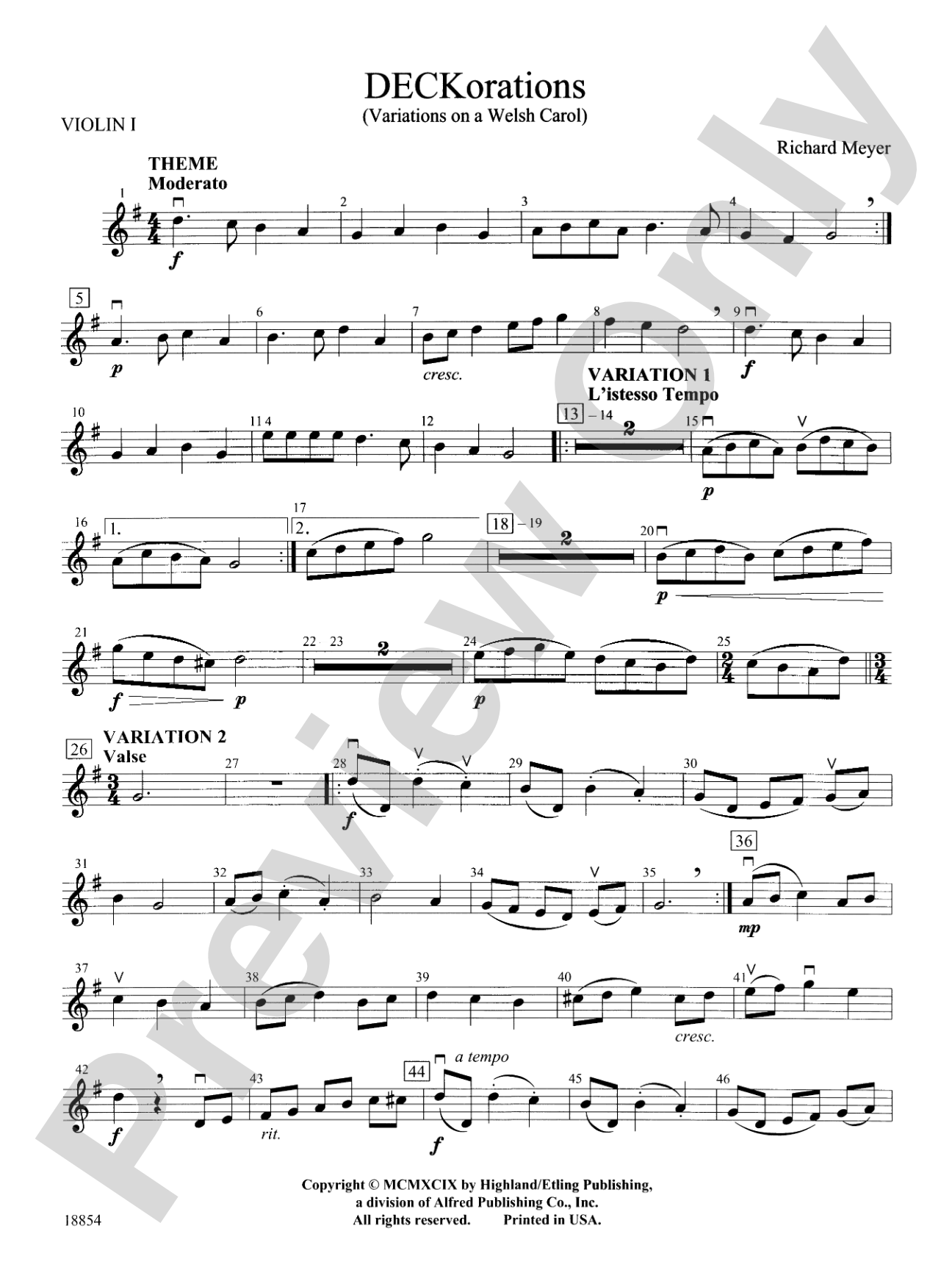

DECKorations: 1st Violin
Arr. Richard Meyer
Grade: 2
Item: 00-PC-0014259_VN1
$7.99
Pickup currently not available
Description
This clever arrangement of "Deck the Halls" is the perfect way to introduce your orchestra to them and variations form. Included in the five variations are a Viennese waltz, Spanish tango and Bach-style contrapuntal finale. Your students will have a great time discovering how the familiar melody has been altered, while learing a wide variety of playing techniques. The perfect level for your December holiday concert!


Don't just read it, hear it, play along with it, and watch your students grow with it. In MakeMusic Cloud, DECKorations: 1st Violin comes alive with professional accompaniment, adjustable tempo, and built-in practice tools that turn solo practice into real progress.
Open in the Player
Jump straight in and assign it today.
Start Your Free Trial
Open this title and explore the full library in minutes.
Sample Audio
1
Audio File
--:--
0:00
0:00
Sample Video
No sample videos found.
Additional Details
Series:
Highland/Etling String Orchestra
Publisher:
Alfred Music
Page Count:
68
SKU:
00-PC-0014259_VN1
More about this title
About the Arranger: Richard Meyer

Richard Meyer brought 35 years of string teaching experience to his work across elementary, middle, and high school levels in Southern California public schools. At Oak Avenue Intermediate School in Temple City, he grew the orchestra program from 29 students to 200 over two decades while simultaneously directing the city's elementary string initiative. His work earned national recognition through the "Giving Bach" program, which uses interactive concerts to reach special needs and underserved student populations.
Beyond the classroom, Meyer has conducted the Pasadena Youth Symphony Orchestra for 16 years, leading international tours to Vienna, Australia, and Canada. He serves as a sought-after guest conductor and clinician at major conferences including the A.S.T.A. National Conference and All-State orchestras across multiple states. As a composer and arranger, he has published nearly 200 works and spent 16 years as string editor for Alfred Publishing Company, co-authoring the String Explorer Series and Sight-read It for Strings.
Why we love this
Meyer's five variations give Grade 2 orchestras a genuine exploration of how the same melody transforms through form and style, not just a surface-level arrangement. The progression from Viennese waltz through Spanish tango to Bach-style counterpoint builds orchestral maturity while keeping the familiar "Deck the Halls" thread running throughout, so students experience real musical growth without losing their anchor.
What to expect
The arrangement flows like a musical journey through time and place, opening with recognizable warmth before spiraling into unexpected elegance. Students and audiences alike discover that a carol they thought they knew can sparkle as a European dance, swing with Latin passion, or interweave like a fugue, making "Deck the Halls" feel entirely new.
Who it's for
String orchestras at the Grade 2 level who are ready to move beyond straightforward melody-and-accompaniment textures but still building foundational ensemble skills. This works beautifully for orchestras encountering form and orchestration variation for the first time.
How to get the most out of it
- Rehearse each variation as a distinct musical world. Block out what makes the Viennese waltz dance differently from the tango, and let that stylistic contrast become the rehearsal focus rather than treating all five sections uniformly.
- Give students a chance to hear or see the original carol melody in its simplest form before diving into the full arrangement. Knowing what's "normal" sharpens their ear for what Meyer changes.
- Balance the contrapuntal finale carefully so independent lines sing through without one section drowning out another. This is where the real technical payoff happens for your second-year players.
How to use it
This is an ideal centerpiece for December concerts because it gives audiences the comfort of a holiday favorite while showcasing what your orchestra has learned about style and interpretation. The five-variation structure also works well as a segue piece between sets or as a clever opener that transitions from classical to more contemporary holiday selections.
Skills your students will build
- Recognizing and executing stylistic characteristics of waltz, tango, and baroque counterpoint
- Playing a consistent melody across multiple harmonic and textural contexts
- Balancing independent voice parts in polyphonic writing
- Maintaining rhythmic precision in syncopated and dance-based textures
- Responding to conductor interpretation across distinct musical sections