
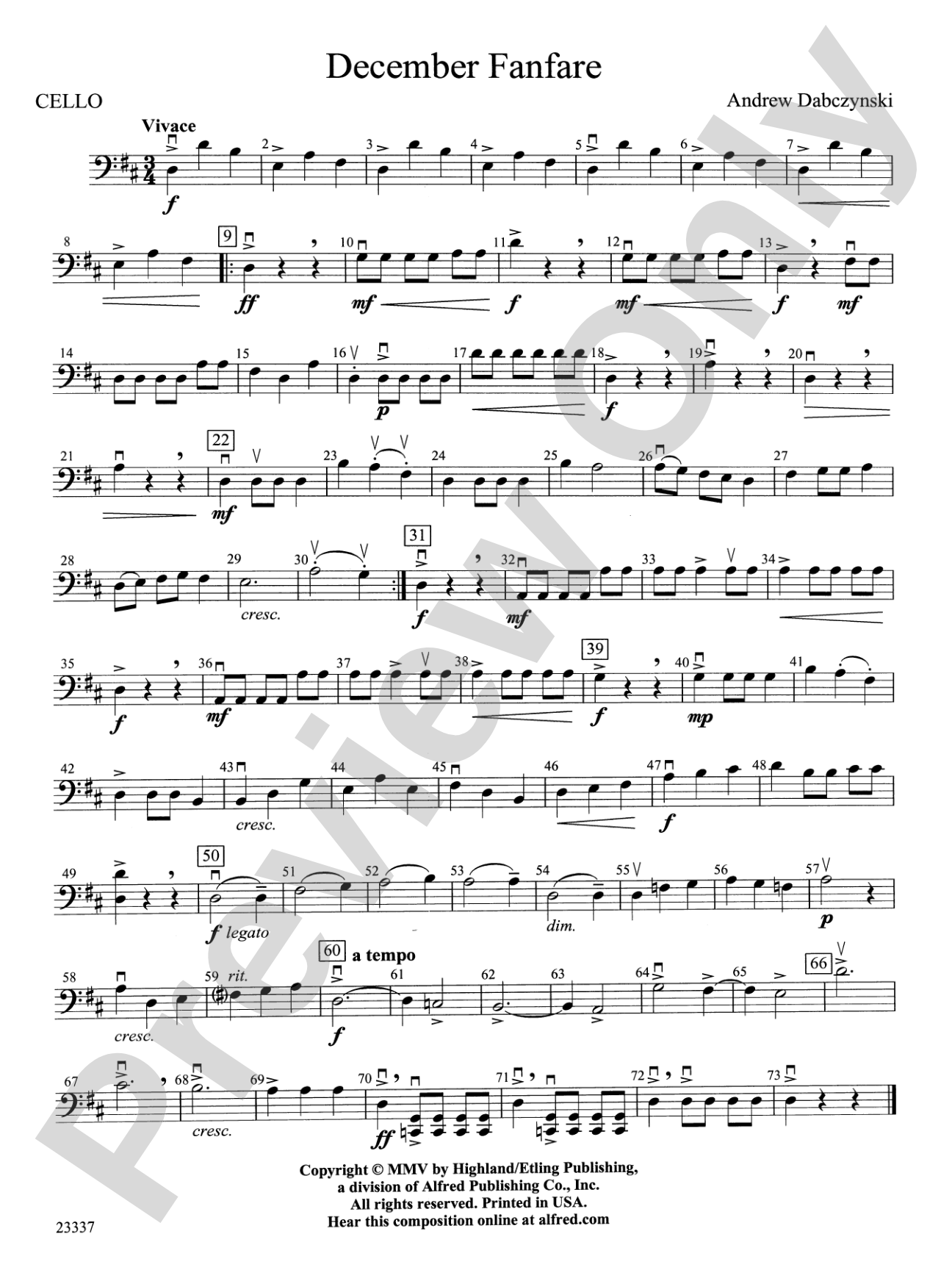

December Fanfare: Cello
By Andrew H. Dabczynski
Grade: 2
Item: 00-PC-0000683_VC1
$5.99
Pickup currently not available
Description
December Fanfare is a perfect, high-energy opening/closing concert selection! Containing a vigorous rhythmic drive and unexpected appearances of familiar melodic ideas, this work makes for a great change of pace on your holiday concert. Even though individual technical demands are not extensive for most students, the piece's expressiveness, dynamic contrasts, and carefully placed articulations can challenge even advanced students.


Don't just read it, hear it, play along with it, and watch your students grow with it. In MakeMusic Cloud, December Fanfare: Cello comes alive with professional accompaniment, adjustable tempo, and built-in practice tools that turn solo practice into real progress.
Open in the Player
Jump straight in and assign it today.
Start Your Free Trial
Open this title and explore the full library in minutes.
Sample Audio
1
Audio File
--:--
0:00
0:00
Sample Video
No sample videos found.
Additional Details
Series:
Highland/Etling String Explorer
Publisher:
Alfred Music
Page Count:
72
SKU:
00-PC-0000683_VC1
More about this title
About the Composer: Andrew H. Dabczynski

Andrew H. Dabczynski has taught string music at every level, from public school orchestras to university coursework, and served as Emeritus Professor of Music Education at Brigham Young University. There, he founded the BYU "New Horizons Orchestra," an ensemble designed for adult beginners that also functioned as a laboratory for string teacher training, work that earned him BYU's Joseph E. White Fellowship for Teaching and Learning. His career includes faculty positions at the Eastman School of Music and administrative roles in Michigan school districts, along with performances as a violist in regional symphonies and six years with the Colden String Quartet.
Recognized nationally for his contributions to string pedagogy, Dabczynski co-authored the String Explorer method series, widely used in school string programs. His research interests span folk music and ethnomusicology, with particular focus on fiddling traditions and how musical knowledge passes between generations. The Utah chapter of the American String Teachers Association honored him as "Higher Education Teacher of the Year" in 2005 and for "Outstanding Contributions to Music Education" in 2014.
Why we love this
Dabczynski understands what young orchestras can actually accomplish, and he's written a piece that sounds ambitious without asking for technical heroics. The rhythmic energy and dynamic shifts create real musical drama at Grade 2, while the familiar melodic fragments give students moments of recognition and confidence. It's the kind of opener that gets an audience's attention immediately and leaves them wanting more.
What to expect
Vigorous and forward-moving, with an infectious rhythmic momentum that grabs attention from the first measure. Beneath the energy, familiar musical phrases surface and disappear, creating moments of warmth and surprise. The piece balances momentum with expressive playing, giving string students chances to shape dynamics and articulation while the orchestra propels forward.
Who it's for
String orchestras at Grade 2 level who want to open or close a concert with something that feels polished and energetic without overwhelming young players. Directors seeking a holiday selection that breaks from traditional arrangements will find the rhythmic drive and unexpected melodic twists refreshing. This piece rewards both developing and more advanced ensembles, as the careful articulations and dynamic layers offer depth for players ready to explore them.
How to get the most out of it
- Shape the rhythmic drive by keeping eighth-note figures crisp and even; let the articulation markings breathe rather than pushing for speed.
- Balance dynamic contrasts carefully, especially when familiar melodies emerge unexpectedly. Make sure upper and lower voices can hear each other during these moments.
- Lock in on the rhythmic foundation early in rehearsals. Once students trust the pulse, they'll have the freedom to shape the expressive elements Dabczynski has written.
- Use concert runs to familiarize students with the piece's energy arc. Performing it through helps them understand how the opening drive connects to the closing moments.
How to use it
Program December Fanfare as an opening selection to establish immediate energy and excitement on a winter concert. Its high-energy character and moderate length make it ideal for a concert opener that sets a strong tone before moving into slower or more introspective selections. The piece also works effectively as a closer, sending the audience out with rhythmic vitality and a sense of accomplishment.
Skills your students will build
- Maintaining steady rhythmic drive across the full ensemble while managing dynamic contrasts
- Articulation clarity and consistency (marking exact stroke placement and release)
- Balancing individual melodic lines when familiar themes move between sections
- Response to conductor cues for tempo and expression changes
- Ensemble listening within a fast-moving texture