
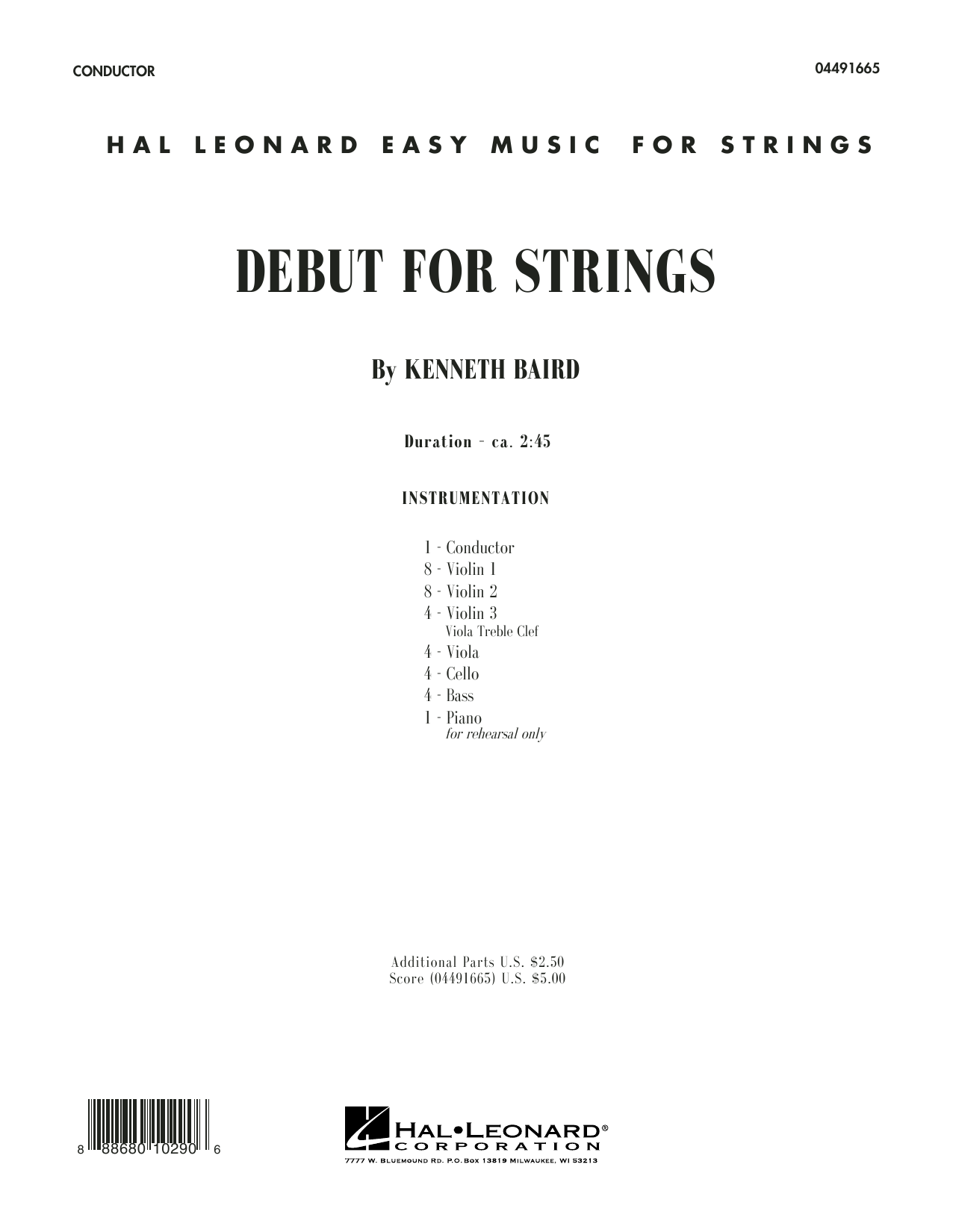

Debut for Strings: String Orchestra Conductor Score & Parts
By Kenneth Baird
Grade: 1
Item: 35-PK00338792
$40.00
Pickup currently not available
Buy Extra Parts (Digital PDF Download)
| Product | Price | Quantity |
|---|---|---|
| Debut for Strings - Conductor Score (Full Score) | $6.00 | |
| Debut for Strings - Violin 1 | $7.00 | |
| Debut for Strings - Violin 2 | $7.00 | |
| Debut for Strings - Violin 3 (Viola Treble Clef) | $7.00 | |
| Debut for Strings - Viola | $7.00 | |
| Debut for Strings - Cello | $7.00 | |
| Debut for Strings - Bass | $7.00 | |
| Debut for Strings - Piano | $7.00 |
Parts Added to Cart!
Description
Here's a strong teaching piece, well-suited for 1st or 2nd year players and a worthy goal toward one of their first performances. The modal harmonies will give students a confident sound and the structure is carefully designed for success at this level. Dur: 2:45


Debut for Strings: String Orchestra Conductor Score & Parts isn't in MakeMusic Cloud just yet...but it could be. Let us know you'd like to see it, and you'll help shape what comes next. In the meantime, start a free trial and dive into thousands of interactive titles your students can play along with today.
Request This Title
Tell us you want it.
Start Your Free Trial
Explore everything that's ready to play right now.
Sample Audio
No sample audio found.
Sample Video
No sample videos found.
Additional Details
Publisher:
Hal Leonard
SKU:
35-PK00338792
More about this title
Why we love this
Baird understands what first and second year string players need: music that sounds substantial without demanding technical heroics. The modal harmonies create a rich, confident sonority that builds student morale, while the carefully scaffolded structure means fewer surprises in the rehearsal room and more success on performance day.
What to expect
The modal harmonies lend an open, resonant quality that feels both contemporary and approachable. The piece sits comfortably under young fingers while delivering a polished, mature sound that surprises audiences unfamiliar with what beginning string players can achieve.
Who it's for
First and second year string orchestras looking for repertoire with real substance. This works equally well for a school ensemble seeking a confidence-building performance or a community youth orchestra introducing intermediate concepts.
How to get the most out of it
- Balance the modal harmony by listening for the root position of each chord; younger players often bury the harmonic foundation when they focus only on their own line.
- Shape the phrasing in four or eight bar units rather than trying to sustain through longer sections; this helps students maintain focus and intonation.
- Record a run-through early in the rehearsal process so students hear what they're building toward, even if the tempo feels slow at first.
How to use it
Pair this as a closing selection on a concert where you're also programming unison or simple two part work; the timbral sophistication will feel like genuine growth. It also works beautifully as a mid year goal that validates the fundamentals you've been teaching since September.
Skills your students will build
- Reading and executing modal harmonic progressions
- Maintaining consistent intonation across sustained whole and half notes
- Responding to conducting gestures for phrase entrances and releases
- Balancing individual parts within a harmonic texture
- Ensemble precision with straightforward rhythmic figures