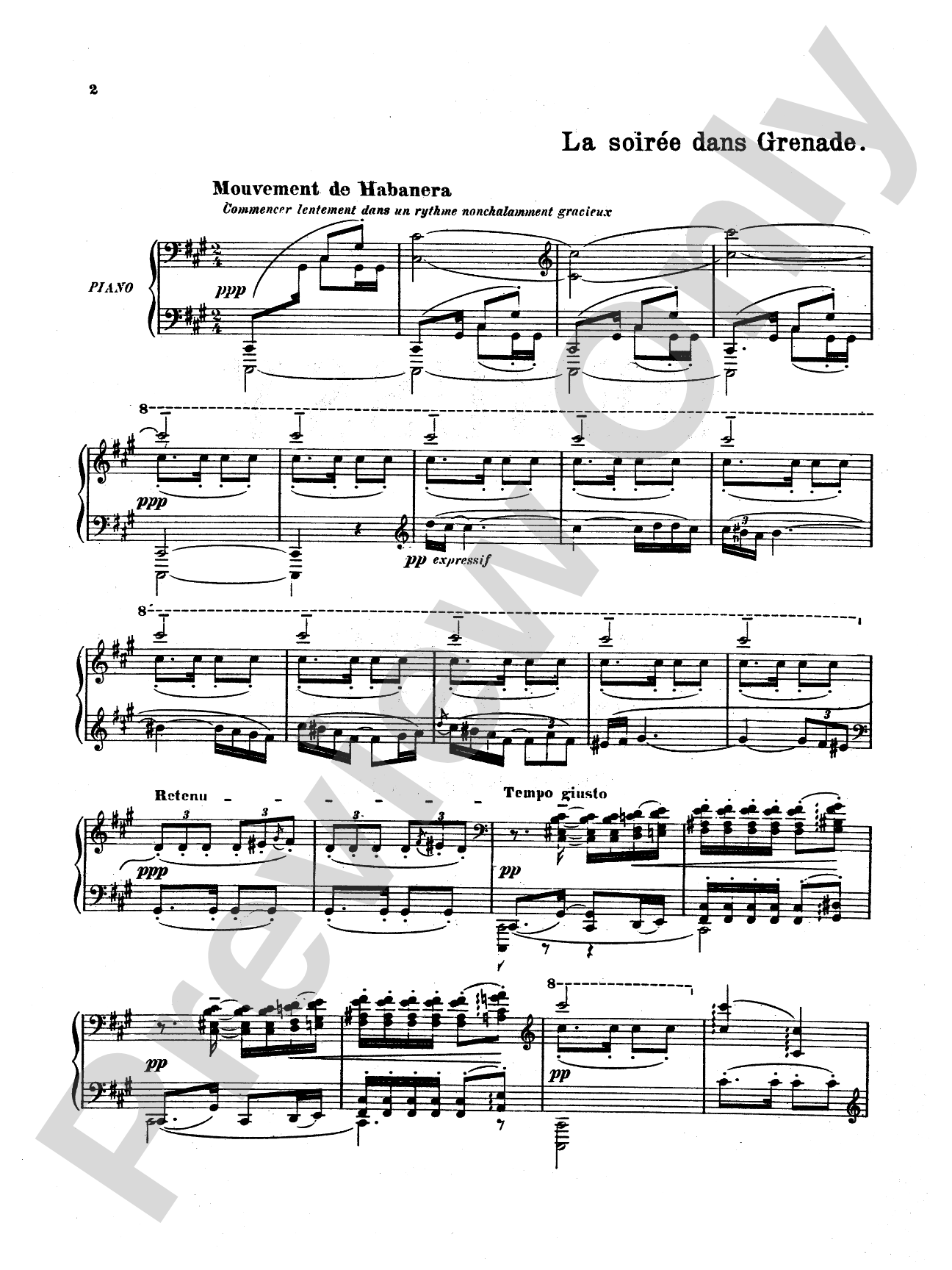
Debussy: Soiree En Grenade (from Estampes) Sheet Music Preview

Debussy: Soiree En Grenade (from Estampes)

By Claude Debussy

Level: Advanced

Item: 00-PC-0006918

Digital Download
$5.99
Description

Don't just read it, hear it, play along with it, and watch your students grow with it. In MakeMusic Cloud, Debussy: Soiree En Grenade (from Estampes) comes alive with professional accompaniment, adjustable tempo, and built-in practice tools that turn solo practice into real progress.

Sample Audio
No sample audio found.
Sample Video
Additional Details
Series: Kalmus Edition
Publisher: Alfred Music
Page Count: 8
SKU: 00-PC-0006918

More about this title

About the Composer: Claude Debussy

Claude Debussy (1862-1918) revolutionized piano writing by treating the instrument as a vehicle for color and atmosphere rather than virtuosic display alone. His exploration of whole-tone scales, parallel harmonies, and unconventional chord progressions fundamentally shifted how composers approached harmony and form in the early twentieth century.

Debussy's influence on music education extends far beyond his own compositions. His work opened doors for generations of teachers and students to think critically about tone quality, pedal usage, and the relationship between technique and musical expression. Studying his scores reveals how musical intent shapes every notational and structural choice.

Why we love this

Soiree En Grenade stands as one of the most musically rewarding and technically demanding pieces in the advanced piano repertoire. The writing captures the essence of Spanish guitar and flamenco idioms through purely pianistic means, offering students a masterclass in how Debussy translates non-keyboard music into idiomatic keyboard textures while maintaining harmonic sophistication.

What to expect

Soiree En Grenade evokes a warm evening in Granada filled with the rhythms and colors of Spanish guitar and flamenco. The piece moves between moments of intimate lyricism and infectious rhythmic energy, painting a vivid landscape through shimmering harmonies, unexpected chord progressions, and writing that captures the natural resonance and decay of guitar strings through piano sonorities.

Who it's for

Advanced pianists ready to engage with Impressionist harmony and the technical demands of rapid figurations and hand independence. This piece suits conservatory students, competitive festival participants, and experienced amateurs seeking repertoire that rewards deep musical investigation alongside technical refinement.

How to get the most out of it

  • Shape the opening guitar-like figures with attention to the implied melody line rather than treating them as neutral accompaniment; each note contributes to the overall contour and emotional arc.
  • Develop independence between hands by practicing sections where the left hand maintains rhythmic drive while the right hand sings the melodic line; this separation clarifies Debussy's orchestration within the keyboard.
  • Experiment with pedal changes on the harmonic shifts to capture the piece's atmospheric color changes without muddying sustained sonorities; mark these changes on your score during practice.
  • Balance the rapid figuration in the middle sections with enough control to let listeners hear the underlying harmonic progressions; speed alone obscures Debussy's harmonic language.

How to use it

Feature this work in a recital dedicated to French Impressionism or early twentieth-century masterworks, where it can sit alongside other Debussy selections or paired with pieces by Ravel and Satie. The piece also works effectively in competitions and evaluations where advanced technical control and musical maturity are expected criteria.

Skills your students will build

  • Pedal control and tone color differentiation through harmonic context
  • Hand independence with one hand maintaining rhythmic momentum while the other carries melodic material
  • Navigation of whole-tone and chromatic harmonic language
  • Rapid figurations requiring evenness and clarity at tempo
  • Interpretation of Impressionistic notation and understanding harmonic function outside traditional tonal frameworks

You May Also Like