

Debussy: Preludes (Books I & II Complete): Piano Book
By Claude Debussy
Item: 00-PK-0002770

$21.99
Pickup currently not available
Buy Extra Parts (Digital PDF Download)
Parts Added to Cart!
Related Items
Preludes, Books I & II Complete: Piano Book |
$21.95
|
View |
Description
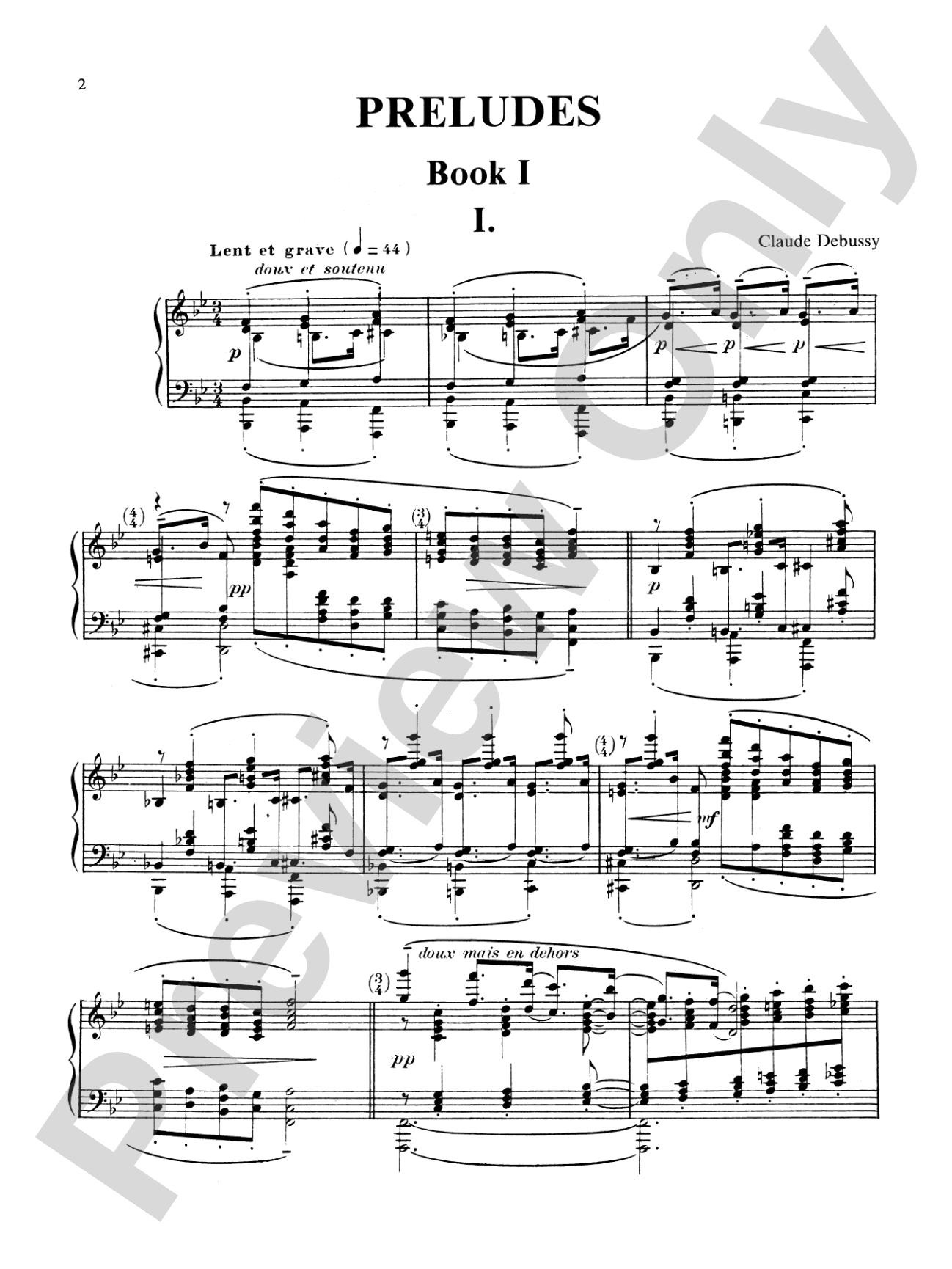
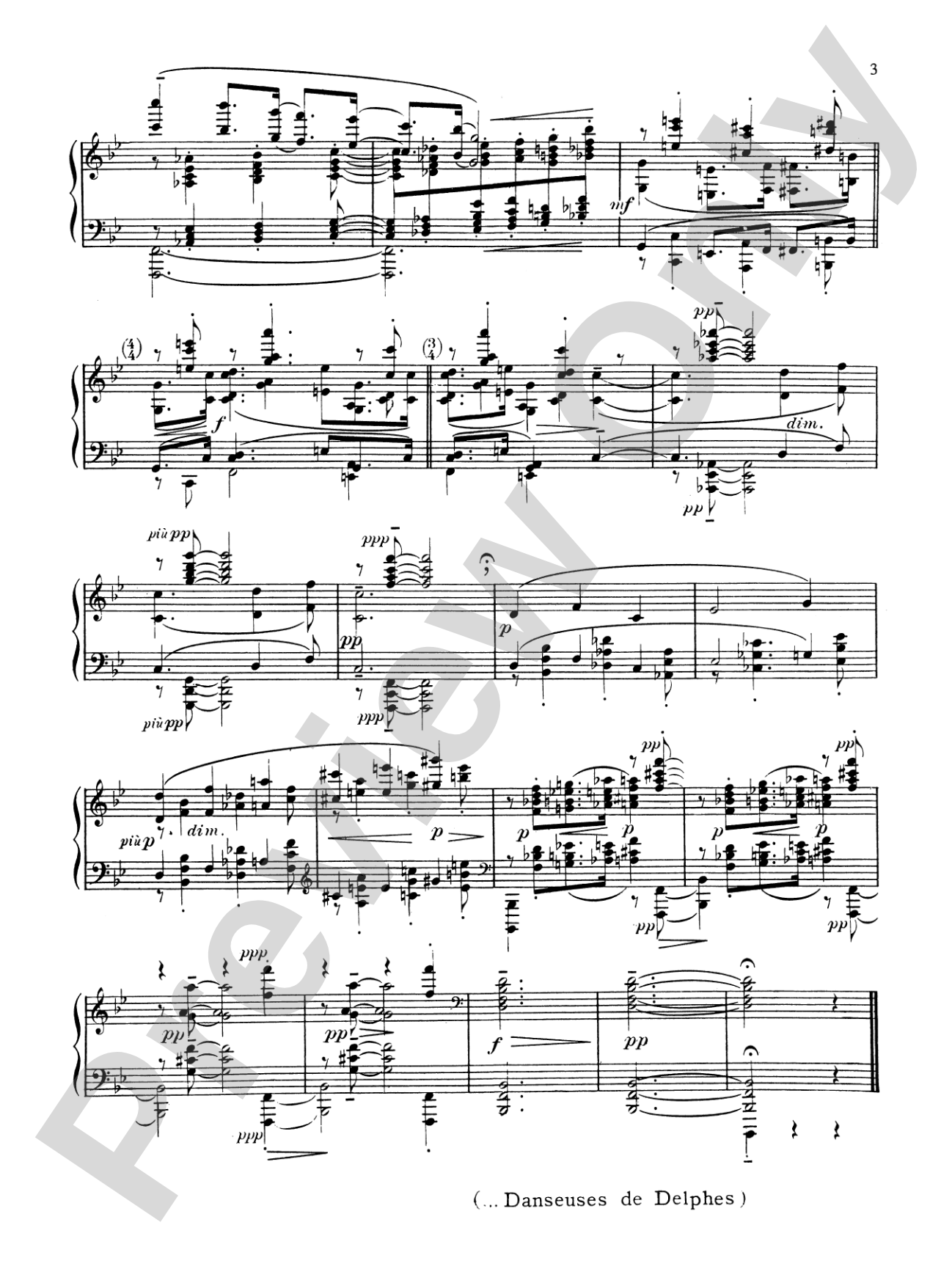
These beautiful French works are a must for all pianists. Titles: Book 1: Danseuses de Delphes * Voiles * Le vent dans la plaine * Les sons et les parfums tournent dans l'air du soir * Les collines d'Anacapri * Des pas sur la neige * Ce qu'a vu le vent d'Ouest * La fille aux cheveux de lin * La serenade interrompue * La Cathédrale engloutie * La danse de Puck * Minstrels. Book 2: Brouillards * Feuilles mortes * La Puerta del Vino * Les Fées sont d'exquises danseuses * Bruyères * "General Lavine" * La terrasse des a udiences du clair de lune * Ondine * Hommage à S. Pickwick Esq. * Canope * Les tierces alternées * Feux d'Artifice.


Don't just read it, hear it, play along with it, and watch your students grow with it. In MakeMusic Cloud, Debussy: Preludes (Books I & II Complete): Piano Book comes alive with professional accompaniment, adjustable tempo, and built-in practice tools that turn solo practice into real progress.
Open in the Player
Jump straight in and assign it today.
Start Your Free Trial
Open this title and explore the full library in minutes.
Sample Audio
No sample audio found.
Sample Video
No sample videos found.
Additional Details
Series:
Kalmus Edition
Publisher:
Alfred Music
Page Count:
132
SKU:
00-PK-0002770
More about this title
About the Composer: Claude Debussy
Claude Debussy (1862, 1918) fundamentally reshaped how composers approached harmony, texture, and form in the early twentieth century. Working within the French conservatory tradition but rejecting its rigid harmonic conventions, he developed a language of musical impressionism that prioritizes color and suggestion over narrative or development. His piano works remain central to the repertoire because they demand both technical precision and interpretive sensitivity from performers.
For students, Debussy's music teaches the relationship between sound and silence, between what is played and what is implied. His Preludes in particular reveal how a composer can build large-scale structures through atmosphere and gesture rather than traditional thematic development, making them invaluable studies in modernist compositional thinking.
Why we love this
These 24 Preludes showcase Debussy at his most inventive, each one a self-contained world with its own harmonic language and textural approach. The collection offers pianists an unparalleled opportunity to develop interpretive maturity alongside technical facility, moving far beyond the predictable patterns of nineteenth-century virtuosity into genuine musical storytelling.
What to expect
These pieces shimmer with suggestion rather than statement, painting scenes through sound rather than declaring them outright. Some float on gossamer textures and whole-tone harmonies; others pulse with rhythmic energy or evoke bells, wind, and water through inventive use of the keyboard.
Who it's for
Advanced pianists preparing for recitals, conservatory juries, or comprehensive study of twentieth-century repertoire will find these Preludes essential. Teachers seeking material to develop students' harmonic sophistication, pedal technique, and interpretive independence across two substantial books will appreciate the breadth and coherence of Debussy's vision.
How to get the most out of it
- Approach the sustain pedal as a compositional tool rather than a blanket effect; Debussy's harmonic ambiguity often depends on carefully timed pedal changes to blend or separate sonorities.
- Listen closely to the implied harmonic movement beneath surface figurations; many pieces use ostinato patterns that can easily become mechanical without attention to subtle shifts in color underneath.
- Balance the freedom of rubato with a secure sense of pulse, particularly in pieces with impressionistic textures where time can feel unmeasured but must still breathe within a coherent framework.
- Study the fingering patterns not as mere convenience but as guides to the intended voice leading and resonance; Debussy's choices reveal how different registers and hand positions color the same harmonic material.
How to use it
Building a recital around selected Preludes allows programmers to create a cohesive, sophisticated evening that showcases pianistic range without relying on showpiece conventions. Pairing individual Preludes with standard repertoire can also anchor a program conceptually, moving listeners between Romantic tradition and early modern sensibility.
Skills your students will build
- Pedal independence and control for blending and separating harmonic layers
- Whole-tone and pentatonic scale fluency and harmonic hearing
- Interpretive flexibility within a framework of structural coherence
- Tonal color production through fingering choices and hand positioning
- Reading complex rhythmic notation including cross-rhythms and asymmetrical patterns
- Understanding impressionistic harmonic syntax (parallel chords, modal mixture, unresolved dissonance)