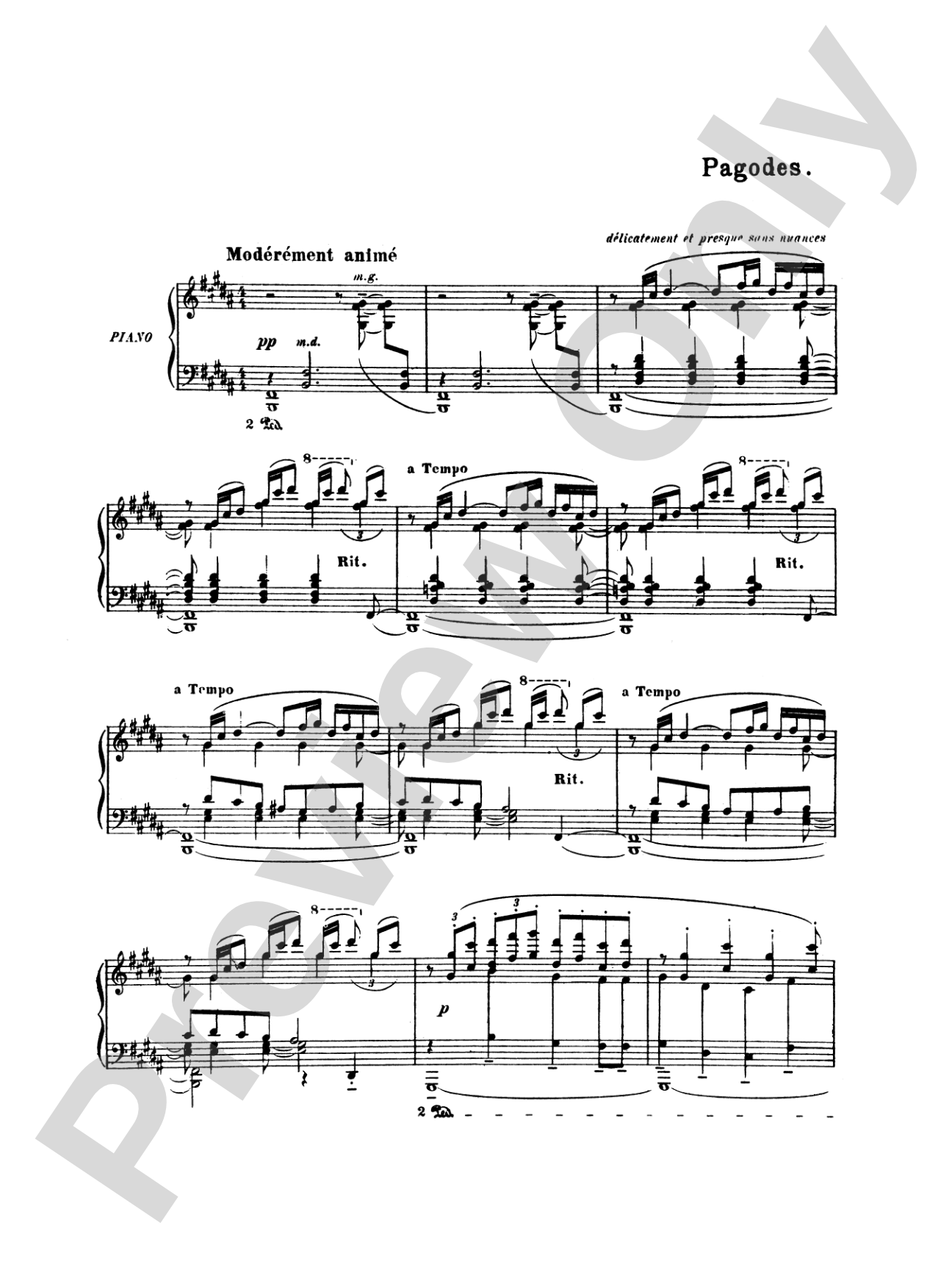
Debussy: Pagodes (from Estampes) Sheet Music Preview

Debussy: Pagodes (from Estampes)

By Claude Debussy

Item: 00-PC-0006910

Digital Download
$5.99
Description
Expertly arranged piano solo from our Kalmus Edition.

Don't just read it, hear it, play along with it, and watch your students grow with it. In MakeMusic Cloud, Debussy: Pagodes (from Estampes) comes alive with professional accompaniment, adjustable tempo, and built-in practice tools that turn solo practice into real progress.

Sample Audio
No sample audio found.
Sample Video
Additional Details
Series: Kalmus Edition
Publisher: Alfred Music
Page Count: 12
SKU: 00-PC-0006910

More about this title

About the Composer: Claude Debussy

Claude Debussy (1862-1918) fundamentally changed how composers approached harmony, color, and form. Rather than following the harmonic logic of the Romantic tradition, he treated chords as sonorities in their own right, exploring what sounds could suggest rather than state directly. His piano writing opened new possibilities for the instrument, often treating it as an orchestra of timbral possibilities.

Debussy's influence on music education extends far beyond performance. His compositions demonstrated that rigorous musical thinking could coexist with impressionistic beauty, making him essential study for pianists learning to hear beyond the page and for composers rethinking what structural coherence could mean in modern music.

Why we love this

Pagodes requires pianists to listen actively to the music unfolding beneath their fingers rather than relying on familiar harmonic pathways. The piece rewards careful attention to sustain pedal, voicing clarity, and timbral balance in ways that transfer directly to other contemporary repertoire. Programming this work signals to your audience that your students understand 20th-century pianistic language.

What to expect

Pagodes evokes the gentle shimmer of Javanese gamelan music that fascinated Debussy after hearing performances at the 1889 Paris Exposition. Pentatonic melody floats over shimmering chord clusters and repeating figures that suggest water, light, and distance rather than stating them outright. The piece unfolds like watching light refract through glass, constant yet always shifting.

Who it's for

Advanced pianists studying 20th-century impressionistic idiom and those preparing for college auditions or recital programs that include modern works. Students ready to move beyond Romantic-era harmonic logic will find this piece both accessible and deeply rewarding as a gateway into Debussy's larger catalogue and the impressionistic movement.

How to get the most out of it

  • Layer the left hand's repeating figures so they sound like a gentle ostinato rather than mechanical repetition; let the pedal blur the attack slightly while keeping individual notes audible.
  • Approach the right hand melodies as instrumental lines floating above the texture, not as primary material competing for weight; think of how a flute sits in an orchestra arrangement.
  • Balance sustain pedal changes with the harmonic rhythm, not the beat; Debussy's chord colors shift in ways that don't always align with the bar line.
  • Experiment with touch to differentiate between shimmering, static harmony and moments of actual melodic movement; the same hand position produces entirely different effects depending on whether you're coloring or singing.

How to use it

Place this on a recital where you can program it alongside other impressionistic works to create a thematic arc, or use it to bridge from Romantic-era repertoire into 20th-century modernism. Its moderate length and manageable technical demands make it valuable for a spring recital slot where students need a substantial contemporary work that showcases artistry and tonal control.

Skills your students will build

  • Sustain pedal control and timing in non-functional harmony
  • Voice leading across registers when harmonic direction is suggested rather than explicit
  • Timbral distinction between harmonic wash and melodic content
  • Reading and executing pentatonic melody against tertian harmonies
  • Listening to overtones and resonance in the instrument while maintaining clarity

You May Also Like