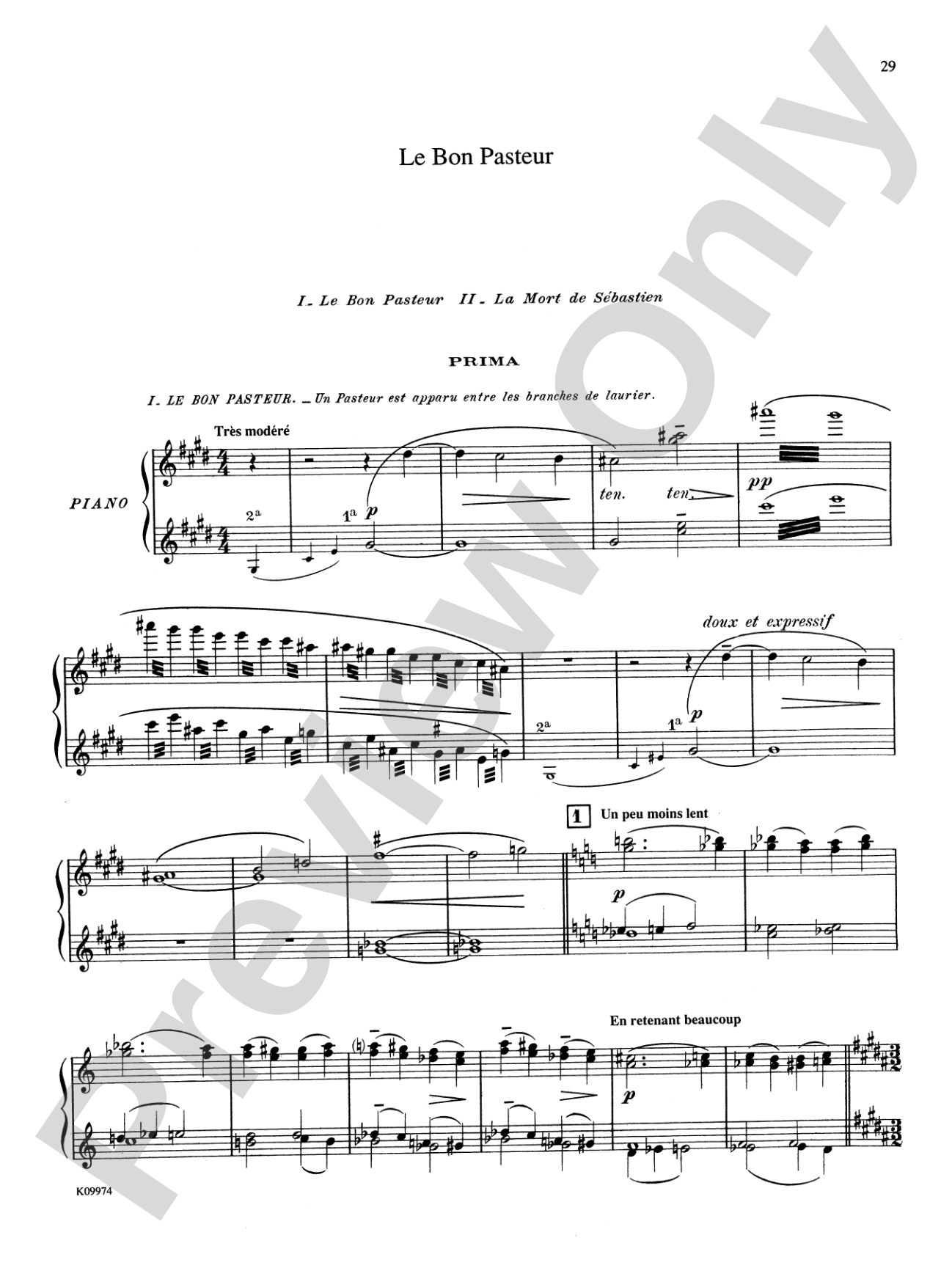
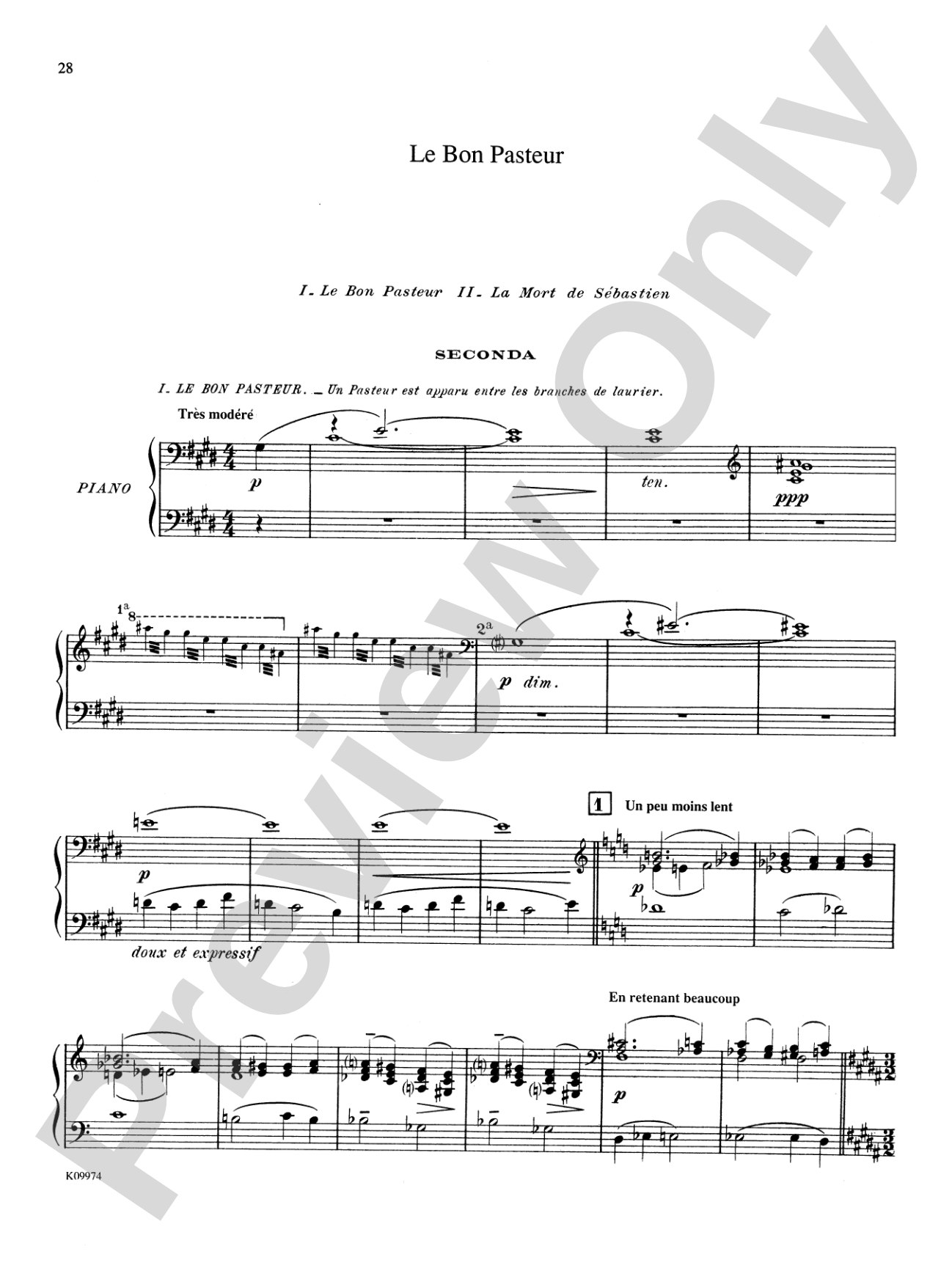
Debussy: Le Martyre de Saint Sébastien (Transcr. Roques) Sheet Music Preview

Debussy: Le Martyre de Saint Sébastien (Transcr. Roques)

By Claude Debussy / transcr. Léon Roques

Item: 00-PC-0014230

Digital Download
$1.99
Description
A new printing of the Roques transcription of Debussy's incidental orchestral work Le Martyre de Saint Sebastien. The work consists of four movements and may be performed as a complete set, or the movements individually. Some movements are easier than others. This piece will make a wonderful addition to recital programs.

Don't just read it, hear it, play along with it, and watch your students grow with it. In MakeMusic Cloud, Debussy: Le Martyre de Saint Sébastien (Transcr. Roques) comes alive with professional accompaniment, adjustable tempo, and built-in practice tools that turn solo practice into real progress.

Sample Audio
No sample audio found.
Sample Video
Additional Details
Series: Kalmus Edition
Publisher: Alfred Music
Page Count: 48
SKU: 00-PC-0014230

More about this title

About the Composer: Claude Debussy

Claude Debussy (1862-1918) fundamentally reshaped how composers approached harmony, orchestration, and form in the late nineteenth and early twentieth centuries. His innovations with whole-tone scales, parallel chord movement, and impressionistic color transformed piano writing and orchestral technique alike, making him essential study for pianists and composers seeking to understand modern musical language.

Debussy's theater works, including Le Martyre de Saint Sébastien, reveal his gift for creating atmospheric, spiritually charged soundscapes through instrumental color. His approach to melody and harmony influenced generations of twentieth-century composers and remains central to the repertoire of accomplished pianists and serious music students.

Why we love this

This transcription gives four-hand pianists access to one of Debussy's most evocative dramatic works without requiring an orchestra. The flexibility to program movements individually or as a complete suite means you can shape the work to fit your recital needs, and the varying difficulty levels across movements make this genuinely useful for collaborative pairs with different technical abilities.

What to expect

Mystical and ethereal, yet structurally purposeful. The four movements drift through Debussy's signature harmonic ambiguity, with moments of startling beauty alongside passages of dark, liturgical intensity. The writing feels orchestral on the keyboard—shimmering, impressionistic, occasionally austere.

Who it's for

Advanced piano duet partners seeking substantial repertoire that showcases Debussy's harmonic innovations without demanding virtuosic fireworks. This work suits programs featuring impressionistic or early twentieth-century music and appeals to pianists who want to explore dramatic, spiritually inflected material.

How to get the most out of it

  • Balance the transparency of Debussy's orchestral colors across both players; the primo part often carries thematic material while the secondo provides harmonic context and texture, so neither player should overshadow the other.
  • Pedal carefully and deliberately, as Debussy's harmonic language relies on resonance and color that the piano sustains differently than the orchestra; coordinate pedal changes between both players to avoid muddiness.
  • Listen closely to the recorded accompaniment or a recording of the orchestral original to internalize the phrasing and rubato Debussy's music demands; the transcription gains authenticity when you understand its orchestral source.

How to use it

Program individual movements as contrasting pieces within a recital of impressionistic works, or perform the complete four-movement cycle as a dramatic centerpiece on a concert featuring French piano literature. The work's theatrical character and varying movement lengths make it adaptable to different program structures.

Skills your students will build

  • Reading and executing Debussy's whole-tone and chromatic harmonic language
  • Balancing transparency and color across two players sharing one instrument
  • Coordinating pedal changes and managing resonance in impressionistic texture
  • Interpreting tempo flexibility and rubato in early twentieth-century music
  • Collaborating as primo and secondo to maintain unified phrasing and dynamics

You May Also Like