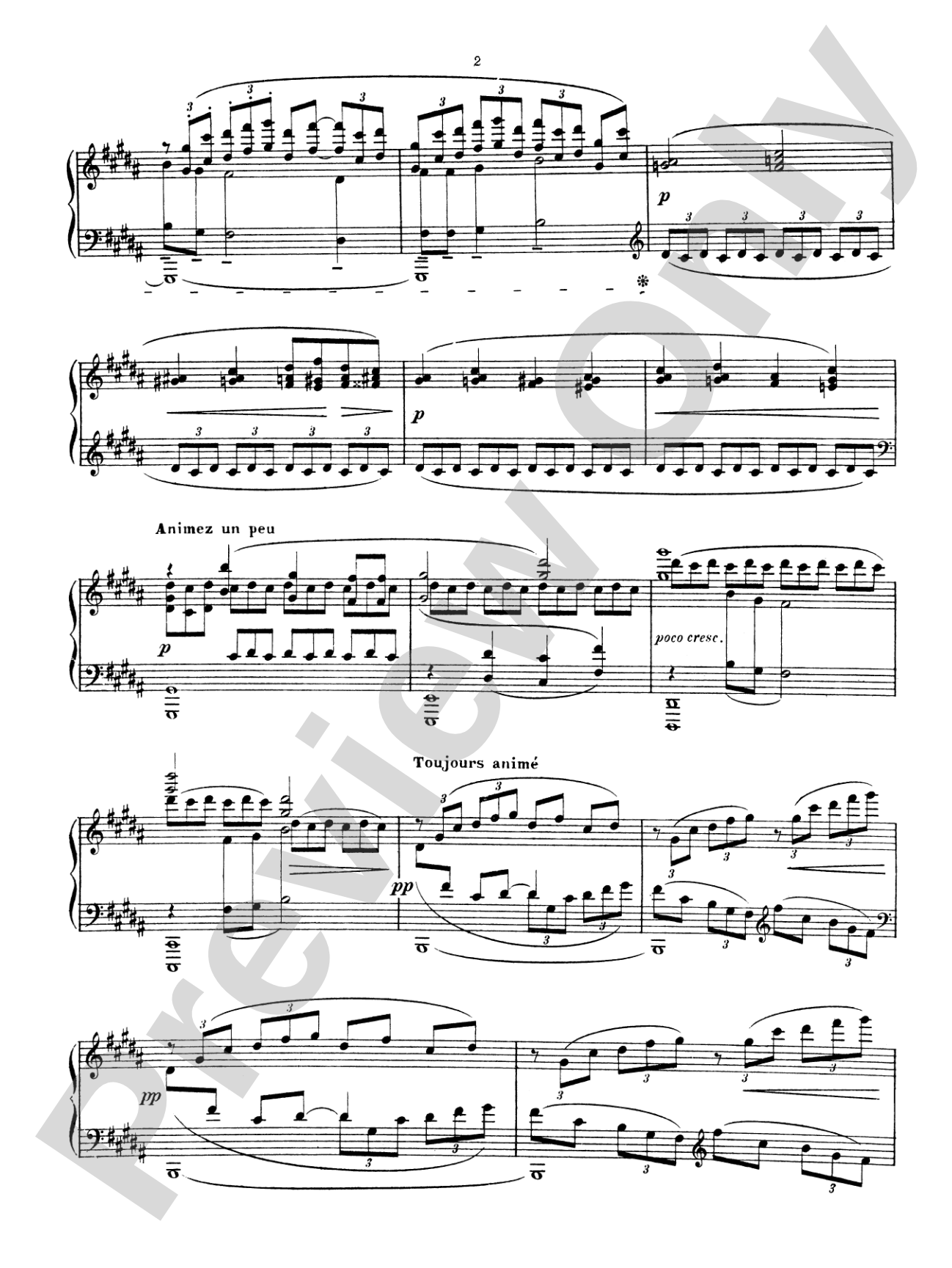
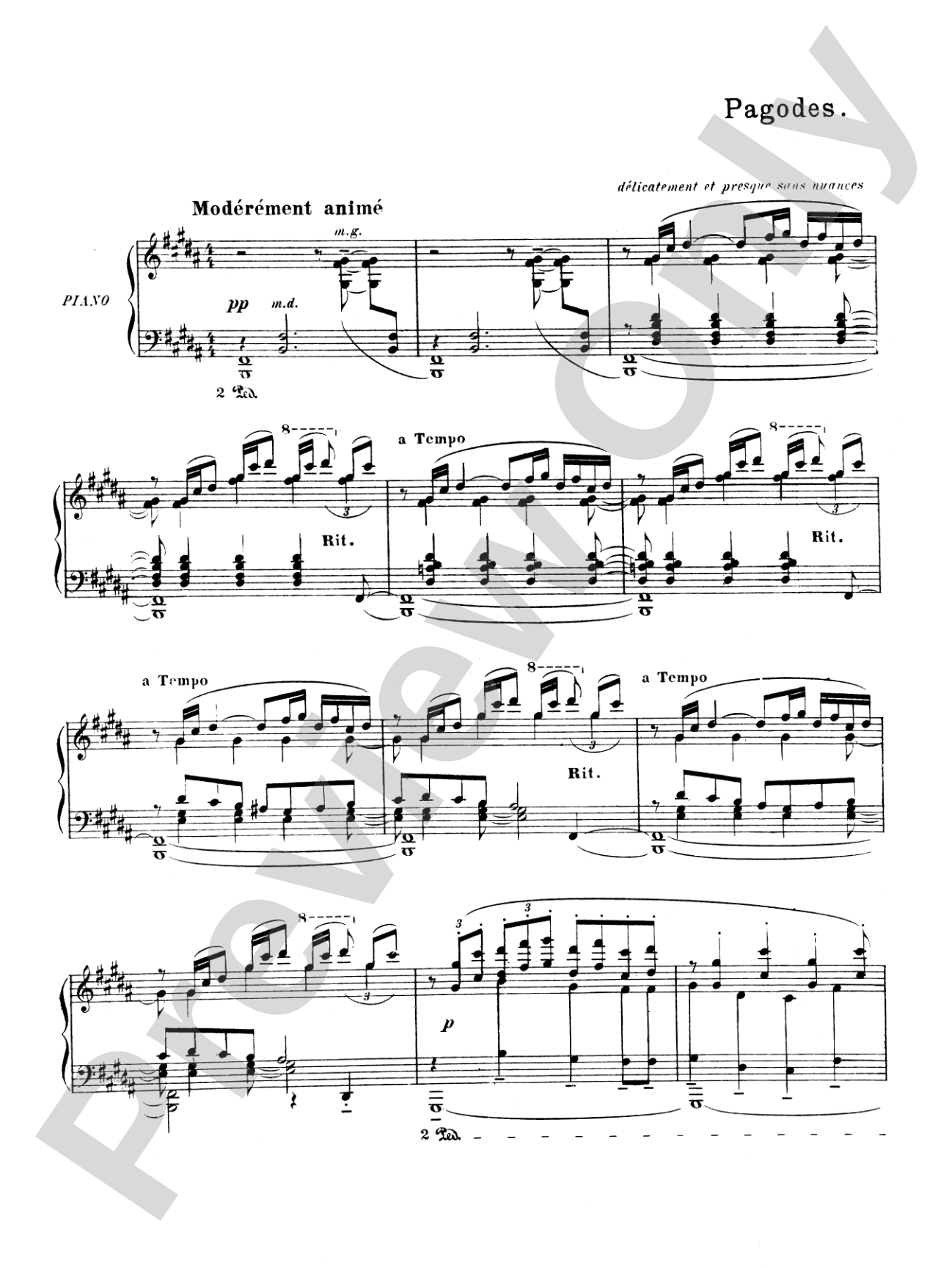
Debussy: Estampes Sheet Music Preview

Debussy: Estampes

By Claude Debussy

Level: Advanced

Item: 00-PC-0006900

Digital Download
$1.99
Description

Don't just read it, hear it, play along with it, and watch your students grow with it. In MakeMusic Cloud, Debussy: Estampes comes alive with professional accompaniment, adjustable tempo, and built-in practice tools that turn solo practice into real progress.

Sample Audio
No sample audio found.
Sample Video
Additional Details
Series: Kalmus Edition
Publisher: Alfred Music
Page Count: 24
SKU: 00-PC-0006900

More about this title

About the Composer: Claude Debussy

Claude Debussy (1862-1918) fundamentally reshaped how composers approached harmony, texture, and orchestral color in the late 19th century. His work moved beyond the thick chromaticism of Wagner and the rigid forms of academic tradition, instead building pieces from impressions, timbre, and the subtle interactions of sound. Debussy's piano writing in particular treated the instrument as an orchestra itself, exploiting resonance, pedal effects, and register to create shimmering, atmospheric soundscapes that influenced generations of composers and pianists.

Estampes stands as one of his most important early piano collections, completed in 1903. The work demonstrates his mature compositional voice and remains essential to understanding 20th-century keyboard literature. His influence on contemporary classical music, jazz, and film scoring is immeasurable.

Why we love this

Estampes presents three entirely distinct musical worlds without sacrificing coherence or sophistication. Each movement develops its own harmonic language and pianistic vocabulary, giving advanced students a masterclass in how impressionistic technique can serve radically different expressive goals. The collection demands serious engagement with pedal control, harmonic ambiguity, and the physics of the instrument itself.

What to expect

Estampes evokes travel, sensory immersion, and the distortion of memory. The three movements transport the listener to different emotional and geographic landscapes, each rendered in shimmering, impressionistic detail. The writing floats between clarity and haze, grounding itself occasionally in concrete harmonic moments before dissolving back into atmospheric suggestion.

Who it's for

Advanced pianists preparing repertoire for conservatory study, competition, or recital performance. This collection belongs in the hands of students ready to grapple with extended harmonic language, coloristic pedal work, and the interpretive freedom that impressionistic music demands.

How to get the most out of it

  • Treat the pedal as a compositional element, not an effect. Debussy's pedal markings create harmonic resonance that's integral to the piece's structure; changing pedal too frequently muddies his carefully layered sonorities.
  • Listen for the melodic lines buried within chordal and textural passages. In impressionistic writing, the tune isn't always on top, and bringing out inner voices requires careful voicing and attention to weight distribution across the keyboard.
  • Work with the printed dynamics and articulation marks as guides to phrase structure. Debussy's markings are sparse but deliberate; respecting them reveals his formal architecture.
  • Balance technical clarity with the piece's dreamy, impressionistic surface. Precision in the accompaniment figures allows the harmonic colors to emerge without sounding mechanical.

How to use it

Program this collection on a recital that explores early modernism or 20th-century keyboard literature. Estampes pairs well with other impressionistic works (Ravel, Satie) or with pieces that respond to it stylistically. For students, learning these pieces opens doors to contemporary repertoire that builds on similar harmonic and textural principles.

Skills your students will build

  • Pedal technique and harmonic resonance management
  • Reading and interpreting ambiguous harmony and extended tonality
  • Voicing inner melodic lines within complex textures
  • Controlling tone color and dynamics to create impressionistic atmosphere
  • Balancing technical precision with interpretive freedom

You May Also Like