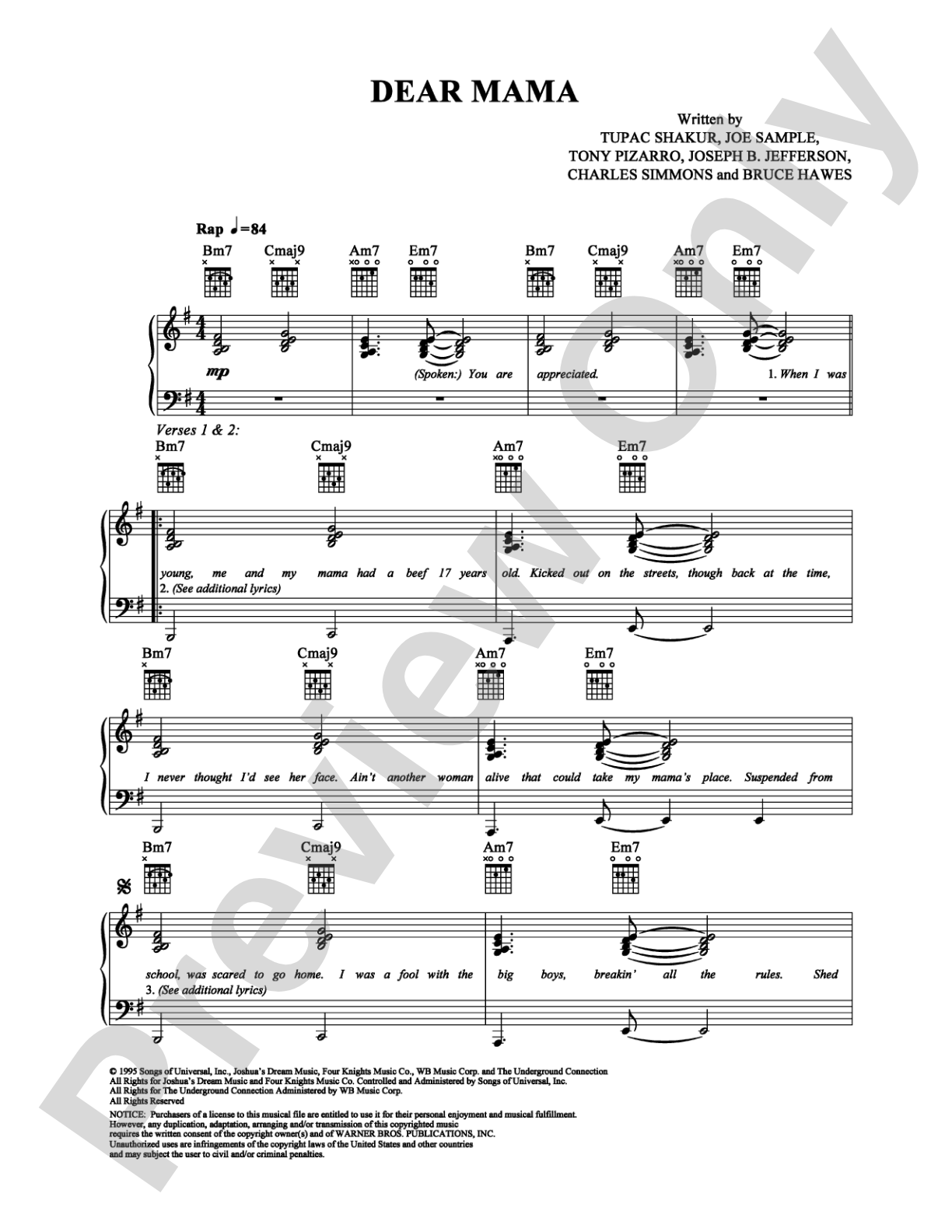
Dear Mama: Piano/Vocal/Chords Digital Sheet Music

Dear Mama: Piano/Vocal/Chords Digital Sheet Music

Tupac Shakur, Joseph B. Jefferson, Charles Simmons, Bruce Hawes, Joe Sample, Tony Pizarro

Item: 00-PS-0006402

Digital Download
$3.99
Description

Dear Mama: Piano/Vocal/Chords Digital Sheet Music isn't in MakeMusic Cloud just yet...but it could be. Let us know you'd like to see it, and you'll help shape what comes next. In the meantime, start a free trial and dive into thousands of interactive titles your students can play along with today.

Sample Audio
No sample audio found.
Sample Video
Additional Details
SKU: 00-PS-0006402

More about this title

About the Artist: Tupac Shakur

Tupac Shakur (1971-1996) was a rapper, actor, and cultural figure whose influence extended far beyond hip-hop. His music combined introspective lyricism with social commentary, addressing themes of poverty, systemic inequality, and personal struggle with unusual emotional depth for the genre. Shakur's ability to shift between aggressive delivery and vulnerable storytelling made him one of the most compelling voices in 1990s rap.

As a composer and artist, Shakur worked with producers who shaped his sound into something both sonically sophisticated and lyrically complex. His catalog remains studied in music education contexts as an example of how vernacular music can carry substantive artistic and social weight. Teachers and musicians continue to engage with his work to understand contemporary songwriting, narrative structure in popular music, and the intersection of poetry and production.

Why we love this

This is an opportunity to place significant hip-hop repertoire in the hands of piano students and vocalists who might not otherwise encounter it in formal music education. The song's emotional directness and the challenge of interpreting rap phrasing through a piano/vocal arrangement opens conversations about genre, authenticity, and how different musical settings can reveal new dimensions of a composition.

What to expect

A moment of raw honesty framed by piano accompaniment that grounds the intensity without softening it. The song moves between aggressive urgency and tender vulnerability, creating space for the vocalist to inhabit both registers authentically. The arrangement invites pianists to support a deeply personal narrative without overshadowing the words at its center.

Who it's for

Vocalists and pianists studying contemporary repertoire, hip-hop history, or songwriting that blends personal narrative with social consciousness. This arrangement opens the door for advanced high school and college students to examine how 1990s rap classics function as composed music deserving of serious performance and interpretation.

How to get the most out of it

  • Study the original recording to understand Shakur's phrasing and rhythmic placement against the beat; the piano/vocal score notation may not fully capture the syncopation and breath work that define his delivery.
  • Treat the piano part as a foundation that supports, rather than doubles, the vocal line; this creates space for the vocalist's natural inflection and ad-lib sensibility.
  • Balance lyrical clarity with musicality; the spoken passages and rapid-fire verses require intentional diction work separate from pure vocal technique.
  • Experiment with the relationship between rubato in the vocal line and a steady, grounded piano accompaniment to capture the emotional tension in the song's most vulnerable moments.

How to use it

Include this in a recital or showcase focused on American songwriting across genres, particularly one examining how hip-hop artists function as composers and lyricists. It also works as a bridge piece when programming classical vocal works alongside contemporary music, helping audiences understand that formal musical study and hip-hop are not opposing categories.

Skills your students will build

  • Interpreting syncopated rhythms and rap phrasing in a notated score
  • Adapting vocal delivery across multiple emotional registers within a single piece
  • Accompanying a vocalist with sensitivity to spoken word and rhythmic flexibility
  • Understanding how genre conventions (hip-hop) translate into piano/vocal arranging choices

You May Also Like