
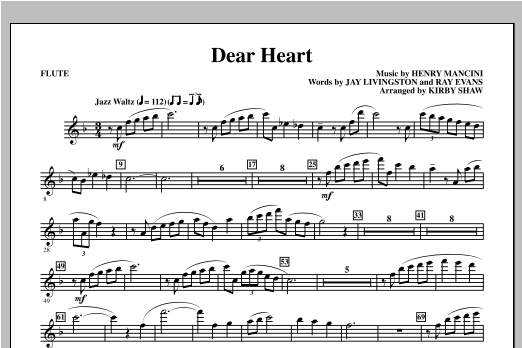

Dear Heart (arr. Kirby Shaw): Choral Instrumental Pak
Arranged by Kirby Shaw
Item: 35-PK00261643
$20.00
Pickup currently not available
Buy Extra Parts (Digital PDF Download)
Parts Added to Cart!
Description
Flute and rhythm section bring charm to this jazz waltz setting of Henry Mancini's famous theme from the 1964 movie, most famously recorded by Andy Williams. Available separately: SATB, SAB, SSA, ShowTrax CD. Rhythm Section and Flute parts available as a digital download (fl, gtr, b, dm). Duration: ca. 2:55.


Dear Heart (arr. Kirby Shaw): Choral Instrumental Pak isn't in MakeMusic Cloud just yet...but it could be. Let us know you'd like to see it, and you'll help shape what comes next. In the meantime, start a free trial and dive into thousands of interactive titles your students can play along with today.
Request This Title
Tell us you want it.
Start Your Free Trial
Explore everything that's ready to play right now.
Sample Audio
No sample audio found.
Sample Video
No sample videos found.
Additional Details
Publisher:
Hal Leonard
SKU:
35-PK00261643
More about this title
About the Arranger: Kirby Shaw

Kirby Shaw's reputation as a choral educator reaches across six continents, from his early work in Mt. Shasta public schools through his leadership of innovative vocal jazz ensembles at College of the Siskiyous, Colorado State University, and the University of Missouri at Kansas City. His formal training spans Music Education and Choral Composition from San Jose State University, plus a DMA in Choral Conducting from the University of Washington. He has studied jazz vocalization directly with legends including Bobby McFerrin, Al Jarreau, and Jon Hendricks, bringing that hands-on knowledge into every arrangement he creates.
With over 2500 published choral works selling nearly 20 million copies worldwide, Shaw balances prolific output with meticulous craft. His recent commission from the Mormon Tabernacle Choir alongside ongoing work with his a cappella ensemble Just 4 Kicks keeps him rooted in active music-making. Multiple ASCAP awards acknowledge the reach of his compositions, which continue to define the choral music landscape in concert halls and classrooms globally.
Why we love this
Shaw's arrangement transforms a beloved standard into something that sits perfectly between accessible charm and legitimate musical sophistication. The jazz waltz framework feels natural and swingable rather than forced, while the flute and rhythm section writing gives instrumental players real personalities to explore without overshadowing the singers. This is one of those arrangements that makes both directors and students genuinely happy to rehearse it.
What to expect
Nostalgia with a wink. The arrangement trades maudlin sentimentality for genuine elegance, letting the jazz waltz meter give the melody room to breathe. It feels like a sophisticated evening where everyone's at ease.
Who it's for
Choirs seeking repertoire that bridges concert traditions with accessible popular material will find a natural fit here. Directors building mixed-level ensembles benefit from how the SATB, SAB, and SSA options let you customize voicing while maintaining the same gorgeous orchestration.
How to get the most out of it
- Balance the flute line so it shines as a true voice in the ensemble rather than doubling or shadowing the choir. This melody needs air and independence to make the jazz waltz feel alive.
- Let the rhythm section lock into a relaxed, conversational swing feel. The drums should lay back slightly rather than pushing the tempo; this music breathes better when it floats a little.
- Encourage the singers to listen closely to the guitar and bass during bridges or sectional moments. The conversational interplay between voices and instruments is where the arrangement really earns its character.
- Use dynamics subtly. The arrangement's sophistication comes through in how the voices nestle around the flute and rhythm section, not in sudden dynamic shifts.
How to use it
This works beautifully as a contrast piece in a concert of varied styles, or as the emotional anchor of a program built around standards and vocal jazz. The roughly three-minute duration makes it ideal for closing a set with something genuinely warm, or mid-program when you want to shift the mood without losing momentum.
Skills your students will build
- Singing in swing feel and jazz phrasing within a waltz meter
- Listening across ensemble parts to maintain balance between voices and instruments
- Reading and interpreting jazz chord changes and voicings
- Sustaining legit vocal tone while navigating jazz inflection