Deacon Blues Sheet Music Preview

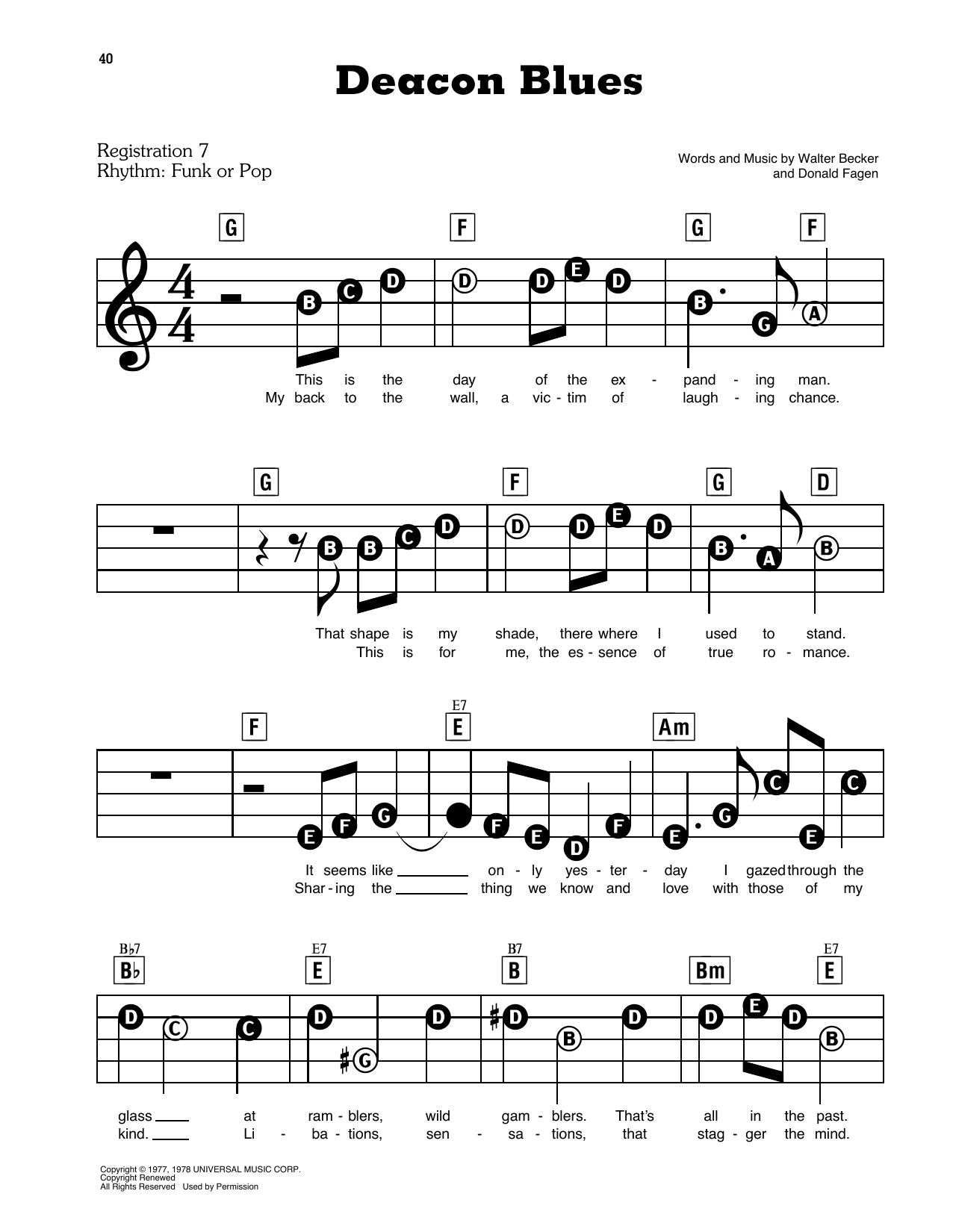
Deacon Blues: E-Z Play Today

As performed by Steely Dan

Item: 35-DS00451260

Digital Download
$4.99
Description

Deacon Blues: E-Z Play Today isn't in MakeMusic Cloud just yet...but it could be. Let us know you'd like to see it, and you'll help shape what comes next. In the meantime, start a free trial and dive into thousands of interactive titles your students can play along with today.

Sample Audio
No sample audio found.
Sample Video
Additional Details
Publisher: Hal Leonard
Page Count: 4
SKU: 35-DS00451260

More about this title

About the Artist: Steely Dan

Steely Dan emerged from the Los Angeles studio scene in the early 1970s as Donald Fagen and Walter Becker, two songwriters obsessed with harmonic sophistication, rhythmic precision, and jazz inflections. Their meticulous approach to arranging and production set a standard for pop music that valued musicianship and complex harmonies alongside radio accessibility. For music educators, Steely Dan's catalog offers a masterclass in how jazz language lives within popular song structures, making their work invaluable for students learning to navigate sophisticated chord changes and syncopated grooves.

Their influence on contemporary jazz and pop arranging remains substantial because they proved that intricate voicings, extended harmonies, and subtle rhythmic displacements could reach mainstream audiences. Teaching Steely Dan gives students permission to embrace complexity without sacrificing musicality or groove.

Why we love this

This arrangement captures what makes Steely Dan's compositional voice distinctive: jazz voicings that sit comfortably under a rock groove, with enough harmonic motion to keep pianists engaged through multiple hearings. Four pages is the right length to explore the song without overwhelming students, and the melody translates beautifully to the solo voice on piano. Your students will encounter the kind of sophisticated chord extensions and substitutions they'll hear in contemporary jazz, but grounded in a song they might actually recognize.

What to expect

A urbane, slightly detached coolness underlies the groove, as though the song knows something wry about the world. The voicings are rich and modern without sounding precious, and there's enough space in the arrangement for the pianist to develop interpretive choices around dynamics and touch.

Who it's for

Pianists who are beginning to explore jazz harmony through popular song, particularly those comfortable reading chord symbols alongside traditional notation. This arrangement also works for students building groove sensitivity and understanding how syncopation functions within a rock context.

How to get the most out of it

  • Let the rhythm breathe. Steely Dan's grooves sit slightly behind the beat; rush the tempo and you lose the character entirely.
  • Voice the left hand voicings as written rather than reducing them to root position chords. The specific intervals matter to the harmonic color.
  • Balance the melody so it sits above the harmonic texture without sounding detached. Think 'conversational' rather than 'accompanied.'

How to use it

Pair this with other piano arrangements of 1970s pop and rock that use jazz harmony (Doobie Brothers, Steely Dan's own catalog) to show students how this harmonic language saturated commercial music during that era. It also works well as a solo recital piece for an advanced student, especially if they're building a program around the intersection of jazz and rock.

Skills your students will build

  • Reading and realizing jazz voicings on piano
  • Distinguishing between melody and harmonic accompaniment in syncopated contexts
  • Sustaining a groove with deliberate rhythmic placement
  • Voice leading in extended harmony (sevenths, ninths, and altered extensions)

You May Also Like