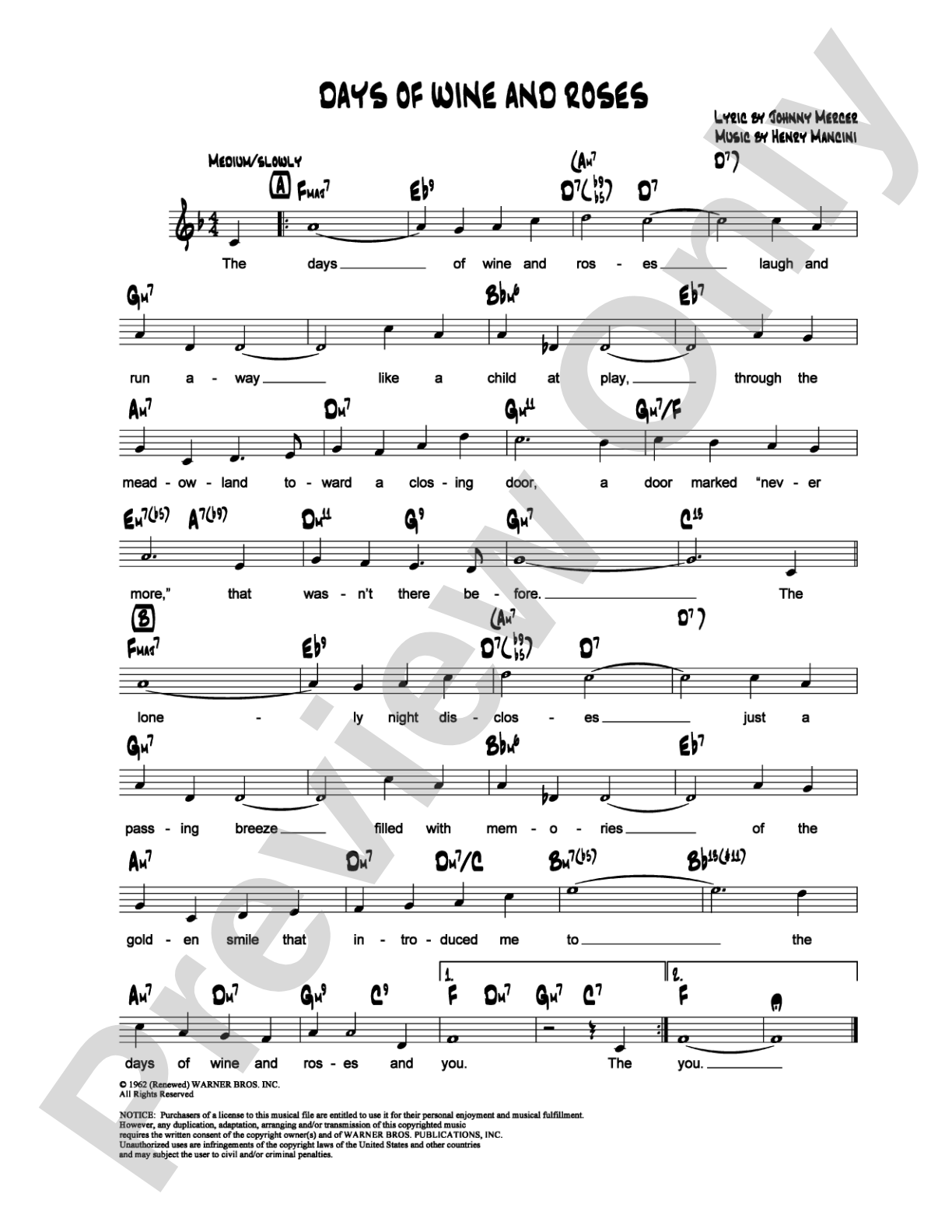
Days of Wine and Roses: Lead Sheet Digital Sheet Music

Days of Wine and Roses: Lead Sheet Digital Sheet Music

Henry Mancini, Andy Williams

Item: 00-PS-0002085

Digital Download
$1.99
Description

Days of Wine and Roses: Lead Sheet Digital Sheet Music isn't in MakeMusic Cloud just yet...but it could be. Let us know you'd like to see it, and you'll help shape what comes next. In the meantime, start a free trial and dive into thousands of interactive titles your students can play along with today.

Sample Audio
No sample audio found.
Sample Video
Additional Details
SKU: 00-PS-0002085

More about this title

About the Artist: Andy Williams

Andy Williams (1927-2012) was an American singer and television personality whose smooth baritone and sophisticated interpretations made him one of the defining vocalists of the 1950s and 1960s. His career spanned recording, film, and an iconic television variety show that introduced millions to standards and popular songs performed with genuine musicianship and warmth.

Why we love this

This lead sheet captures one of the most elegantly crafted standards in the American songbook, and having it in digital form means your students can work through the melody and chord changes at their own pace without hunting for vinyl or out-of-print books. The song's moderate range and straightforward melodic contour make it accessible for developing musicians while its rich harmonic palette rewards deeper study in jazz and popular music contexts.

What to expect

A wistful, nostalgic tune that moves with unhurried elegance. The melody unfolds like a conversation between old friends, tinged with gentle melancholy yet grounded in musical grace. There's an inherent sophistication in the phrasing that invites lyrical, thoughtful interpretation.

Who it's for

Jazz pianists and vocalists learning the standard repertoire benefit from studying this lead sheet's clean harmonic language and timeless melody. It's equally valuable for music theory students exploring mid-century song composition and arrangers looking to understand how a deceptively simple tune can support sophisticated reharmonization.

How to get the most out of it

  • Pay attention to the lyrical phrasing suggested by the words even if you're playing an instrumental version; the melody sits naturally when shaped like song rather than strict notation.
  • Voice the chords with intention rather than playing them mechanically. Each harmonic shift supports the emotional arc of the melody.
  • Notice where the melody moves by step versus leap, and let that guide your dynamic shaping and articulation choices.

How to use it

This works well in jazz ensemble or vocal jazz recitals where standards are featured alongside original compositions. It pairs naturally with other mid-century popular songs and offers an excellent stepping stone for students transitioning from classical to jazz or popular music contexts.

Skills your students will build

  • Reading and performing chord changes in lead sheet notation
  • Phrasing and expression in the context of song melody
  • Understanding functional harmony in American popular song
  • Stylistic interpretation of jazz standards

You May Also Like