

Daydreams: Violin Educational Pack
By Robert Sheldon
Grade: 1
Item: 00-PC-0016363_VN_EDPAK
$5.99
Pickup currently not available
Description
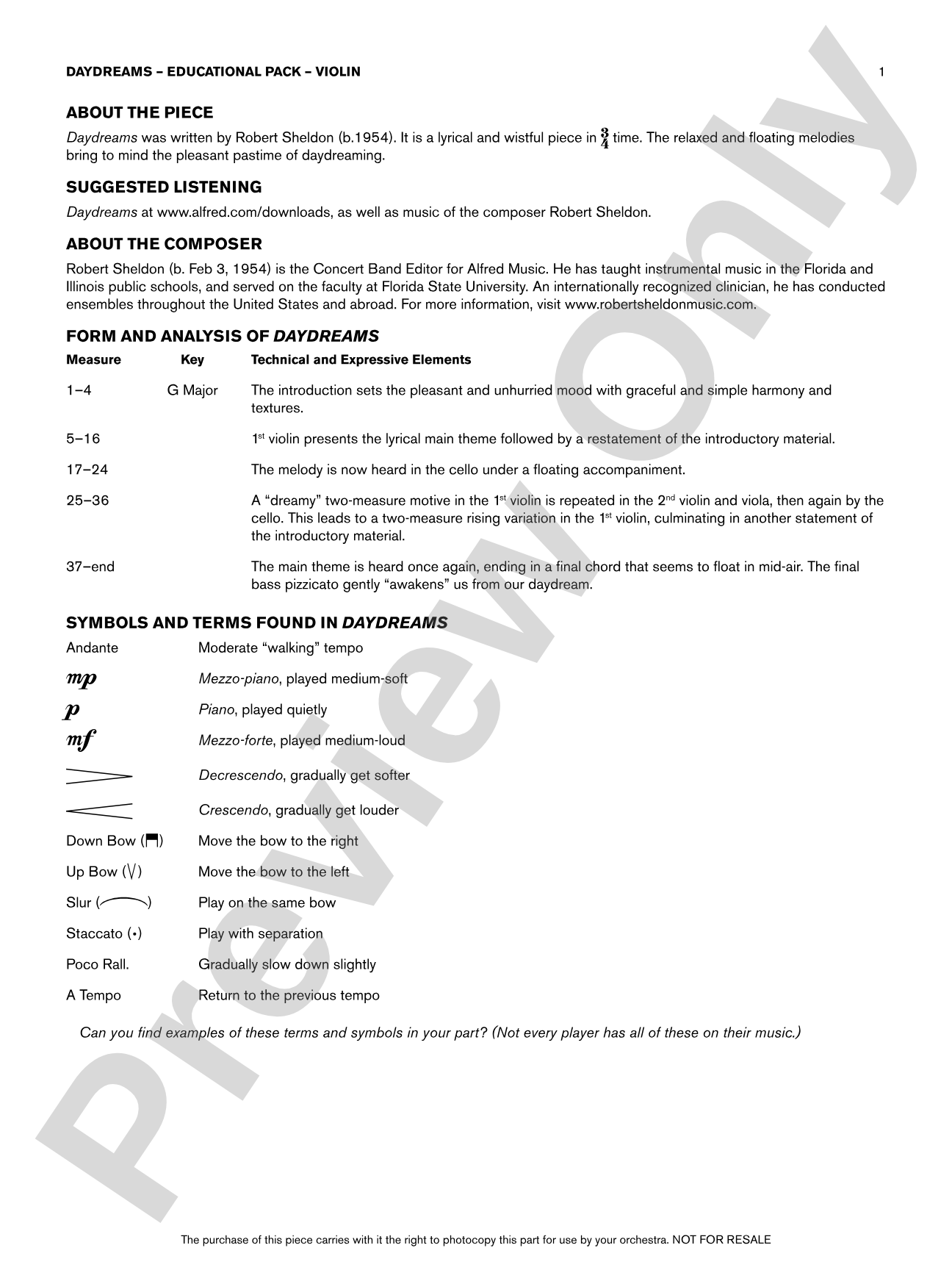
Everyone has the pleasure of an occasional daydream where reality is set aside and happy thoughts or memories are brought to mind. It is in this spirit that this piece transports your audience to a lovely, imaginary place during your concert. (1:40)
Correlates to Sound Innovations Book 1, Level 4. This title is available in MakeMusic Cloud.


Correlates to Sound Innovations Book 1, Level 4. This title is available in MakeMusic Cloud.
Don't just read it, hear it, play along with it, and watch your students grow with it. In MakeMusic Cloud, Daydreams: Violin Educational Pack comes alive with professional accompaniment, adjustable tempo, and built-in practice tools that turn solo practice into real progress.
Open in the Player
Jump straight in and assign it today.
Start Your Free Trial
Open this title and explore the full library in minutes.
Sample Audio
1
Audio File
--:--
0:00
0:00
Sample Video
No sample videos found.
Additional Details
Series:
Sound Innovations for String Orchestra
Publisher:
Alfred Music
Page Count:
80
SKU:
00-PC-0016363_VN_EDPAK
More about this title
About the Composer: Robert Sheldon

Robert Sheldon's output spans both wind band and string orchestra repertoire, earning him recognition as one of the most frequently performed composers in American schools. His works have received accolades from the American School Band Director's Association, Phi Beta Mu, and ASCAP, and they appear regularly on state and national festival programs. Beyond composing, Sheldon serves as lead author of the Sound Innovations series and maintains an active schedule as guest conductor and clinician at honor bands, universities, and state music education conferences across the United States and internationally.
Sheldon's conducting and teaching engagements have taken him to venues including Carnegie Hall, Orchestra Hall in Chicago, Symphony Hall in Boston, the Sydney Opera House, and the Kennedy Center. His work with ensembles on multiple continents has reinforced his understanding of how music education shapes young musicians. He received an honorary doctorate from VanderCook College of Music in 2020, recognizing his sustained contributions to the field.
Why we love this
Sheldon's skill at writing for younger ensembles shines here. He crafts an entirely singable melodic line supported by simple, supportive harmony that lets every stand contribute meaningfully without overwhelming them. The piece accomplishes something many Grade 1 works struggle with: it sounds mature and genuinely musical while remaining technically accessible.
What to expect
Daydreams captures that moment when your mind wanders somewhere warm and comforting. The orchestration is unhurried and gentle, with a straightforward melody that invites the listener into an imaginary landscape. By the end of its 1:40 duration, the piece leaves audiences feeling transported and refreshed, exactly as Sheldon intended.
Who it's for
This piece is designed for string orchestras at Grade 1 level, particularly ensembles working through Sound Innovations Book 1 at Level 4. It suits programs introducing young orchestral musicians to concert repertoire that feels rewarding without demanding advanced technique.
How to get the most out of it
- Shape the main melody with gentle phrase arcs rather than playing it straight. Younger string players often benefit from a conductor who models the breathing and release points they should hear in each four or eight-bar phrase.
- Balance the accompaniment parts so they recede behind the primary melodic voice. Many conductors find that asking inner voices to play a touch softer than marked actually reveals Sheldon's harmonic clarity.
- Let the piece breathe at natural phrase endings. Resist rushing through section transitions; a brief pause or ritardando signals to the audience that we are moving between thoughts within the daydream.
- Encourage open, sustained bow strokes in the upper strings during melodic moments. The emotional core of this work depends on tone quality, not technical display.
How to use it
Program this as a concert opener or as part of a thematic set exploring imagination and memory. Its brief length and accessible character make it ideal for family concerts, holiday programs, or spring festivals where you want to show students' musical growth without programming a technically demanding piece. It pairs well alongside folk song arrangements or other Grade 1 works that emphasize lyricism.
Skills your students will build
- Sustaining long melodic lines with consistent vibrato and tone quality
- Balancing harmonic texture so inner voices support without overpowering the melody
- Responding to conductor's phrasing and phrase shaping cues
- Playing with dynamic control and nuance at Grade 1 level
- Coordinating ensemble entries and releases across the full string orchestra