
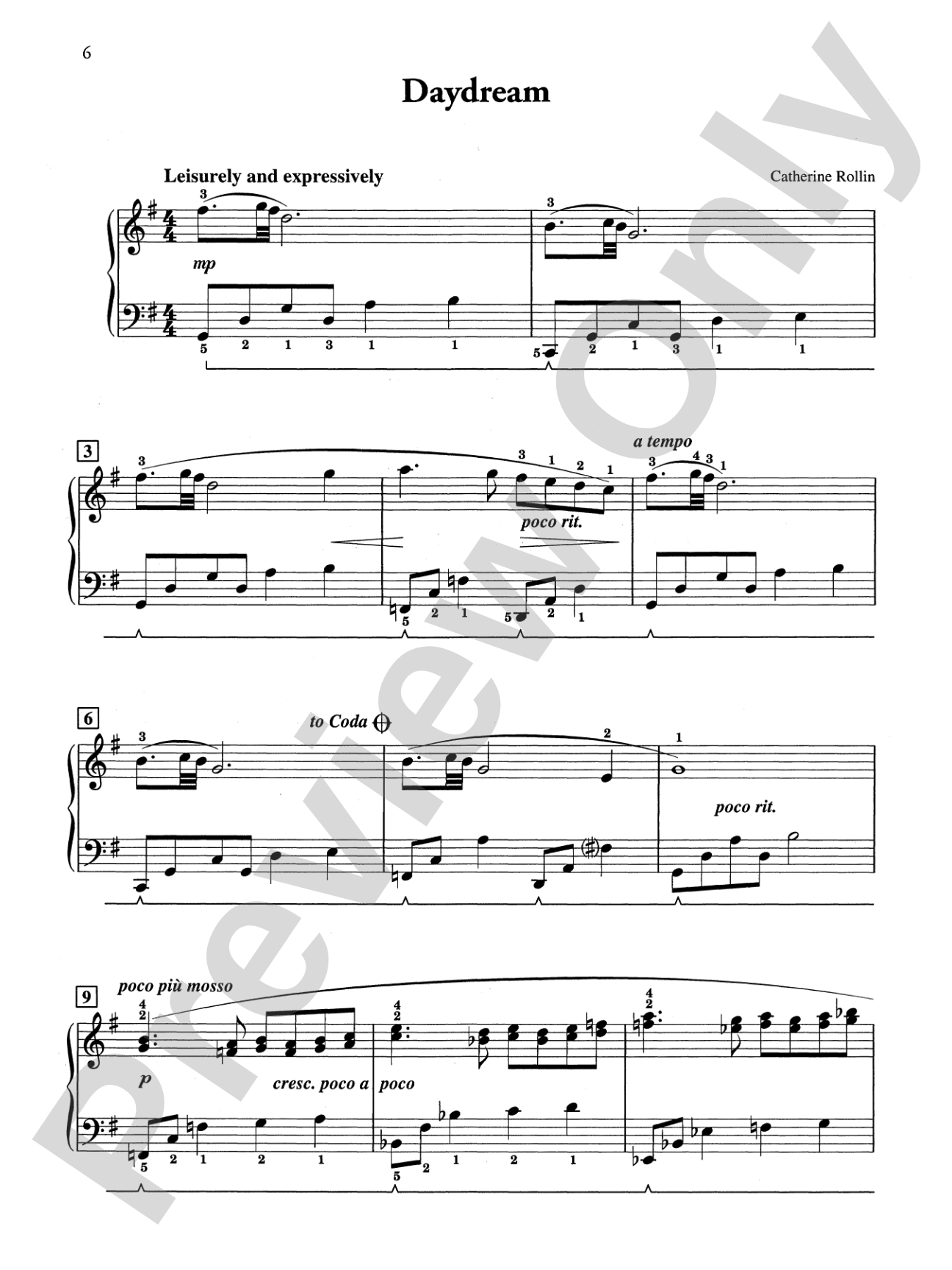

Daydream: Piano
8 Expressive Solos for Intermediate Pianists
By Catherine Rollin
Level: Intermediate
Item: 00-PS-0017706
$3.99
Pickup currently not available
Description
This collection of intermediate piano solos is perfect for the romantic at heart. All of the pieces are lyrical, expressive, and absolutely beautiful! Titles: Daydream * First Loss * A Heart Takes Flight * Lament * A Lovely Mood * Love Theme * Prairie Love * Simple Pleasures. "Love Theme" is on the ABRSM 2025-2026 Piano Syllabus.


Daydream: Piano isn't in MakeMusic Cloud just yet...but it could be. Let us know you'd like to see it, and you'll help shape what comes next. In the meantime, start a free trial and dive into thousands of interactive titles your students can play along with today.
Request This Title
Tell us you want it.
Start Your Free Trial
Explore everything that's ready to play right now.
Sample Audio
1
Daydream
--:--
Daydream
0:00
0:00
Sample Video
No sample videos found.
Additional Details
Publisher:
Alfred Music
Page Count:
24
SKU:
00-PS-0017706
More about this title
About the Composer: Catherine Rollin

Catherine Rollin divides her time between performing, teaching award-winning students, and composing. She holds a Bachelor of Musical Arts degree with distinction from the University of Michigan and a Master of Music degree from Oakland University School of Performing Arts. Over her career, she has presented workshops and masterclasses across more than 200 cities throughout the United States, Canada, Japan, and Taiwan.
Rollin's compositional work has earned recognition from major organizations including the Music Teachers National Association (MTNA), the Michigan Music Teachers Association, and the National Federation of Music Clubs. She received an ASCAP award for her Museum Masterpieces series and was recently commissioned by the MTNA's From the Pen to the Premiere initiative, which resulted in Suite Detroit, a trio for flute, alto saxophone, and piano that premiered at the 2018 MTNA national conference. The Steinway Society featured her as both composer and pianist in concert during fall 2018.
Why we love this
These eight pieces land perfectly in that sweet spot where students finally have room to explore genuine musicality without wrestling with technical complexity. Rollin's gift for melody shines through every selection, and because "Love Theme" appears on the ABRSM syllabus, students get dual incentive: repertoire that matters for their exams and pieces that simply feel wonderful to play and hear.
What to expect
These solos evoke quiet introspection and gentle emotion. Each piece unfolds with a singing quality that feels intimate, like overhearing someone lost in thought, with moments of wistfulness balanced by warmth and contentment.
Who it's for
Intermediate pianists who thrive on expressive, song-like material are the natural audience here. Students preparing for ABRSM exams, recitals, or simply wanting to develop interpretive skills will find authentic challenges in these pieces.
How to get the most out of it
- Let the pedal sustain the harmonic foundation while keeping the melodic line clear and vocal. Resist the urge to hold down the sustain pedal continuously; change it thoughtfully between harmonic shifts to maintain transparency.
- Shape each phrase as if singing it aloud. These pieces thrive on subtle dynamic shaping and breath-like phrasing that brings out their lyrical character.
- Explore tempo flexibility within each piece. Rollin's writing invites gentle rubato and subtle ritardando at phrase endings; don't lock into a metronomic pulse.
- Balance the accompaniment figures so they support without overwhelming the melody. If left-hand patterns feel heavy, they will mask the beauty of what's written above.
How to use it
Use these pieces as a standalone recital program, or select individual pieces to open or close concert sets where you want to establish a lyrical, reflective mood. They pair naturally with art songs and romantic-era art music, making them ideal for creating thematic concerts around poetry and emotion.
Skills your students will build
- Sustain pedal technique and harmonic awareness
- Phrasing and dynamic shaping in lyrical contexts
- Melodic voice leading and song-like expression
- Tempo flexibility and interpretive choice-making
- Balance between accompaniment and melody