Day Dream Sheet Music Preview

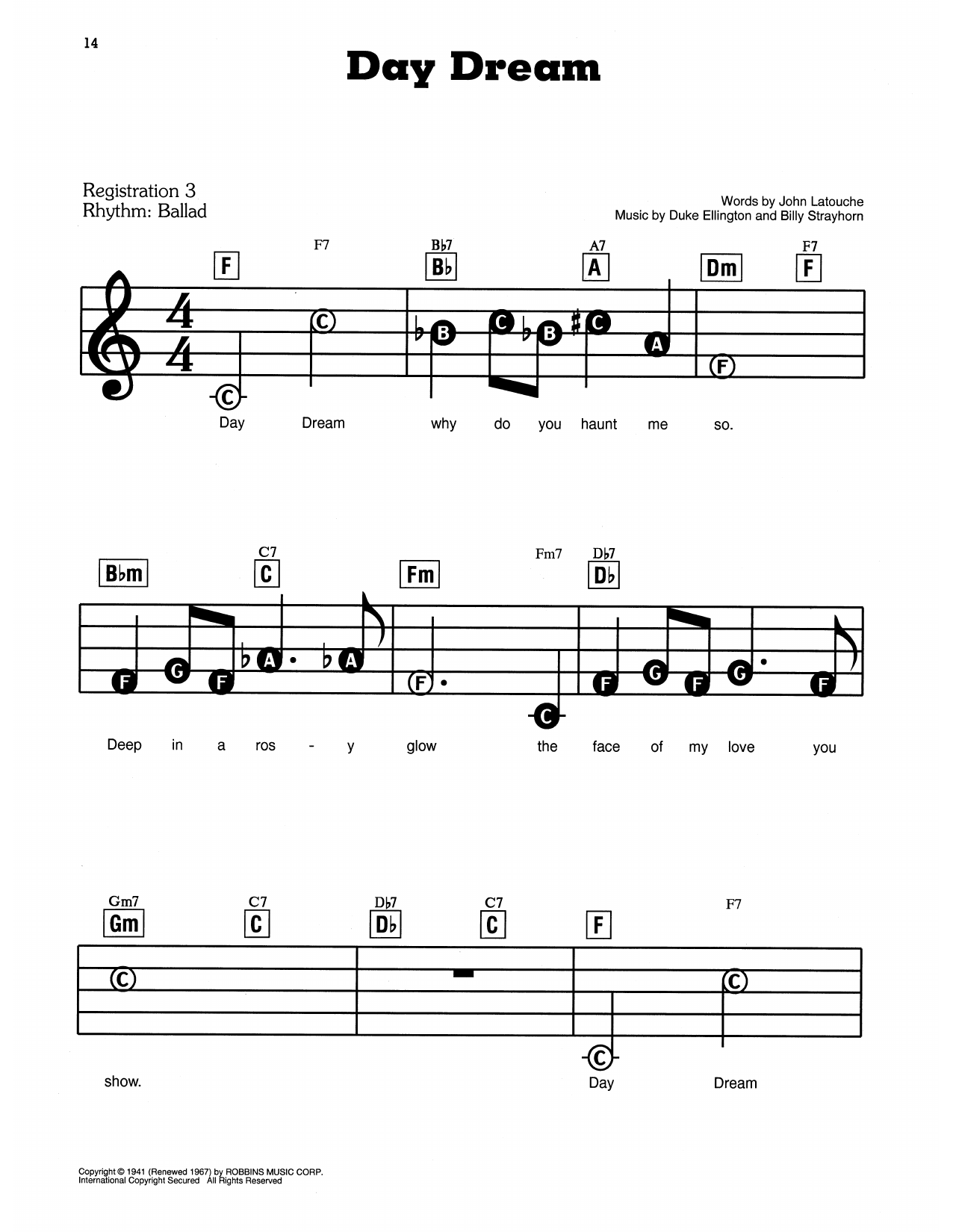
Day Dream: E-Z Play Today

As performed by Duke Ellington

Item: 35-DS01861976

Digital Download
$4.99
Description

Day Dream: E-Z Play Today isn't in MakeMusic Cloud just yet...but it could be. Let us know you'd like to see it, and you'll help shape what comes next. In the meantime, start a free trial and dive into thousands of interactive titles your students can play along with today.

Sample Audio
No sample audio found.
Sample Video
Additional Details
Publisher: Hal Leonard
Page Count: 3
SKU: 35-DS01861976

More about this title

About the Artist: Duke Ellington

Duke Ellington stands as one of the twentieth century's most prolific and innovative composers, creating a body of work that transcends jazz into the realm of serious concert music. His harmonic sophistication and orchestral thinking influenced not only jazz musicians but also classical composers, and his pieces have become standards in both jazz and educational settings. Ellington's approach to composition emphasized the voices and personalities of his ensemble members, making his music both intellectually rigorous and deeply human.

Why we love this

Ellington's harmonic language opens doors to understanding jazz piano at a level that respects the listener's intelligence. The piece sits comfortably on the page for intermediate pianists while rewarding careful attention to voice leading and the subtle interplay between melody and accompaniment.

What to expect

Dreamy and introspective, with the kind of gentle sophistication that suggests late-night contemplation rather than urgency. The harmonies have both warmth and subtle melancholy, inviting the performer into quiet reflection.

Who it's for

Intermediate pianists ready to explore jazz standards with real compositional substance. Teachers who want to introduce students to Ellington's voice and harmonic palette through an accessible entry point.

How to get the most out of it

  • Balance the left hand chord voicings so they support rather than overshadow the melody. Ellington's sophistication lives in how the hands converse, not in splashy accompaniment figures.
  • Let the recording guide your sense of time and phrasing. The rhythmic flexibility jazz demands differs from classical rubato; listen closely to how the accompaniment breathes.
  • Voice the upper chord tones distinctly so listeners hear the harmonic movement. These sonorities are part of what makes Ellington's writing memorable.

How to use it

Include this in a jazz appreciation or standards survey unit, pairing it with other Ellington pieces to show his compositional range. It works equally well as a showcase solo piece in a recital or as part of a piano elective exploring twentieth-century American music.

Skills your students will build

  • Jazz voicing and harmonic hearing
  • Rubato and rhythmic flexibility in a jazz context
  • Reading and interpreting jazz notation and articulations
  • Balancing melodic and harmonic layers in performance

You May Also Like