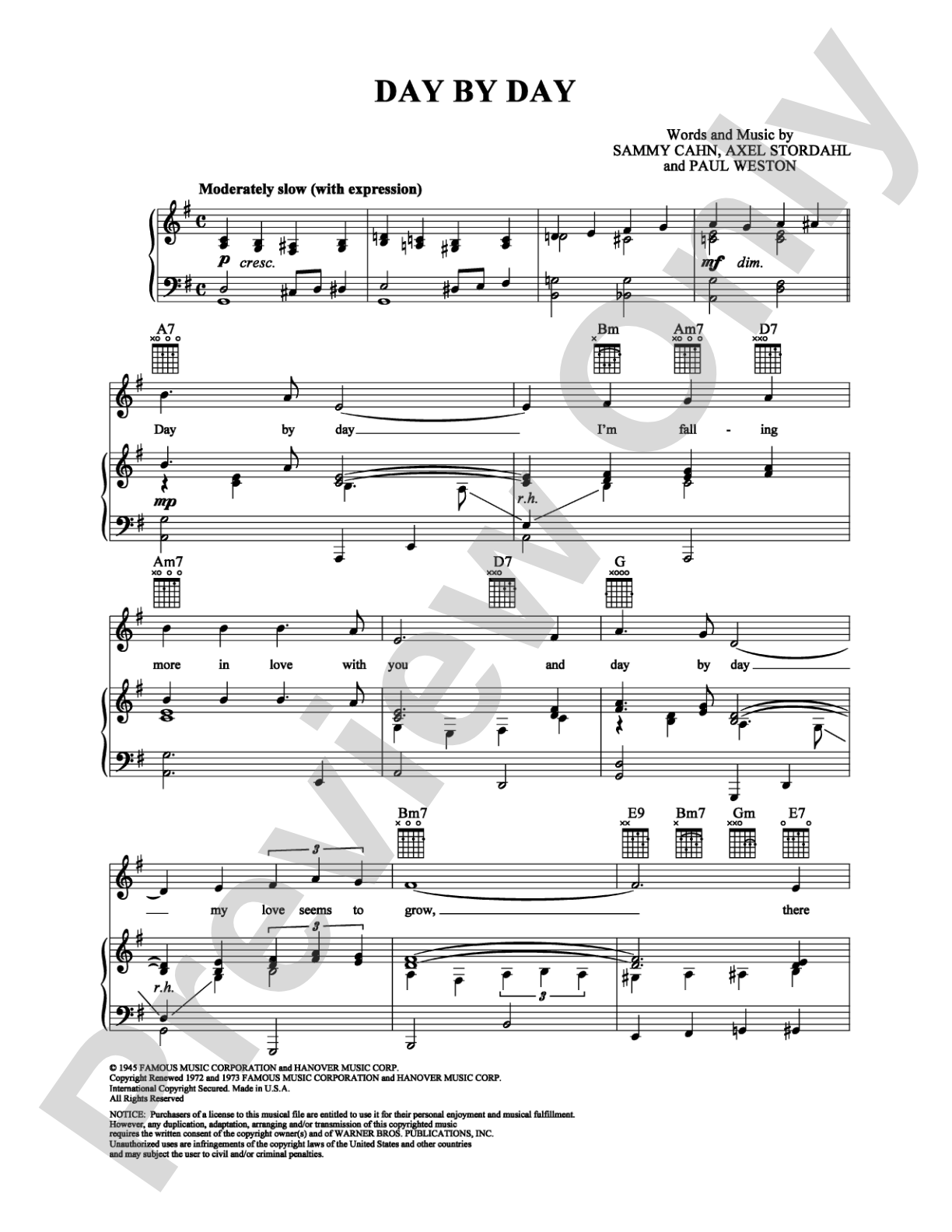
Day By Day: Piano/Vocal/Chords Digital Sheet Music

Day By Day: Piano/Vocal/Chords Digital Sheet Music

Frank Sinatra, Sammy Cahn, Shirley Bassey, Carmen McRae, June Hutton

Item: 00-PS-0006684

Digital Download
$2.95
Description

Day By Day: Piano/Vocal/Chords Digital Sheet Music isn't in MakeMusic Cloud just yet...but it could be. Let us know you'd like to see it, and you'll help shape what comes next. In the meantime, start a free trial and dive into thousands of interactive titles your students can play along with today.

Sample Audio
No sample audio found.
Sample Video
Additional Details
SKU: 00-PS-0006684

More about this title

About the Artist: Frank Sinatra

Frank Sinatra (1915-1998) shaped American popular music across seven decades, from his early work with big bands through his solo career as one of the most recorded artists in history. His influence on vocal phrasing, microphone technique, and interpretive depth set standards that singers still study today, making his recordings essential listening for understanding 20th-century vocal performance.

Why we love this

This standard has weathered decades because its harmonic sophistication rewards both amateur and advanced pianists. The chord changes invite genuine jazz voicing exploration, while the vocal melody sits naturally across a wide range, making it equally valuable for teaching interpretive nuance or coaching a singer through genuine emotional arc.

What to expect

The song sits in intimate space between resignation and hope, inviting a performer to live in emotional ambiguity rather than resolve it cleanly. The piano-voice partnership allows for real conversation, where subtle changes in rubato or harmonic color shift meaning without requiring dramatic vocal choices.

Who it's for

Pianists and singers preparing material for jazz recitals, cabaret settings, or vocal jazz ensembles will find strong pedagogical and performance value here. Teachers introducing students to American songbook standards benefit from this song's direct emotional clarity and accessible harmonic language.

How to get the most out of it

  • Balance the vocal melody against piano comping rather than playing full stride or heavy left-hand voicings; let the voice breathe and lead the phrase.
  • Experiment with chord substitutions in the piano part, especially in sections you repeat, to create space and variation without altering the singer's line.
  • Anchor rhythmic precision on the piano's bass line, treating it as a conversation partner with the vocal rather than accompaniment support.
  • Shape dynamics across the full form; resist holding back power until the final section, instead building intensity through strategic moments of restraint and release.

How to use it

Pair this with other standards from the same era to build a concert exploring vocal jazz interpretation and piano-voice collaboration. It works particularly well as a gentle counterpoint to more uptempo selections, allowing an audience to settle into the room's quietness and hear how much a singer can convey through restraint.

Skills your students will build

  • Interpreting jazz harmony and recognizing chord substitution possibilities
  • Balancing accompaniment texture to support rather than overpower a vocal line
  • Shaping phrase contour and controlling rubato in a standards context
  • Managing the collaborative relationship between pianist and vocalist

You May Also Like