
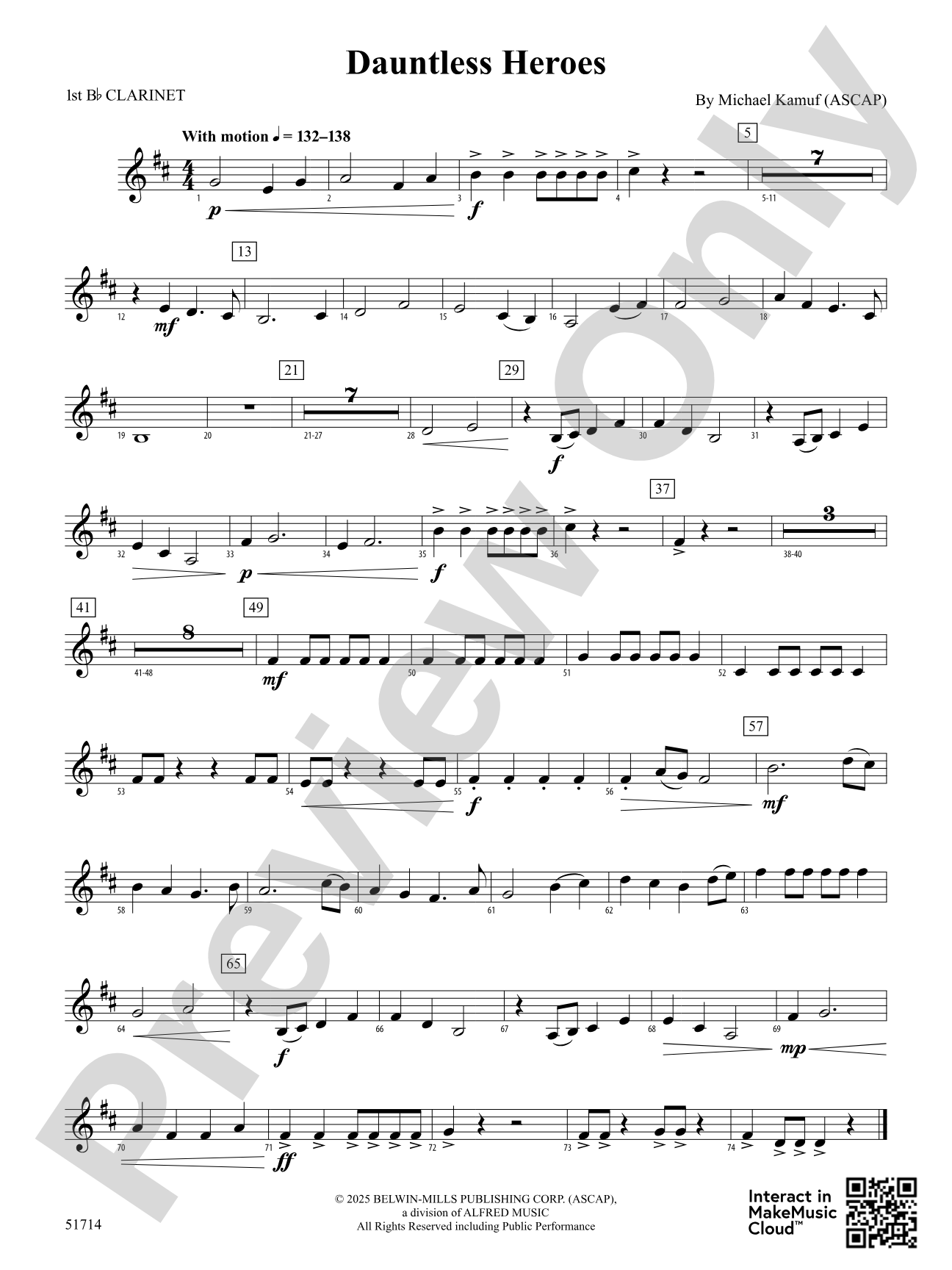

Dauntless Heroes: 1st B-flat Clarinet
By Michael Kamuf
Grade: 1.5
Item: 00-PC-0019469_C1
$3.00
Pickup currently not available
Description
The perfect selection for a beginning string orchestra experience! Composer Michael Kamuf combines bold themes and rich harmonies to create a rewarding work that your students and audiences will enjoy. Dauntless Heroes is playable by strings alone or with any combination of added winds and percussion up to full orchestra. All strings stay in first position! (2:15)


Dauntless Heroes: 1st B-flat Clarinet isn't in MakeMusic Cloud just yet...but it could be. Let us know you'd like to see it, and you'll help shape what comes next. In the meantime, start a free trial and dive into thousands of interactive titles your students can play along with today.
Request This Title
Tell us you want it.
Start Your Free Trial
Explore everything that's ready to play right now.
Sample Audio
1
Audio File
--:--
0:00
0:00
Sample Video
Additional Details
Series:
Belwin Beginning Full Orchestra
Publisher:
Alfred Music
SKU:
00-PC-0019469_C1
More about this title
About the Composer: Michael Kamuf

Michael Kamuf earned degrees in Jazz Performance and Music Education from the Dana School of Music at Youngstown State University, followed by a Master of Arts in Instrumental Conducting from George Mason University. His compositions and arrangements have been performed by prestigious ensembles including the Woody Herman and Glenn Miller Orchestras, the USAF Airmen of Note, and the US Navy Commodores, as well as soloists like James Moody, Eddie Daniels, and Sean Jones.
Kamuf spent three decades teaching instrumental music in Montgomery County, Maryland Public Schools, where he directed bands and orchestras at John T. Baker Middle School for twenty-seven years. His student ensembles earned consistent festival recognition and commissioned works for young concert bands. As an exclusive Belwin composer, Kamuf maintains over 100 published works across jazz, orchestra, and concert band catalogs. He currently leads the Mike Kamuf Little Big Band and continues performing and composing in the Baltimore and Washington, DC region.
Why we love this
Kamuf writes with acute understanding of where beginning orchestras actually are. The first-position-only strings requirement removes technical barriers while the optional wind and percussion parts let you scale the piece up as your ensemble grows. You get bold, confident themes that engage audiences and reward student effort without demanding years of training.
What to expect
Dauntless Heroes announces itself with conviction. The bold thematic material and rich harmonies create a sense of purpose and vitality that energizes both players and listeners. It's the kind of piece that makes beginning musicians feel like they're making real music.
Who it's for
Beginning string orchestras ready to step beyond simple unison pieces into ensemble writing with real harmonic color. This works equally well for directors introducing winds and percussion to a young string program or for full orchestras that need accessible material with immediate performance payoff.
How to get the most out of it
- Lock the string sections into rhythmic unity before adding winds and percussion. The foundation matters most at this level, and a tight string core makes any optional doubling sound polished.
- Let the melodic themes breathe. Resist overdriving the tempo; these bold ideas work best when each phrase has room to land.
- Balance the parts carefully if you add winds or percussion. Begin rehearsals with strings only to establish the core, then layer in optional instruments gradually to maintain clarity.
- Use the two-minute-fifteen-second runtime as a rehearsal advantage. You can run this multiple times in a single rehearsal to build confidence and consistency without fatigue.
How to use it
Program this as a festival or concert opener where you want to establish confidence and energy early. The flexibility to perform it strings-only or with added forces makes it equally useful at smaller spring concerts or larger festival showcases.
Skills your students will build
- Reading and executing first-position string technique across all parts
- Ensemble balance and blend with layered harmonic textures
- Sectional independence while maintaining overall ensemble cohesion
- Rhythmic precision in repeated figures and syncopated passages