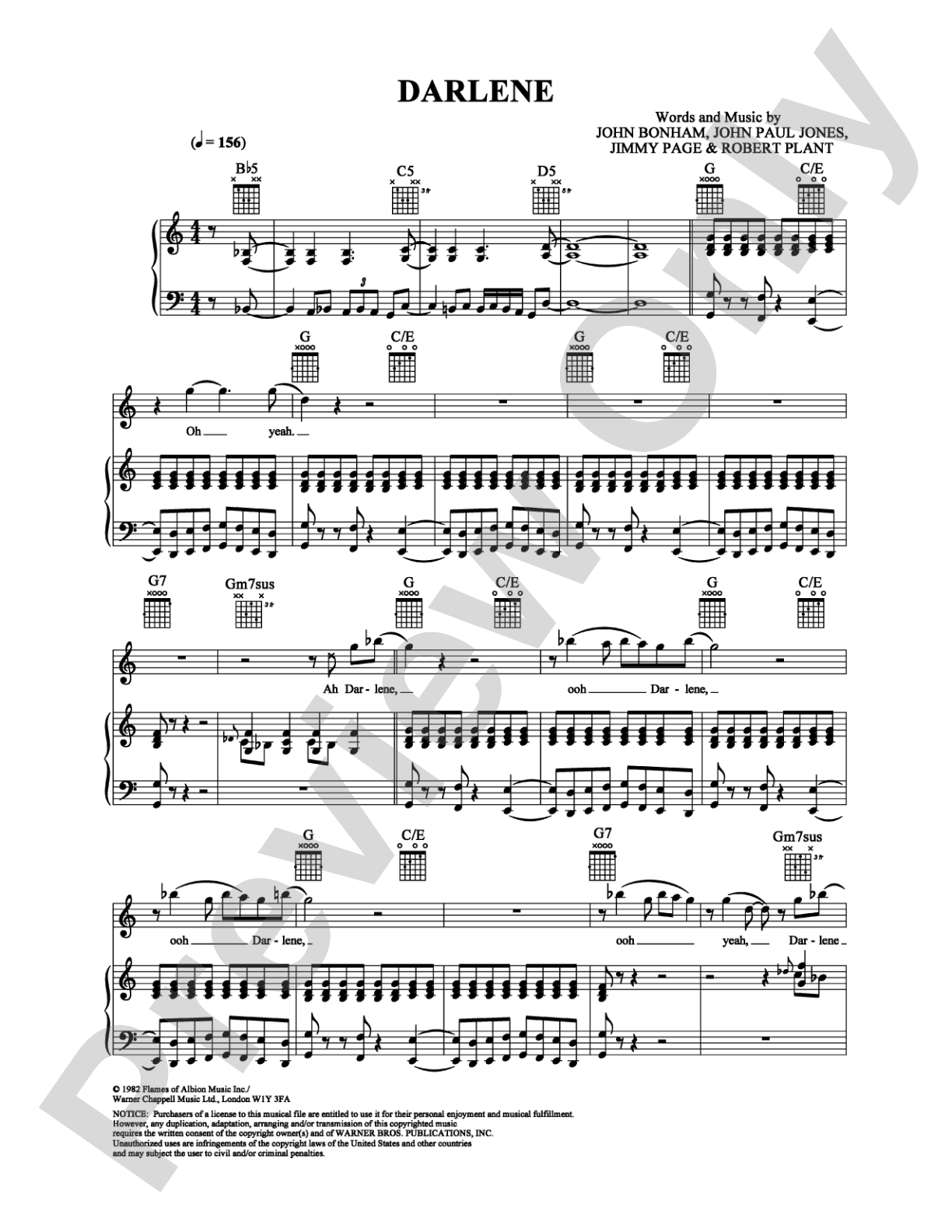
Darlene: Piano/Vocal/Chords Digital Sheet Music

Darlene: Piano/Vocal/Chords Digital Sheet Music

Led Zeppelin, Jimmy Page, Robert Plant, John Paul Jones, John Bonham

Item: 00-PS-0002445

Digital Download
$3.99
Description

Darlene: Piano/Vocal/Chords Digital Sheet Music isn't in MakeMusic Cloud just yet...but it could be. Let us know you'd like to see it, and you'll help shape what comes next. In the meantime, start a free trial and dive into thousands of interactive titles your students can play along with today.

Sample Audio
No sample audio found.
Sample Video
Additional Details
SKU: 00-PS-0002445

More about this title

About the Artist: Led Zeppelin

Led Zeppelin shaped rock music across four decades, pioneering the sound that would define hard rock and heavy metal. The band's approach to arrangement, dynamics, and layered production influenced countless musicians and remains a cornerstone of rock education and performance.

Why we love this

Rock standards deserve serious musical attention, and Zeppelin's catalog rewards it. This piece gives pianists and vocalists a chance to dig into the harmonic sophistication and dynamic drama that made the band essential, all while working with accessible notation.

What to expect

Heavy, deliberate, and atmospheric. The piece unfolds with the kind of careful intensity Zeppelin was known for, built on solid harmonic ground but colored by unconventional progressions and dynamics that shift the listener's weight.

Who it's for

Pianists and vocalist-pianists exploring rock repertoire beyond the classical canon, as well as music students examining how harmony and arrangement function in popular music. This works equally well for recital preparation or classroom study of rock composition.

How to get the most out of it

  • Pay attention to the chord voicings provided; they capture the band's signature dense, layered sound that requires intentional voice leading at the piano.
  • Balance vocal phrasing with the piano accompaniment so neither overwhelms the other; the song lives in the conversation between voice and instrument.
  • Use tempo and dynamics to shape the emotional arc; rushing flattens the power, while dragging loses momentum.

How to use it

Include this in a recital that explores non-classical tradition, or use it as a bridge assignment in music theory or history classes examining how rock and classical musical language intersect. It works particularly well alongside other singer-songwriter or band arrangements that expand students' sense of what belongs in concert programming.

Skills your students will build

  • reading and interpreting rock chord notation
  • balancing vocal melody with accompaniment texture
  • executing dynamic control across longer phrases
  • understanding harmonic vocabulary outside traditional classical progressions

You May Also Like