
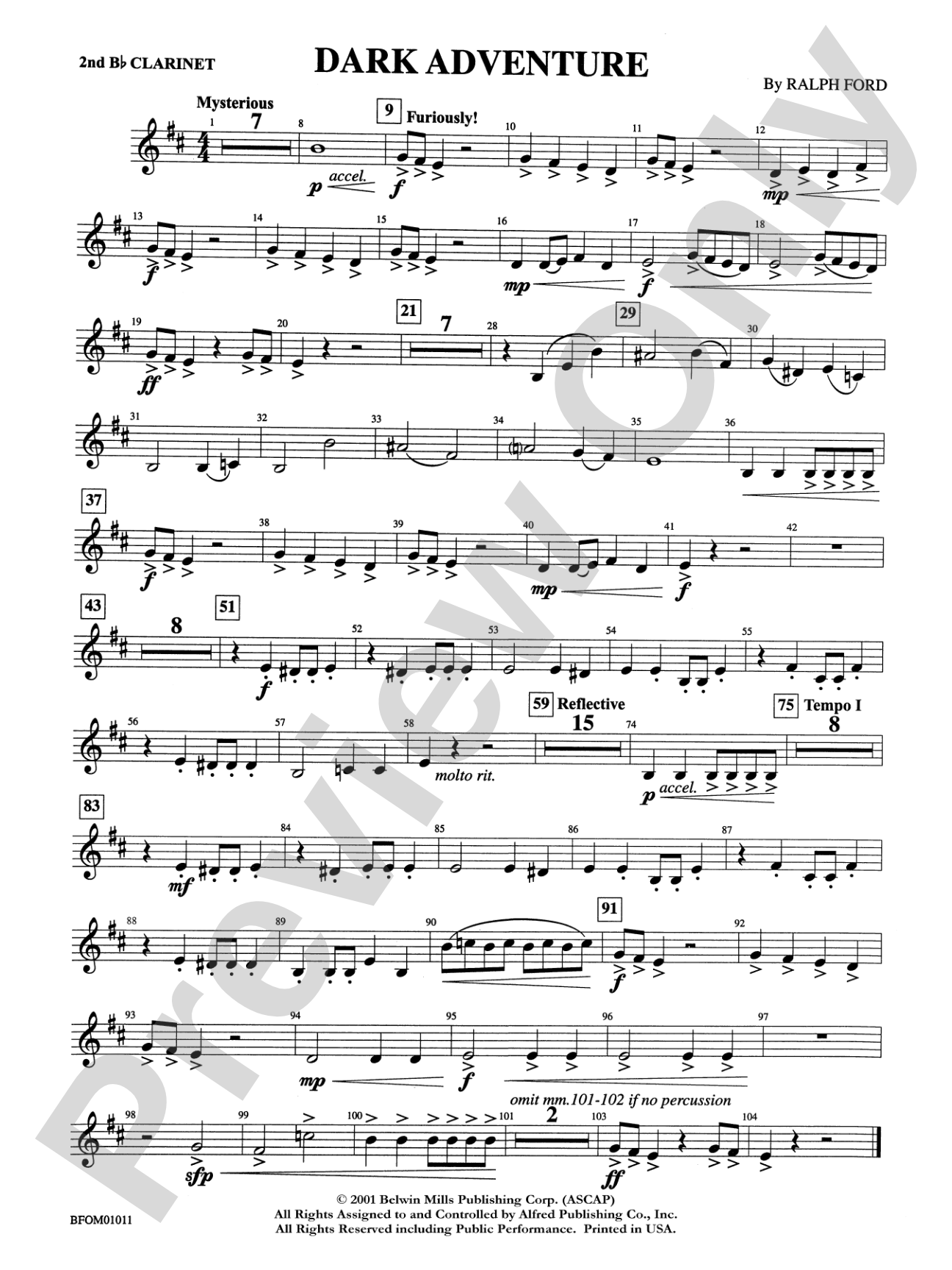

Dark Adventure: 2nd B-flat Clarinet
By Ralph Ford
Grade: 2.5
Item: 00-PC-0002228_C2
$3.00
Pickup currently not available
Description
A musical adventure through mysticism and magic. This unique setting offers a wide variety of dynamics, textures, and styles while remaining playable. The momentum is quickly established, and your students are part of the journey. This is a super piece that will capture the imagination of students and listeners alike. This title is available in MakeMusic Cloud. A Federation Festivals 2020-2024 selection. (3:25)


Don't just read it, hear it, play along with it, and watch your students grow with it. In MakeMusic Cloud, Dark Adventure: 2nd B-flat Clarinet comes alive with professional accompaniment, adjustable tempo, and built-in practice tools that turn solo practice into real progress.
Open in the Player
Jump straight in and assign it today.
Start Your Free Trial
Open this title and explore the full library in minutes.
Sample Audio
1
Audio File
--:--
0:00
0:00
Sample Video
No sample videos found.
Additional Details
Series:
Belwin Intermediate String/Full Orchestra
Publisher:
Alfred Music
Page Count:
236
SKU:
00-PC-0002228_C2
More about this title
About the Composer: Ralph Ford

Ralph Ford has built a distinctive career spanning composition, arrangement, conducting, and media production. A faculty member for 29 years at the university level, he has composed and arranged over 250 works for orchestra, concert band, jazz ensemble, and marching band through his exclusive relationship with the Belwin division of Alfred Music. His commissions have been performed worldwide by university, military, professional, community, and school ensembles, and his work extends into broadcast media, where he has composed news packages for national network affiliates and created scores for television and radio productions.
Ford's arranging work began at age fifteen and deepened during his time at Troy State University, where he served as Director of Jazz Ensemble I for fifteen years and held the position of staff arranger for the university band program. He earned his Master of Science degree in 1988 while teaching orchestration, arranging, theory, jazz studies, and applied brass instruction. Beyond the concert hall, he has received international recognition for advertising work and animation scoring, bringing the same craftsmanship to his educational compositions that defines his commercial and professional output.
Why we love this
Ford paces this journey brilliantly, establishing momentum in the opening moments so students are immediately invested in the narrative arc. The orchestration rewards a full ensemble while remaining genuinely playable at Grade 2.5, avoiding the trap of simplification that drains character from ensemble music.
What to expect
The piece unfolds like a fantasy quest rendered in orchestral color. Mystical passages contrast with driving rhythmic sections, creating an immersive soundscape that draws listeners into Ford's constructed world of magic and adventure without ever feeling contrived or overly dramatic.
Who it's for
This score works for orchestras at the upper end of intermediate study, from middle school through early high school, and serves equally well in contest or concert contexts. Any ensemble that benefits from a single, unified musical concept without sectional showboating will thrive with this material.
How to get the most out of it
- Shape the dynamic arc across the full 3:25 to sustain narrative tension. Mark conductor cues that signal textural shifts so the ensemble understands when they're entering a new 'scene' of the adventure.
- Balance the variety of textures Ford provides by rehearsing each section independently first. Students need to hear how their part functions differently in moments of mysticism versus passages of direct momentum.
- Lock the internal rhythmic pulse with the section leaders before polishing articulation and dynamics. The playability of this work depends on collective confidence with the basic line.
How to use it
Open a concert with this work to establish an imaginative tone for the entire program, or pair it strategically with pieces of different character to showcase your orchestra's range. At 3:25, it fits naturally into a full festival program and satisfies the competition requirement for a single substantial work with musical substance.
Skills your students will build
- Sustaining long dynamic arcs and textural shifts across an extended single-movement form
- Reading and executing rapid changes in articulation and style without losing ensemble cohesion
- Maintaining ensemble balance across varying orchestrations at moderate tempos
- Interpreting expressive musical narrative through coordinated section work