
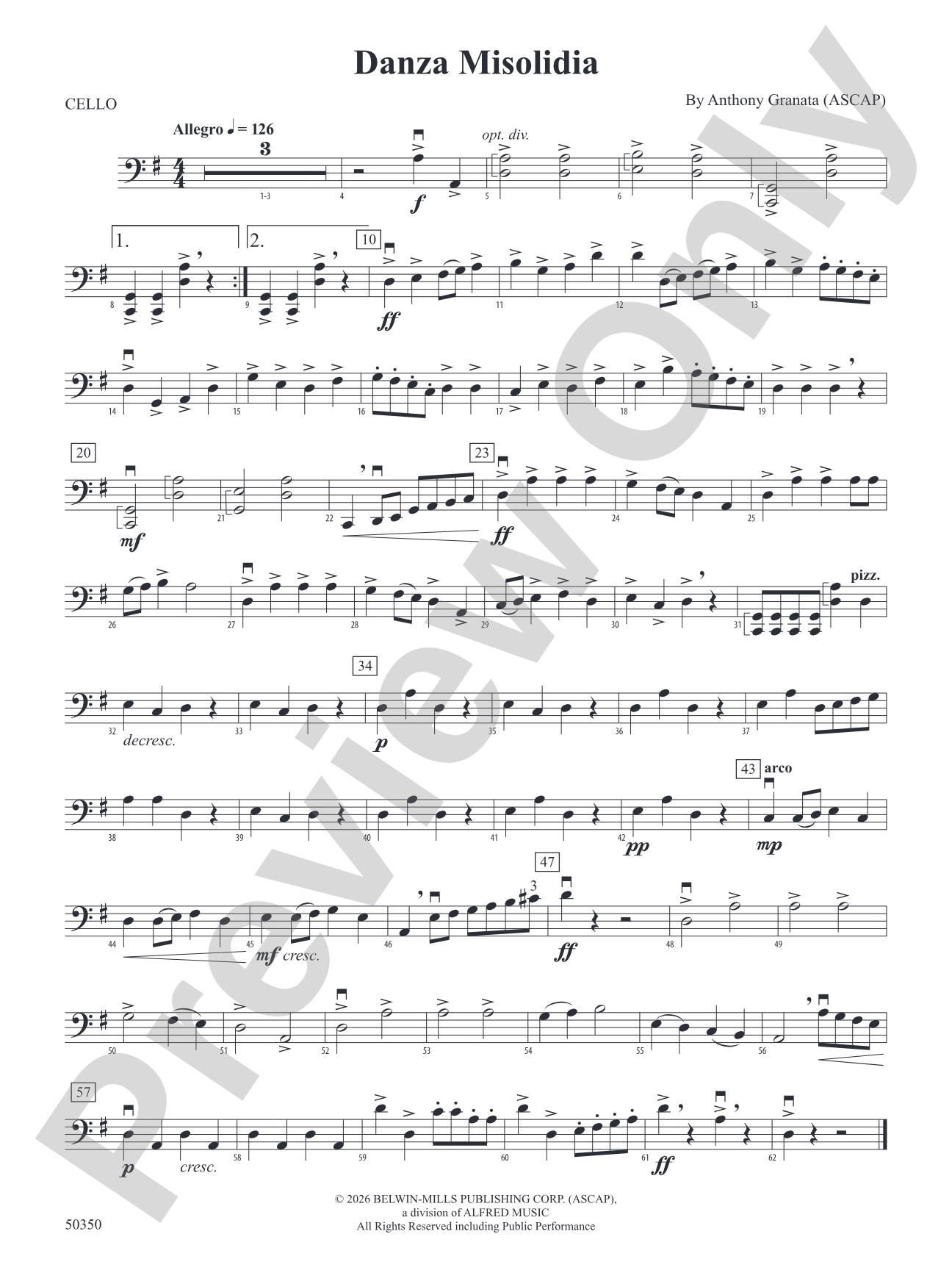

Danza Misolidia: Cello
By Anthony Granata
Grade: 1.5
Item: 00-PC-0019826_VC1
$3.00
Pickup currently not available
Description
Danza Misolidia, by Anthony Granata, is an energetic and contemporary hoedown featuring a bold and catchy modal theme. Translated from Italian, this "Mixolydian Dance" opens with a robust and heavily accented melody in unison by the violins and violas before the cellos and basses enter with loud and forceful double stops. The melody becomes the focus of a round, played simultaneously at different times by the orchestra, followed by a quiet pizzicato section that sets the stage for a resounding and exciting finale. Students will use C naturals, slurs, double stops, G and C string notes, and first violins will use their E string. A perfect and mature-sounding piece that is accessible to younger players and will surely show off your beginning orchestra's abilities, Danza Misolidia will engage your students and captivate your audiences.


Discover MakeMusic Cloud: thousands of interactive titles your students can play along with today.
Sample Audio
1
Audio File
--:--
0:00
0:00
Sample Video
Additional Details
Series:
Belwin Beginning String Orchestra
Publisher:
Alfred Music
SKU:
00-PC-0019826_VC1
More about this title
About the Composer: Anthony Granata

Anthony Granata teaches middle school orchestra in Westport, Connecticut, and studied at Western Connecticut State University. He has worked across elementary, middle, and high school levels teaching beginning band, chorus, elementary music, and orchestra. His path back to composition came directly from the classroom: after stepping away from writing music early in his career, he returned to it as a tool for helping young string players tackle technical and musical concepts in context.
Granata began composing at twelve and remains an active violist who performs regularly. His work in public school music education stems from personal experience; he received his own foundational string training through the Norwalk public school music program. Currently pursuing a degree in school administration, he continues to advocate for robust music programs in public schools.
Why we love this
Granata has written an energetic piece that sounds mature and accomplished without demanding advanced technique. The Mixolydian modal color and round structure give it genuine compositional interest, while the bold unison opening and forceful double stops deliver the kind of moment that builds confidence in younger ensembles. This works just as well in a festival setting as it does on a regular concert, and your students will feel the difference between what they're playing and standard beginner fare.
What to expect
A spirited, folk-tinged hoedown that swings and dances. The Mixolydian mode gives it a slightly unsettled, energetic character; the pizzicato section brings mischief and playfulness; the finale arrives with the kind of full-throttled joy that leaves an audience grinning. This is music that sounds both contemporary and celebratory.
Who it's for
Beginning string orchestras in grades 2 through 5 looking for contemporary repertoire with real personality. Directors seeking a piece that works equally well at contests and regular concerts will find Danza Misolidia ideal for players who are just building confidence with position work, modal sounds, and ensemble balance.
How to get the most out of it
- Nail the unison opening with the violins and violas. Heavy accents and rhythmic precision here set the tone for everything that follows; if that melody lands cleanly, the piece has momentum.
- Balance the round section carefully so each voice enters distinctly and the texture builds rather than muddles. Mark clear entrance cues in your parts if needed.
- Use the quiet pizzicato section as a genuine contrast. The silence and restraint here make the finale feel earned and explosive by comparison.
- Lock in the rhythm section (cellos and basses) on their double stops in the opening. Strong, centered tone on those thick intervals anchors the whole sound.
How to use it
Program this as a concert opener or closer when you want to show off your orchestra's rhythmic vitality and musicality without stretching their technical limits. It pairs well with a more lyrical piece on the same concert, offering contrast in mood and orchestration. Young orchestras preparing for festival competition will find it both rewarding to rehearse and impressive to perform.
Skills your students will build
- Reading and executing accents in unison passages
- Playing double stops with secure intonation and tone
- Navigating C naturals in the Mixolydian mode
- Entering precisely as part of a round structure
- First violin ensemble members reading on the E string
- Executing smooth slurs across string changes
- Controlling articulation and dynamics in pizzicato sections