
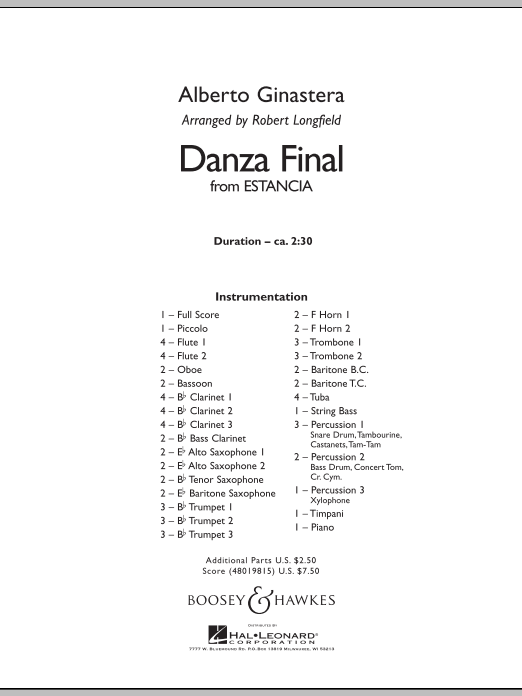

Danza Final (from "Estancia"): Concert Band Conductor Score & Parts
By Alberto Ginastera / Arranged by Robert Longfield
Grade: 3.5
Item: 35-PK00119842
$70.00
Pickup currently not available
Buy Extra Parts (Digital PDF Download)
Parts Added to Cart!
Description
From Argentina's foremost 20th-century composer Alberto Ginastera, here is an adaptation of his famous "Danza Final" from the ballet "Estancia" in a version for younger players. Still rhythmically dynamic and authentically arranged, this will be an exciting addition to any concert program. Dur: 2:30


Danza Final (from "Estancia"): Concert Band Conductor Score & Parts isn't in MakeMusic Cloud just yet...but it could be. Let us know you'd like to see it, and you'll help shape what comes next. In the meantime, start a free trial and dive into thousands of interactive titles your students can play along with today.
Request This Title
Tell us you want it.
Start Your Free Trial
Explore everything that's ready to play right now.
Sample Audio
No sample audio found.
Sample Video
No sample videos found.
Additional Details
Publisher:
Hal Leonard
SKU:
35-PK00119842
More about this title
About the Composer: Alberto Ginastera
Alberto Ginastera (1916–1983) shaped the sound of 20th-century Latin American classical music. Working across opera, ballet, orchestral music, and chamber works, he developed a compositional language that drew on Argentine folk idioms, indigenous rhythms, and modernist techniques without ever becoming merely decorative. His ballet "Estancia" (1941) remains one of his most performed works, capturing the energy and spirit of life on the Argentine pampas.
Ginastera's music demands something of both players and audiences: rhythmic precision, dynamic control, and an embrace of dissonance alongside melody. For student musicians, his works offer a gateway into mid-20th-century concert music that sounds vital and contemporary rather than historical. Teachers value his pieces because they build technical maturity while remaining genuinely exciting to perform.
Why we love this
This arrangement strips away nothing essential from Ginastera's original vision. The Danza Final thrives on its rhythmic propulsion and percussive energy, qualities that translate beautifully to younger ensembles when the orchestration is thoughtfully adapted. Longfield preserves the authentic harmonic language and driving pulse while keeping part writing accessible, making this a genuine engagement with 20th-century modernism rather than a diluted version.
What to expect
Propulsive and unapologetic. The Danza Final rushes forward with syncopated rhythms, dissonant harmonies that feel modern and sharp, and orchestral colors that shift between dense and transparent. There's an underlying tension here, a rhythmic restlessness that never settles into comfortable resolution. This is music that sounds like it means something.
Who it's for
Intermediate concert bands ready to explore music beyond the standard American repertoire. This works for ensembles at the Grade 3.5 level who have solid intonation control and can handle quick rhythmic figures without falling apart.
How to get the most out of it
- Lock the rhythmic pulse early in rehearsals. The forward momentum defines this piece, and ensemble control of the underlying beat creates the foundation for everything else.
- Balance the percussion section carefully. The rhythm section needs clarity without drowning the melodic lines; rehearse them separately first, then layer in the winds.
- Shape the dynamic contrasts decisively. Ginastera's orchestration relies on sudden shifts between thick, aggressive sections and cleaner textures. Commit fully to each dynamic level.
- Emphasize the Argentine character without exaggeration. The folk elements are woven into the modernist fabric; let the rhythmic precision speak rather than adding theatrical interpretation.
How to use it
Pair this with other 20th-century repertoire to build a concert exploring non-European musical traditions, or position it as a closing piece that leaves the audience energized. At 2:30, it paces well after a lyrical work or between heavier selections. It also serves as an excellent entry point for directors introducing students to Ginastera's compositional world before tackling his more demanding pieces.
Skills your students will build
- Reading syncopated rhythms across beat divisions
- Maintaining ensemble precision through rapid rhythmic figures
- Responding to sudden dynamic and textural shifts
- Balancing modern harmonic language with clear intonation
- Distinguishing rhythmic roles within the ensemble (pulse, syncopation, counter-rhythm)