
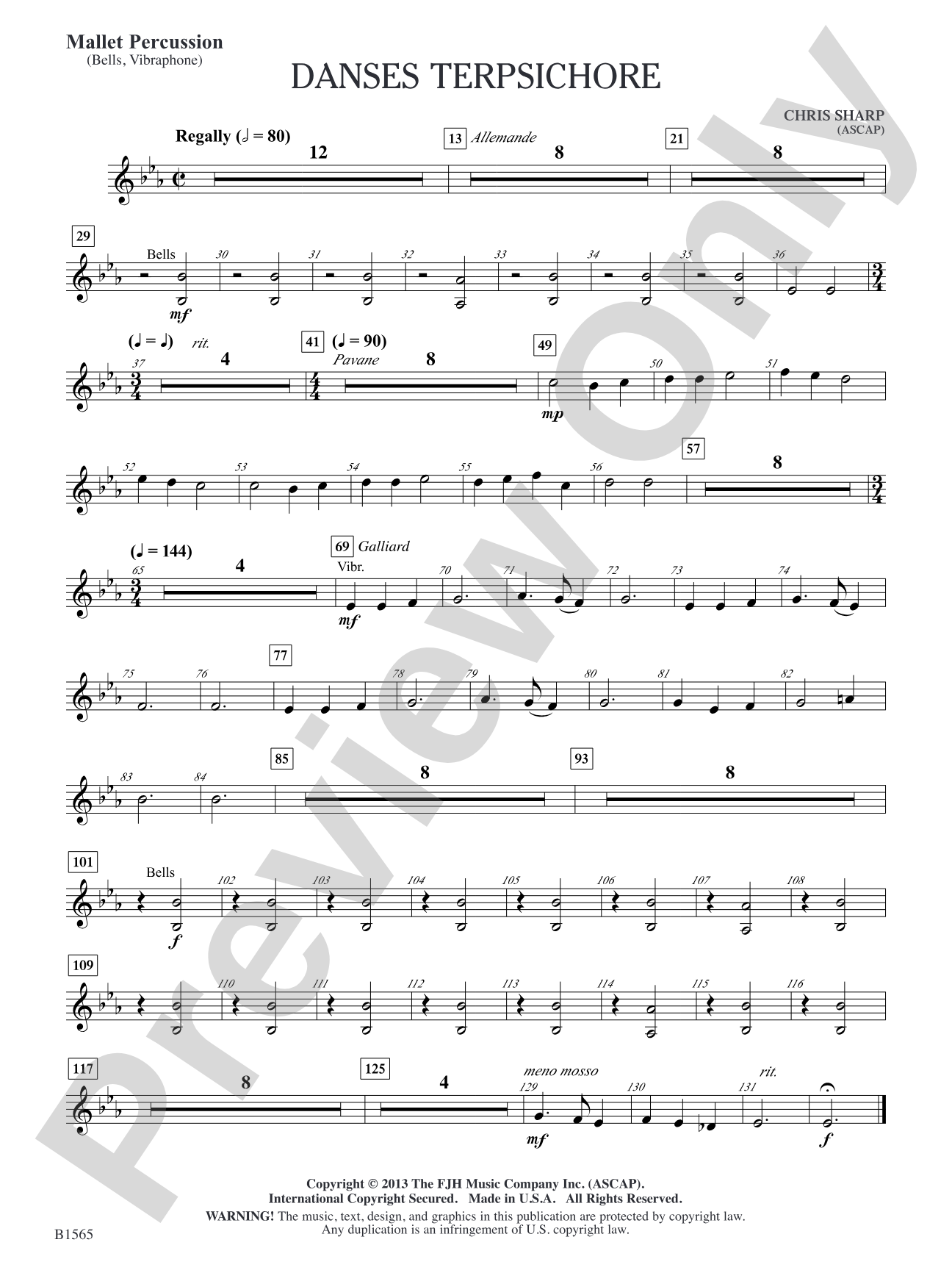

Danses Terpsichore: Mallet Percussion
By Chris Sharp
Grade: 2
Item: 98-PC-DB1565_M1
$7.00
Pickup currently not available
Description
Composed as a follow-up to the writer's popular Danse Antiqua, this three-part Renaissance-style dance suite features a wealth of musical styles in one continuous movement. The opening Allemande showcases a courtly duple-meter dance. The ensuing Pavane features a slower, more dignified melody. The final Galliard is presented as a lively triple-meter dance with some adventurous harmonic language. A wonderful addition to the repertoire!


Danses Terpsichore: Mallet Percussion isn't in MakeMusic Cloud just yet...but it could be. Let us know you'd like to see it, and you'll help shape what comes next. In the meantime, start a free trial and dive into thousands of interactive titles your students can play along with today.
Request This Title
Tell us you want it.
Start Your Free Trial
Explore everything that's ready to play right now.
Sample Audio
1
Audio File
--:--
0:00
0:00
Sample Video
No sample videos found.
Additional Details
Series:
FJH Concert Band
Publisher:
The FJH Music Company, Inc.
SKU:
98-PC-DB1565_M1
More about this title
About the Composer: Chris Sharp

Chris Sharp holds a Ph.D. and has built a career bridging classical composition, entertainment music, and education. His background includes eleven years as a performing trombonist and band leader at Walt Disney World, followed by decades of arranging and orchestrating for Disney parks worldwide, creating music for live shows, recordings, and television broadcasts. He has also composed and arranged for a wide range of clients including Universal Studios, the Boston Pops, the Dallas Brass, and several military ensembles.
Sharp remains deeply invested in music education, having taught at middle school, high school, and college levels. He currently serves as Director of Bands at Polk State College in Winter Haven, where he also teaches music theory, music technology, and arranging. His work as a clinician, guest conductor, and adjudicator for major organizations including Bands of America and Drum Corps International reflects his commitment to the concert and jazz band communities. His compositions and arrangements receive regular performances at major venues such as the Midwest Clinic, and he is a multiple recipient of the ASCAPlus award.
Why we love this
Sharp follows a successful formula here by taking the three most recognizable Renaissance dances and treating each with its own character while maintaining musical coherence across a single movement. The grade 2 scoring is genuinely playable without sacrificing the sophistication of the harmonic language, particularly in the Galliard, which keeps young ensembles engaged and challenged. The piece works equally well as a concert selection or festival entry, giving you programming flexibility.
What to expect
The Allemande opens with courtly restraint and stately pacing, inviting the band into a Renaissance ballroom. The Pavane slows the pulse and deepens the emotional tone, creating a moment of dignified reflection before the Galliard's triple-meter energy and unexpected harmonic colors lift the ensemble into brighter, more adventurous territory. The whole arc feels like a miniature journey through three different moods of Renaissance court life.
Who it's for
This suite works for grade 2 concert bands preparing for festivals or building a balanced concert program that includes classical forms without requiring advanced technical facility. Directors looking to teach historical context through performance will find the three distinct dance types immediately accessible for student discussion and contextual learning.
How to get the most out of it
- Shape the Allemande's courtly character by bringing out the duple-meter pulse without rushing; let the rhythm establish the Renaissance courtyard atmosphere before moving forward.
- Balance the Pavane's slower melody across your ensemble to ensure it sings rather than sags, especially important since younger bands often lose patience with sustained lines.
- Mark the meter shift to triple time before the Galliard and give your section leaders a clear entrance cue; the harmonic language Sharp uses will reward precise attacks.
- Use the three distinct sections to coach different aspects of your band's musicality: formal phrasing in the first section, legit melodic playing in the second, and rhythmic clarity in the third.
How to use it
Program this as the centerpiece of a concert that explores Renaissance and early Baroque music, pairing it with shorter pieces that either precede it historically or demonstrate later interpretations of these forms. It also serves as an excellent festival selection at the grade 2 level, giving judges something immediately recognizable while showcasing your band's ability to shift character and style within a single work. Consider placing it near the end of your concert, where the varied tempos and moods will leave audiences with a memorable final impression.
Skills your students will build
- Distinguishing and performing contrasting duple and triple meters within a single piece
- Sustaining longer melodic lines with consistent tone and phrasing
- Responding to harmonic language that moves beyond basic diatonic progressions
- Maintaining ensemble balance and rhythmic precision across tempo changes
- Understanding Renaissance dance forms and their historical musical context