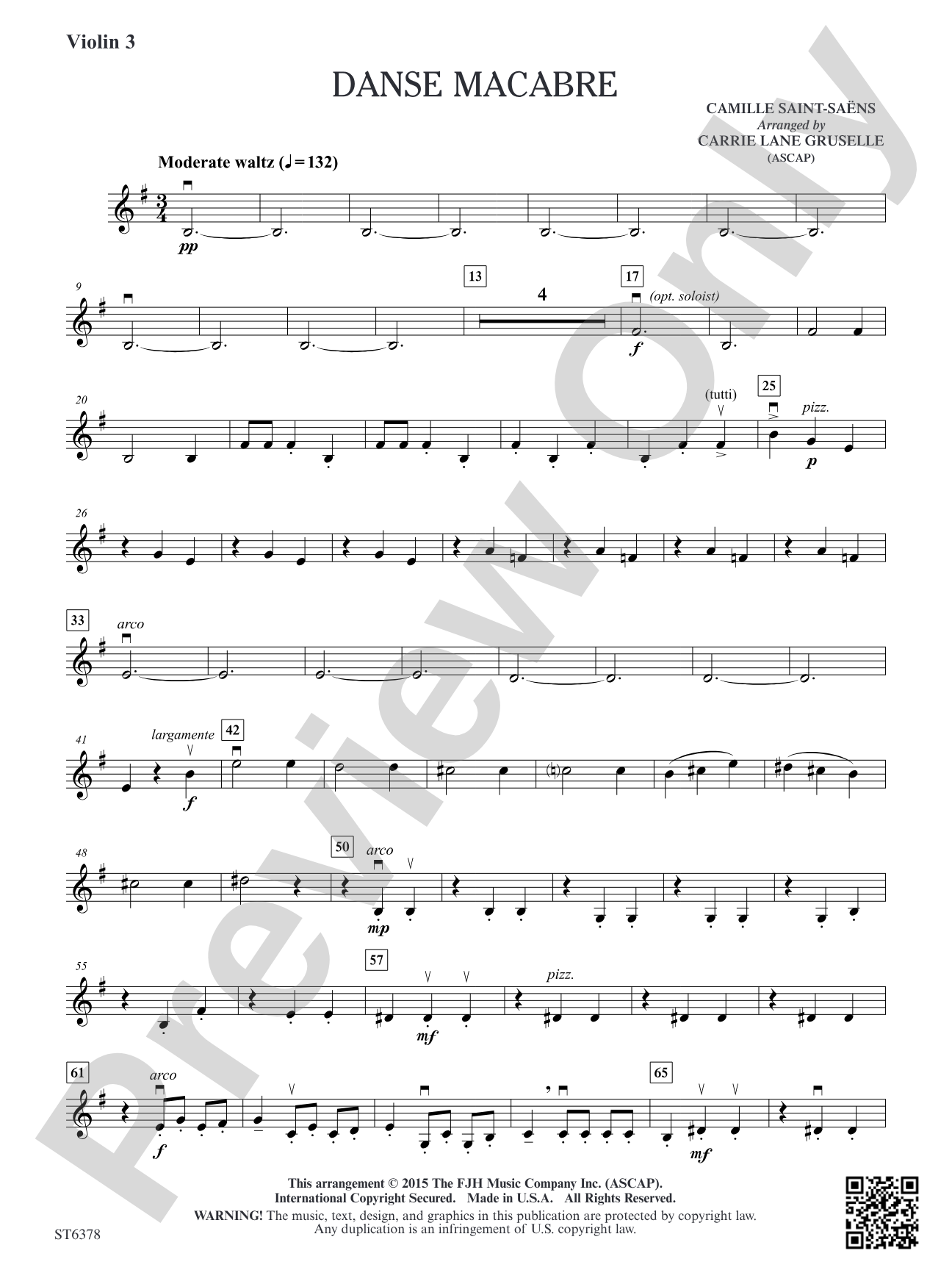
Danse Macabre: Violin 3 (Viola T.C.) Sheet Music Preview

Danse Macabre: Violin 3 (Viola T.C.)

By Camille Saint-Saëns / arr. Carrie Lane Gruselle

Grade: 3

Item: 98-PC-DST6378_VN3

Digital Download
$7.00
Description
The clock strikes midnight, a ghostly fiddler plays eerie tones, and skeletons dance until the rooster crows at dawn. Saint-Saëns brings the spooky to life in his Danse Macabre, which has been arranged here in an approachable E minor. Perfect for Halloween or as a change of pace for any time of year!

Danse Macabre: Violin 3 (Viola T.C.) isn't in MakeMusic Cloud just yet...but it could be. Let us know you'd like to see it, and you'll help shape what comes next. In the meantime, start a free trial and dive into thousands of interactive titles your students can play along with today.

Sample Audio
0:00
0:00
Sample Video
Additional Details
Series: FJH String Orchestra
Publisher: The FJH Music Company, Inc.
SKU: 98-PC-DST6378_VN3

More about this title

About the Composer: Camille Saint-Saëns

Camille Saint-Saëns (1835-1921) was a French composer, organist, and pianist whose technical mastery and inventive orchestration shaped late 19th-century concert music. He wrote across every major genre—symphonies, concertos, operas, and character pieces—and brought wit, color, and structural clarity to everything he touched. His ability to blend serious musical substance with immediate appeal made his work enduringly popular with audiences and orchestras alike.

Saint-Saëns composed Danse Macabre in 1874 as a symphonic poem that captures the folklore image of Death playing violin while skeletons dance through the night. The piece showcases his gift for vivid orchestration and memorable melody, making it a concert favorite that demonstrates how a composer can paint a complete dramatic narrative within a single movement.

Why we love this

This arrangement captures the theatrical heart of Saint-Saëns' masterpiece while keeping the technical demands realistic for Grade 3 ensembles. The transposition to E minor keeps the dark, minor-key character intact while opening the piece to string orchestras that might struggle with the original key, and Gruselle's orchestration preserves the iconic solo violin line that makes the piece instantly recognizable. Students get to play repertoire with genuine dramatic weight and immediate audience appeal.

What to expect

Eerie and energetic by turns, with a relentless forward momentum that pulls the listener into a supernatural midnight scene. The famous solo violin line carries an almost mournful, otherworldly quality, while the ensemble rhythms drive forward with urgent, skeletal precision until the final sunrise ends the dance.

Who it's for

String orchestras at the Grade 3 level looking for a masterwork arrangement that delivers dramatic impact without overwhelming technical requirements. Conductors seeking a piece with genuine narrative arc and audience appeal for fall concerts, Halloween events, or any program that benefits from a change of pace and theatrical flair.

How to get the most out of it

  • Bring out the solo violin line in the opening and returning sections; this is the ghostly fiddler at the heart of the story, and it should cut through clearly even in a student ensemble.
  • Shape the rhythm section (cellos and basses) to lock in tightly during the dance passages; the driving rhythmic pulse is what propels the piece forward and builds energy toward the rooster's crow.
  • Let the arco sections in the middle register breathe and sustain their chords; they create the harmonic foundation that supports the melodic activity above.
  • Manage the dynamic arc across the entire piece so the final acceleration and fortissimo landing feel earned rather than sudden; this is a journey from witching hour to dawn.

How to use it

Program this in the second half of a concert where it can stand alone as a statement piece, or pair it with other character-driven orchestral works to build a thematic program around storytelling and orchestral color. It works equally well as an October or November concert highlight or as a spring program offering that proves your students can tackle serious repertoire with style.

Skills your students will build

  • Sustaining long tones with consistent tone quality and intonation
  • Playing rapid scalar passages and repeated rhythmic figures with clarity and precision
  • Responding to dramatic dynamic shifts and tempo changes
  • Balancing ensemble texture when melody is distributed across sections
  • Maintaining rhythmic accuracy during syncopated and driving passages

You May Also Like