
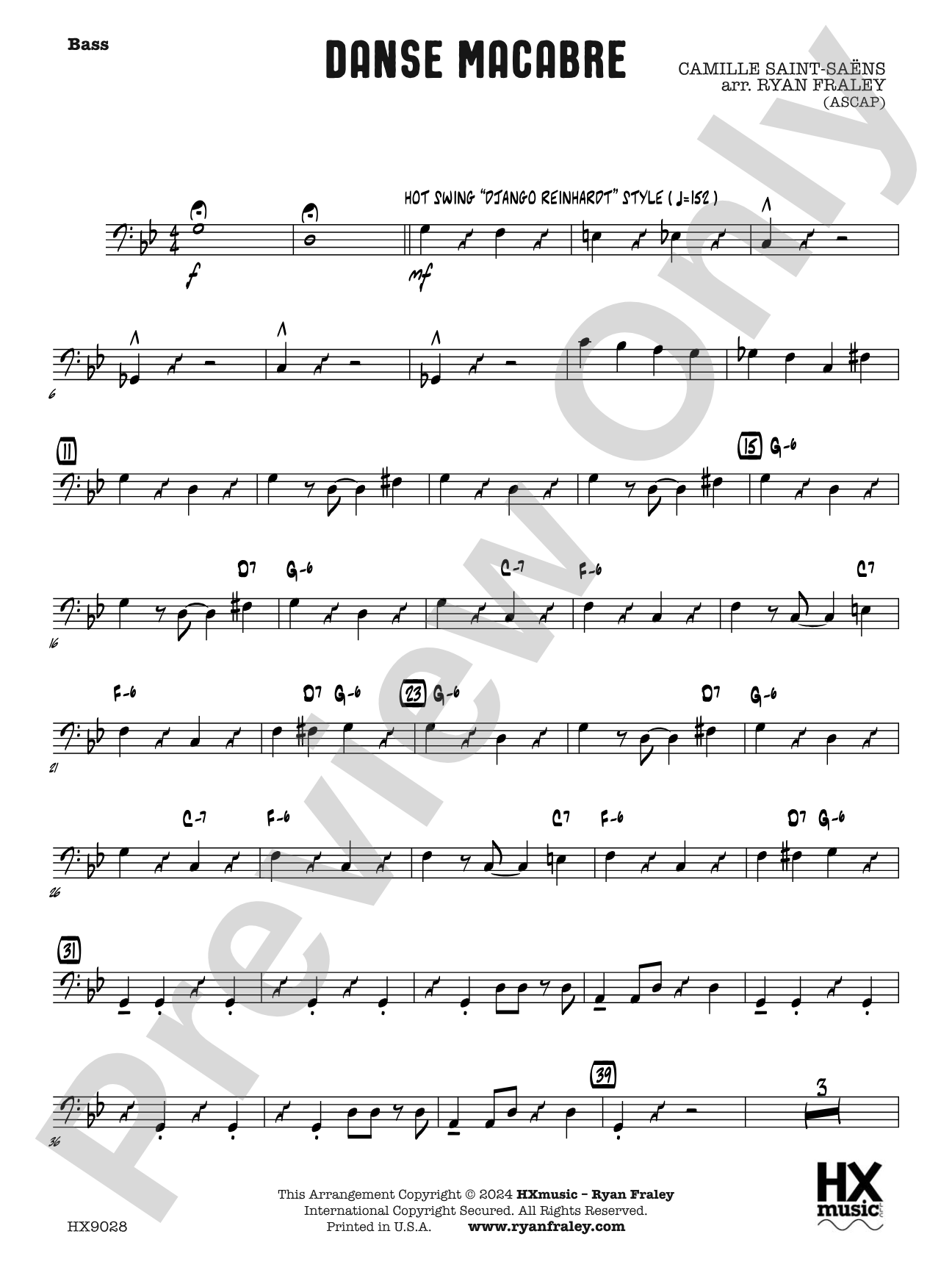

Danse Macabre: Bass
By Camille Saint-Saëns / arr. Ryan Fraley
Grade: 2.5
Item: 98-PC-DHX9028_SB
$3.99
Pickup currently not available
Description
Ryan Fraley's arrangement of Camille Saint-Saëns' Danse Macabre transforms the iconic nineteenth-century supernatural tone poem into a dynamic 1930s hot-jazz piece reminiscent of Django Reinhardt's swing style. The work brings the haunting themes to life, set against compelling backbeats. It features skillfully written solos for plunger trumpet and trombone, an open solo section for improvisation (transcribed solos provided), and a sizzling sax soli, inviting musicians to delve into a fusion of classical sophistication and the exuberant spirit of early jazz. Top trumpet note: F-sharp 5.


Danse Macabre: Bass isn't in MakeMusic Cloud just yet...but it could be. Let us know you'd like to see it, and you'll help shape what comes next. In the meantime, start a free trial and dive into thousands of interactive titles your students can play along with today.
Request This Title
Tell us you want it.
Start Your Free Trial
Explore everything that's ready to play right now.
Sample Audio
1
Audio File
--:--
0:00
0:00
Sample Video
Additional Details
Series:
HXmusic
Publisher:
HXmusic
SKU:
98-PC-DHX9028_SB
More about this title
About the Composer: Camille Saint-Saëns
Camille Saint-Saëns (1835, 1921) was a French composer of extraordinary technical facility and prolific output. His mastery across orchestral, operatic, and chamber genres made him one of the most celebrated musicians of the nineteenth century, and his works remain central to the concert repertoire. Danse Macabre, composed in 1874, stands as one of his most inventive tone poems; its depiction of skeletal revelers dancing at midnight established it as a perennial favorite for Halloween programming and supernatural storytelling in music.
What made Saint-Saëns enduring in music education is his gift for memorable melody paired with sophisticated harmonic language. Teachers and students encounter his writing across levels, from simple pedagogical pieces to complex symphonic works. His ability to evoke vivid imagery through orchestration, as in Danse Macabre's ghostly violin tremolos and xylophone effects, demonstrates how instrumental color serves narrative, a principle that translates directly into jazz arranging and improvisational contexts.
Why we love this
Ryan Fraley's take on this masterwork captures the macabre shimmer of the original while fully embracing early-jazz vocabulary in a way that never feels forced. The plunger trumpet and trombone solos are written with idiomatic swing phrasing that sits naturally in the hands, and the open improv section (with transcriptions included) gives students a genuine entry point into jazz melodicism without leaving them unmoored. It's a rare arrangement that respects both the source material and the idiom it's translated into.
What to expect
The piece captures the mischievous energy of ghosts at a midnight ball, all wit and shimmer rather than dread. Fraley's 1930s hot-jazz palette, with its bright horns, snappy backbeats, and moment of open improvisation, gives the supernatural subject matter a playful, almost vaudeville flavor. You'll hear the original's famous xylophone gleam translated into the band's percussion, and the skeletal waltz becomes a swinging celebration.
Who it's for
Jazz ensembles at the high school or early collegiate level looking for repertoire with genuine sophistication and crossover appeal. This works equally well for groups building confidence in swing style and for experienced bands seeking fresh programming around Halloween or October concerts.
How to get the most out of it
- Shape the opening theme with a slight swagger; treat the Saint-Saëns melody as a jazz standard rather than a classical statement. The harmonic sophistication is already there from the original, so the rhythm section's job is to anchor it in a groove.
- Balance the plunger soloists prominently in the mix during their passages. These lines carry the arrangement's character and need space to breathe and inflect with the swing articulation marked in the score.
- Prepare transcribed solos in advance for any musicians taking the open improvisation section, then encourage departures once they understand the harmonic framework. The provided transcriptions are scaffolding, not ceiling.
- Let the sax soli section cook; the writing is voiced for blend, so resist the urge to overbalance soloists. This is where the ensemble sound becomes the feature.
How to use it
This is an obvious choice for October concert programming, but its strong melodic identity and moderate difficulty also make it valuable as a mid-season ensemble piece that builds players' jazz language without consuming rehearsal time on fundamentals. Pair it with another classical arrangement (a Gershwin or Kern piece) to create a concert theme around 'masterworks reimagined,' or use it as your closer on a jazz pops concert where it will land with memorable impact.
Skills your students will build
- Reading and executing swing articulation and phrasing in a classical melody
- Plunger mute technique and voice-like expression in trumpet and trombone
- Improvisation over a harmonic framework (with transcribed examples as reference)
- Blend and balance in saxophone sectional writing
- Listening for and responding to rhythmic grooves and backbeat emphasis