
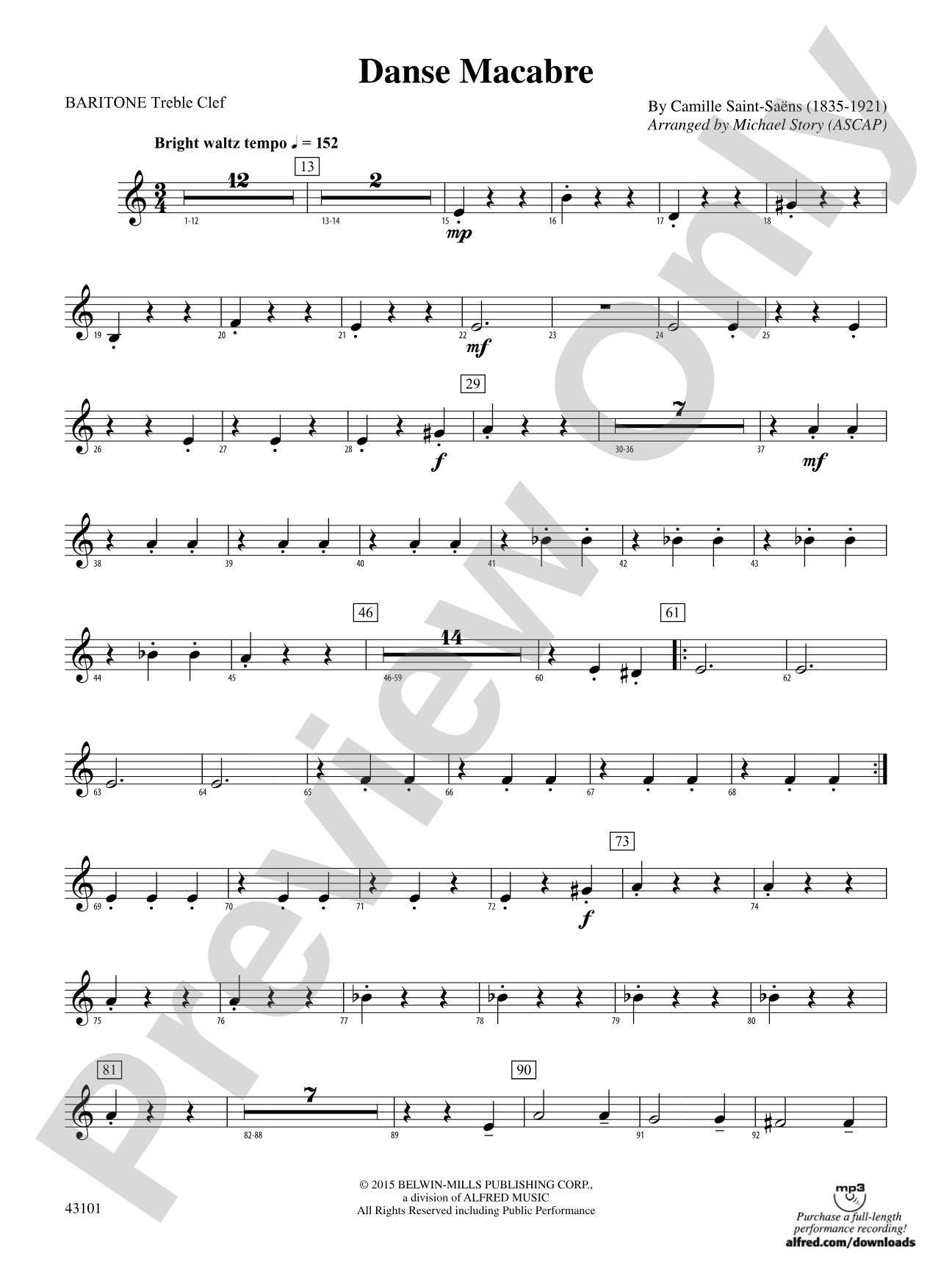

Danse Macabre: Baritone T.C.
By Camille Saint-Saëns / arr. Michael Story
Grade: 2 (Easy)
Item: 00-PC-0016752_BTC1
$3.00
Pickup currently not available
Description
This work was originally scored as a tone poem that was written in 1874 by well-known French composer Camille Saint-Saëns. The basis of the piece is an old French superstition where at the stroke of midnight on Halloween, Death appears and summons the dead to dance while he plays his music for them. In a familiar 3/4, it's spooky enough for a Halloween performance and classical enough for any program or contest all year long! (3:15)


Don't just read it, hear it, play along with it, and watch your students grow with it. In MakeMusic Cloud, Danse Macabre: Baritone T.C. comes alive with professional accompaniment, adjustable tempo, and built-in practice tools that turn solo practice into real progress.
Open in the Player
Jump straight in and assign it today.
Start Your Free Trial
Open this title and explore the full library in minutes.
Sample Audio
1
Audio File
--:--
0:00
0:00
Sample Video
Additional Details
Series:
Belwin Young Band
Publisher:
Alfred Music
Page Count:
234
SKU:
00-PC-0016752_BTC1
More about this title
About the Composer: Camille Saint-Saëns
Camille Saint-Saëns (1835-1921) was a French composer, organist, and pianist whose prolific output spanned nearly every musical genre. His command of orchestration and gift for memorable melody made him one of the most performed composers of the Romantic era, and his works remain central to concert repertoire today.
Saint-Saëns composed Danse Macabre in 1874 as a symphonic poem, drawing inspiration from the medieval legend of Death leading the dead in midnight revelry. The piece showcases his mastery of programmatic writing, using vivid orchestral color and rhythmic vitality to bring supernatural imagery to life. For generations of musicians, it has served as an accessible entry point to the Romantic symphonic tradition.
Why we love this
Michael Story's arrangement captures the sinister elegance of the original without overwhelming a young band. The Grade 2 scoring distributes the iconic themes accessibly while maintaining the piece's theatrical punch, making it equally at home in a Halloween concert or a spring festival. Few arrangements of this masterwork succeed in being both playable and genuinely effective.
What to expect
Danse Macabre unfolds like a supernatural narrative: skeletal percussion and eerie flourishes give way to a hypnotic waltz that builds in intensity and gothic charm. There's an irresistible momentum to the piece, driven by its famous rhythmic ostinato and the mounting energy as Death's dance reaches its peak, then suddenly collapses into silence as the spell breaks.
Who it's for
This arrangement serves Grade 2 concert bands looking for a sophisticated piece that doesn't demand advanced technique. It works equally well for Halloween performances, classical music showcases, and contest programming, making it a versatile choice for directors seeking repertoire that engages both student musicians and audiences.
How to get the most out of it
- Keep the opening pizzicato strings (simulated in the band texture) crisp and rhythmically precise; this establishes the eerie foundation that everything else builds on.
- Balance the solo violin passages (often assigned to clarinet or trumpet in band settings) so they sit slightly forward without dominating; they're meant to wail, not overpower.
- Shape the famous waltz theme with clear phrasing and a steady, almost relentless pulse; resist the urge to rush as energy builds into the climax.
- Use dynamics to paint the narrative arc: soft and mysterious in early sections, building through the dance itself, then subsiding as dawn breaks and the dead return to their graves.
How to use it
Program this as a centerpiece for a fall concert, especially around Halloween, where its theatrical nature and audience recognition create immediate engagement. It also pairs effectively on a classical music program, bridging accessible Romantic material with more advanced repertoire. At 3:15, it's substantial enough to anchor a set without monopolizing rehearsal time for smaller bands.
Skills your students will build
- Reading rhythmic ostinatos and maintaining steady pulse in waltz meter
- Balancing ensemble sound across multiple simultaneous melodic lines
- Dynamic control and shaping of theme development from soft to climactic passages
- Coordinating articulation (particularly staccato pizzicato effects) within a unified ensemble texture