
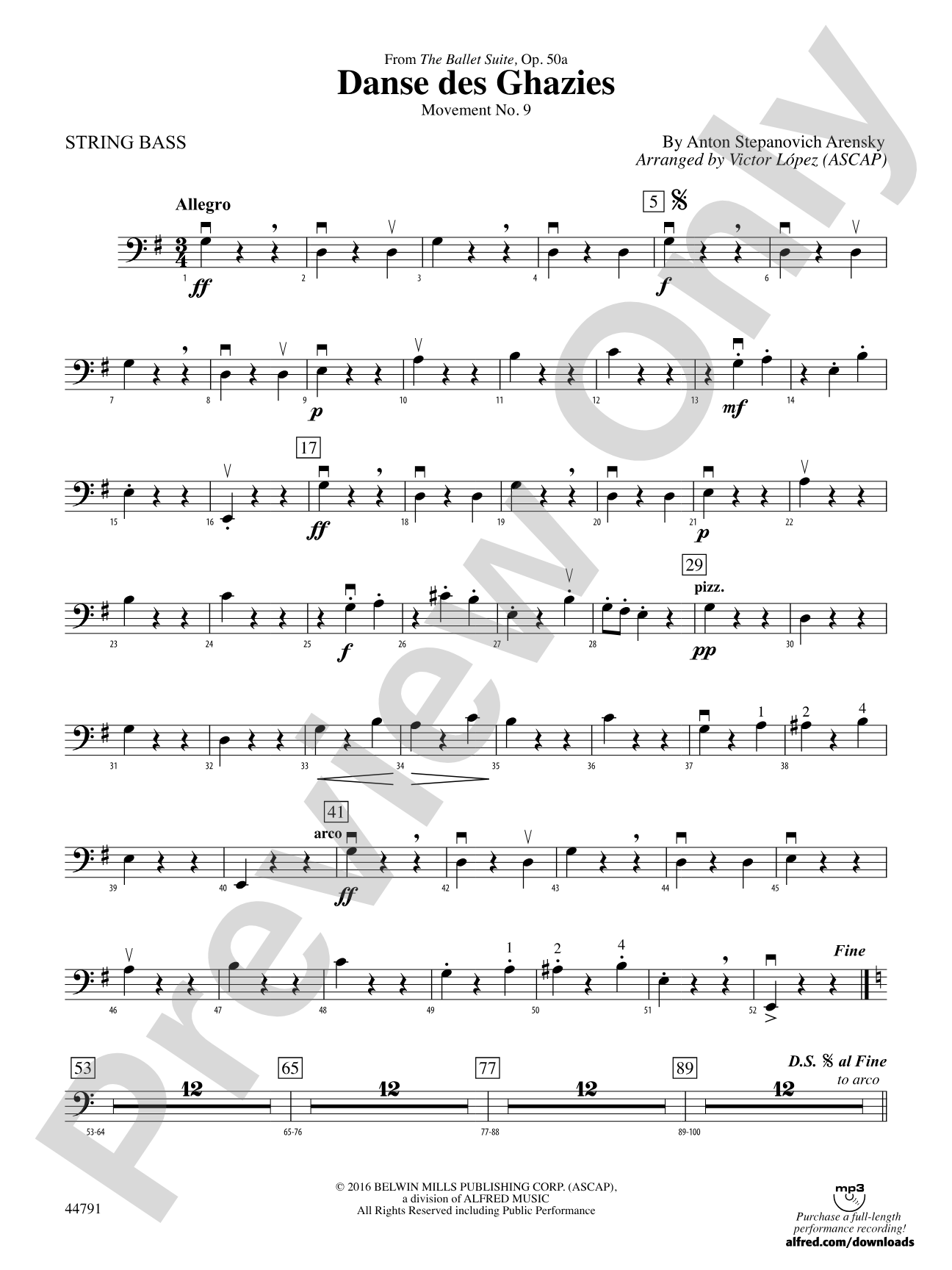

Danse des Ghazies: String Bass
Movement, No. 9
By Anton Stepanovich Arensky / arr. Victor López
Grade: 1.5
Item: 00-PC-0017308_SB
$3.00
Pickup currently not available
Description
Originally written for piano, "Danse des Ghazies" from Egyptian Nights is an outstanding work by Anton Stepanovich Arensky that has been wonderfully arranged for beginning full orchestra by Victor López. Its light texture, melodic contour, and playful nature will be an excellent addition to any contest program. (3:00)


Don't just read it, hear it, play along with it, and watch your students grow with it. In MakeMusic Cloud, Danse des Ghazies: String Bass comes alive with professional accompaniment, adjustable tempo, and built-in practice tools that turn solo practice into real progress.
Open in the Player
Jump straight in and assign it today.
Start Your Free Trial
Open this title and explore the full library in minutes.
Sample Audio
1
Audio File
--:--
0:00
0:00
Sample Video
Additional Details
Series:
Belwin Beginning Full Orchestra
Publisher:
Alfred Music
Page Count:
216
SKU:
00-PC-0017308_SB
More about this title
About the Composer: Anton Stepanovich Arensky
Anton Stepanovich Arensky (1861-1906) was a Russian composer, pianist, and conductor whose gift for orchestration and melodic invention earned him respect across Europe during the late Romantic era. Though less frequently programmed today than his contemporaries, Arensky's works reveal a composer deeply invested in craft, color, and the pleasures of accessible, well-crafted music. His piano works in particular showcase an elegance and lightness that translates beautifully to ensemble settings.
Arensky's career took him from Moscow to St. Petersburg, where he taught composition and served as conductor. His prolific output includes operas, ballets, chamber works, and orchestral pieces that demonstrate his mastery of form and harmonic sophistication. For young orchestras, his music offers an ideal bridge between early exposure and more complex Romantic repertoire.
Why we love this
López's arrangement preserves the buoyant character of the original while remaining genuinely playable for beginning orchestras. The piece programs confidently on contest schedules because it combines legitimate musical substance with the accessibility that young orchestras need, making it a rare find at this grade level that won't sound simplified.
What to expect
A graceful, spirited dance that sparkles without demanding virtuosity. The music dances lightly across the orchestra, with melodic lines that sing naturally and harmonies that feel both fresh and fundamentally sound. You'll hear the Romantic era's love of beautiful melody channeled into something delightfully accessible and unhurried.
Who it's for
Beginning full orchestras looking for repertoire that sounds polished at contest while remaining within technical reach. Directors seeking pieces that showcase musicality and ensemble balance without requiring advanced technical skills from individual players.
How to get the most out of it
- Maintain the light, dance-like character throughout. Resist the temptation to broaden the tempo; the piece's charm depends on rhythmic precision and a sense of forward motion.
- Balance the melody between sections carefully. Because the orchestration is transparent, any imbalance in the winds or strings becomes immediately audible to the audience.
- Shape phrases clearly without relying on dramatic dynamic swells. The piece moves through gentle contours, so conductors should think of sculpting with small adjustments rather than broad gestures.
- Tune the sustained harmonies in the full orchestra passages. With a lighter texture, intonation issues that might blend into thicker orchestrations will stand out.
How to use it
Place this early in a contest set to establish a professional, musical tone before moving to more dramatic or technically demanding works. It also works excellently on a general concert program paired with Romantic-era shorter works or as a confident opener that gives the orchestra immediate ensemble success.
Skills your students will build
- Balancing transparent orchestration across multiple sections
- Maintaining steady, dance-based rhythm without rushing
- Ensemble intonation in four-part harmonic writing
- Phrasing and musical shape without relying on dynamic extremes
- Reading and responding to the conductor's clear beat in lyrical context